

Tando Allahyar is home to numerous shrines of Sufi saints from well-established Sufi orders. These Sufi saints played an important role in carrying their spiritual mentors' teachings to different communities and regions. Their khanqahs and dargahs developed into important spiritual and social spaces, drawing devotees and visitors from surrounding villages and beyond.
More than places of worship and devotion, these shrines became closely woven into the cultural and social life of local communities, where religious practices, shared memories, and traditions continued to flourish. One such figure is Pak Sanghaar, whose shrine is situated about 8 km east of Tando Allahyar town, along the Tando Allahyar–Mirwah Gorchani Road.
Although little is known about him from written sources, his shrine and the traditions associated with it continue to preserve his place in Tando Allahyar's Sufi landscape.
A Master's Network
Not much is known about the life of Pak Sanghaar. His place of birth is unknown, little information survives about his early life, and even the date of his death remains uncertain. Although the local community places his death in the first quarter of the seventeenth century, this date should be treated with caution, given the limitations of oral history. What can be established with greater confidence is his association with Hazrat Makhdoom Lutufullah, better known as Makhdoom Nuh Sarwar (d. 1589), one of the leading Sufi saints of sixteenth-century Sindh. Pak Sanghaar is remembered as one of his prominent deputies who spread his spiritual master's teachings among local communities.
An important reference to Pak Sanghaar appears in Syed Ali Kachi's Azkar Qalandari (1914), which identifies him as one of Hazrat Makhdoom Nuh Sarwar's leading deputies. According to Kachi, Pak Sanghaar was among the twelve prominent deputies of Hazrat Makhdoom Nuh Sarwar. This reference is particularly significant because, in the absence of detailed biographical accounts, it helps establish Pak Sanghaar's position within Hazrat Makhdoom Nuh Sarwar's spiritual network and provides valuable historical context for understanding his role in spreading the saint's teachings.
The cultural and architectural landscape of medieval Sindh was shaped not only by rulers, nobles, and Sufi saints, but also by women whose patronage and influence deserve greater recognition
Kachi also mentions another important deputy of Hazrat Makhdoom Nuh Sarwar in Azkar Qalandari. He states that when Pir Syed Fazil Shah Kalan, a descendant of Hazrat Shaikh Bahauddin Zakariya (d. 1262), arrived at Bukera in 951 AH/1544 CE, followers of Makhdoom Nuh Sarwar were already present in the village. Bukera had developed into a thriving centre for his followers, where Mian Hussain Sanghaar was one of his leading deputies. This suggests that Hazrat Makhdoom Nuh Sarwar's spiritual network was already firmly established in Bukera before Makhdoom Fazil Shah Kalan's arrival.
The arrival of Makhdoom Fazil Shah Kalan (d. 1569) and his family in the area, however, should not be understood as having diminished the influence of Hazrat Makhdoom Nuh Sarwar's deputies and disciples. They continued to maintain their own circles of followers and remained active in spreading their spiritual master's teachings. Their presence points to a religious landscape in which different Sufi networks could exist alongside one another, each maintaining its own spiritual connections, disciples, and spheres of influence.
It is also interesting that two prominent deputies of Hazrat Makhdoom Nuh Sarwar—Pak Sanghaar and Mian Hussain Sanghaar—belonged to the Sanghaar caste. Others from the same community may have been associated with Hazrat Makhdoom Nuh Sarwar and contributed to the spread of his teachings. However, given the paucity of available written sources, it is difficult to identify them or reconstruct their roles with any certainty. The surviving references nevertheless offer an intriguing glimpse into the Sanghaar community's contribution to the wider Sufi network established by Hazrat Makhdoom Nuh Sarwar in Sindh.
The Origins of Pak Sanghaar
It is said that Pak Sanghaar's real name was Syed Abdul Latif. It is also believed that Pak Sanghaar was a close relative of Sajan Sawai, another leading and prominent deputy of Hazrat Makhdoom Nuh Sarwar. If one looks at the genealogy of Sajan Sawai, one does not find such a name or any connection to Pak Sanghaar. This may have been a common belief among ordinary people that Sajan Sawai and Pak Sanghaar were from the same family because both saints were associated with Hazrat Makhdoom Nuh Sarwar.
Khalil Khoso (2017), the author of Pak Sanghaar, writes that Pak Sanghaar received his education from Hussain Sanghaar. Based on interviews he conducted with the Khalifa family, who care for Pak Sanghaar's shrine, he argues that they call him Miyon Hussain instead of Hussain Sanghaar. The Khalifa family go to the shrine of Hussain Sanghaar for a newborn's first head-shaving. At the same time, other Palah community members visit the Pak Sanghaar shrine for their newborns' first head-shaving. According to Khalil Khoso, followers of Pak Sanghaar consider Miyon Hussain the teacher and spiritual mentor of Pak Sanghaar. Moreover, Khalil Khoso writes that the first person from the Palah family was Sarho, who became Pak Sanghaar's deputy. The current Khalifa family, who take care of Pak Sanghaar's shrine, are descendants of Sarho Palah.
According to Hanif Jarwar (2018), the author of Sala Sachai Ja, a pious lady built a tomb over Pak Sanghaar's grave. He notes that her grave is located in the shrine. He does not mention when the tomb was built. He does not even know the name of the pious lady who built the tomb over Pak Sanghaar's grave. Khalil Khoso (2017) believes that the sister of Pak Sanghaar, Taj Bibi, built the tomb over the grave of Pak Sanghaar.
Women also had a visible presence in the public life of medieval Sindh, particularly those from ruling and influential families. Their lives were not always confined to the household; some took an active interest in the religious, social, and even political affairs of their time. The tombs, mosques, and other buildings commissioned by women, still seen in different parts of Sindh, offer a lasting reminder of their role in society. Through these buildings, women expressed their faith, honoured loved ones, supported religious institutions, and left their mark on the places and communities around them. These monuments tell stories that are often missing from written histories. They remind us that the cultural and architectural landscape of medieval Sindh was shaped not only by rulers, nobles, and Sufi saints, but also by women whose patronage and influence deserve greater recognition.
Architecture and Renovation
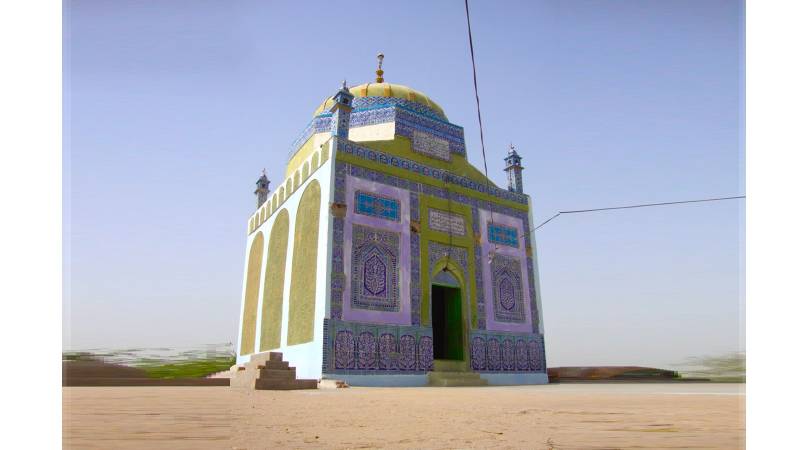
It is a square tomb surmounted with a hemispherical dome. The tomb's distinctive feature is its corner kiosks. The tomb underwent renovations several times. The front of the tomb is adorned with Nasarpuri tiles. The corner kiosks and upper part of the drum, on which the dome rests, are also decorated with Nasarpuri tiles.
Two inscriptions appear on the façade of Pak Sanghaar's tomb. The first inscription, in Sindhi, is fixed on the façade and reads: "The Dargah of Faqir Muhammad Ibrahim Sajjada Nashin Pak Sanghaar." This inscription also records the names of the artisan (Kashigar), Mushtaq Ahmad, and Mistri (mason), Kalu. The second inscription fixed on the drum of the dome bears the name of Faqir Muhammad Ibrahim Palah, Sajjada Nashin of Pak Sanghaar dargah, and the names of the artisan, Mushtaq Ahmad, and the mason (Mistri), Kalu. The year 1989 is also written, indicating that it was renovated that year. This also shows that the tomb was renovated during the time of Faqir Muhammad Ibrahim, the Sajjada nashin of the shrine of Pak Sanghaar.
The name of the Kashigar Mushtaq Ahmad from Nasarpur town appears in both inscriptions. Nasarpur town is famous for glazed tiles in Sindh. In fact, both Hala and Nasarpur are famous towns for tile-making. More importantly, Nasarpur artisans worked on most of the tombs in Tando Allahyar and other districts in Sindh. This does not mean that only Kashigars of Nasarpur decorated the tombs; the artisans of Hala also did. However, the names of Nasarpuri Kashigar appear more frequently on the tombs than those of Hala.
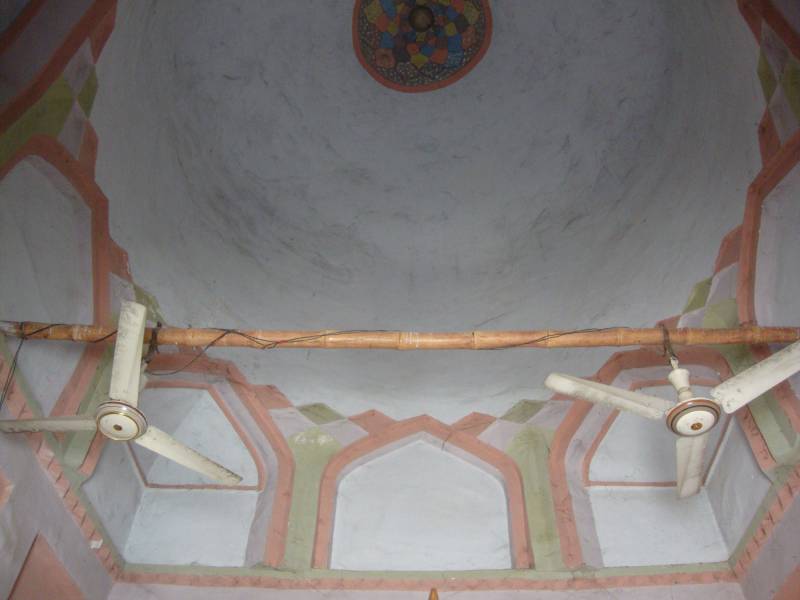
A mosque near the shrine of Pak Sanghaar is also believed to have been built by him when he settled in this area. It is a single-domed mosque with arched entrances. It has also been renovated.
The principal grave in the tomb belongs to Pak Sanghaar. The grave of his sister is also located in the shrine complex of Pak Sanghaar. Other graves, including his first deputy Sarho Palah, are also located in the shrine complex of Pak Sanghaar. In addition, a few other graves are also found in the tomb complex.
The Importance of Oral History
Like many other Sufi saints of Sindh, Pak Sanghaar remains largely unknown to scholars working on Sindh's Sufi traditions. Many such saints appear to have played important roles within their respective silsilas, yet their lives and contributions remain obscure because of the scarcity of written sources. In such cases, oral history becomes an important source of information, although it comes with its own limitations. Oral traditions can help fill gaps in the historical record. Still, over time they may also accumulate multiple layers of memory, interpretation, and legend, making it difficult to separate historical details from later narratives.
This makes fieldwork at Sufi shrines in Sindh particularly challenging. A researcher needs to approach local narratives with care and with a sound understanding of Sindh's religious, social, and political history. Without this broader historical context, one may easily become dependent on hearsay or accept local accounts without sufficient scrutiny, creating more questions than answers. Oral traditions should therefore be treated not simply as factual accounts of the past, but as narratives that need to be understood alongside available historical evidence. Despite these difficulties, one point emerges with some clarity from the traditions surrounding Pak Sanghaar: he is remembered as a deputy of Hazrat Makhdoom Nuh Sarwar. This association provides an important starting point for understanding his place within Sindh's Sufi history.