

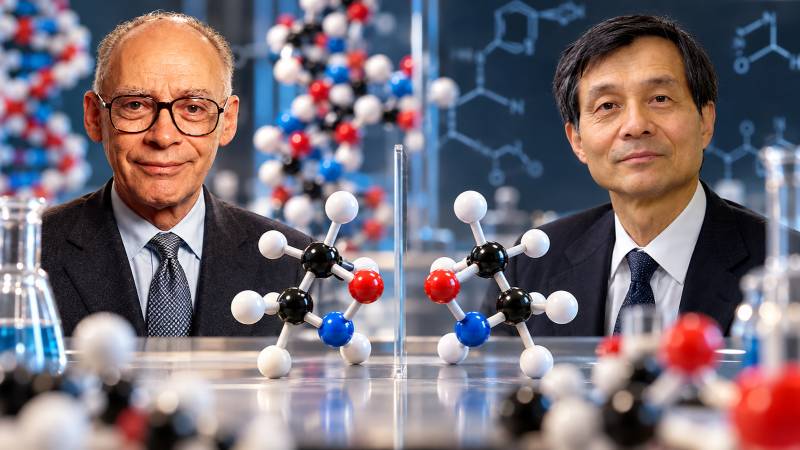
There are scientific discoveries that begin with giant telescopes, particle accelerators or machines buried beneath mountains, and there are others that begin with something as ordinary as our own hands. Hold them before you. They look almost identical, yet the left hand can never be perfectly placed over the right. One is the mirror image of the other. Chemistry possesses the same strange geometry. Many molecules can exist as two mirror-image forms made of the same atoms connected in the same order but arranged differently in three-dimensional space. Chemists call this property chirality, from the Greek word for hand, and the two mirror forms are called enantiomers. To an ordinary laboratory instrument, they may appear nearly identical; to a living cell the difference can be profound. One molecular hand may fit a receptor beautifully while its mirror twin fits poorly or behaves differently. The 2026 Nobel Prize in Chemistry, awarded to Henri B. Kagan and Kenso Soai for non-linear effects and autocatalysis in asymmetric organic synthesis, therefore concerns much more than an elegant reaction. It addresses one of chemistry’s most persistent questions: if nature has no obvious reason to prefer left over right, why is life so overwhelmingly one-handed?
This asymmetry runs through biology. Proteins are built overwhelmingly from L-amino acids, while the sugars in RNA and DNA belong to the D-series. Life has standardized its molecular alphabet. This phenomenon, known as homochirality, is striking because ordinary non-biological chemistry often produces equal amounts of the two mirror forms, a 50:50 mixture known as a racemate. Nature, however, does not generally build one protein from one molecular hand and the next from its mirror image. It has made a choice and maintained it with extraordinary consistency. That is why the Nobel-winning work is more than a story of synthesis. It touches the deeper problem of how a universe that seems almost indifferent between left and right can produce a living world in which one orientation dominates.
The story begins, appropriately, with wine. In the nineteenth century Louis Pasteur studied tartaric acid, a compound associated with grapes and wine deposits. Examining tiny crystals, he noticed that some had facets arranged in one direction while others showed the opposite pattern. With remarkable patience, he separated the mirror-image crystals by hand using tweezers. When dissolved separately, the two forms rotated polarised light in opposite directions; when mixed equally, their optical effects cancelled. Pasteur had glimpsed molecular asymmetry before chemists possessed a modern structural picture of molecules. He later observed that microorganisms could discriminate between the two forms. Biology, in other words, could tell left from right even when conventional chemistry found the distinction elusive. From a few almost invisible crystal facets emerged the powerful idea that living matter has a preferred molecular handedness.
The twentieth century brought major advances through chiral catalysts, substances that accelerate reactions while steering them toward one mirror-image product. The importance of asymmetric synthesis was recognised by the 2001 Nobel Prize to William Knowles, Ryoji Noyori and Barry Sharpless, and again in 2021 when Benjamin List and David MacMillan were honoured for asymmetric organocatalysis. Yet Kagan and Soai were addressing a subtler question. They were not simply asking how chemistry could be forced to choose one hand. They wanted to understand how a tiny initial preference could become a much larger one. That question linked practical organic synthesis to the deeper mystery of biological homochirality.
A theoretical clue had appeared in 1953, when the British physicist Charles Frank proposed a model in which one molecular handedness could reinforce itself. His idea required a form of positive feedback: a product would help create more of itself. This process is known as autocatalysis. Imagine a factory in which the first machine leaving the production line immediately joins the factory floor and helps build more machines of the same kind. Production would accelerate rapidly. In a chiral system, if right-handed molecules helped generate more right-handed molecules, while left-handed molecules did the same for their own kind, then even a tiny statistical imbalance could grow until one form dominated. Frank had shown mathematically how microscopic asymmetry might become macroscopic homochirality. What remained was to demonstrate such behaviour experimentally.
Henri Kagan supplied a crucial part of that bridge. In the early 1980s chemists generally assumed a simple relationship between the enantiomeric purity of a chiral catalyst and that of the product it produced. A modest excess of one catalyst enantiomer should, it seemed, generate a similarly modest excess of the corresponding product. Kagan questioned this assumption. Metal-based catalysts can associate into different aggregates, and combinations of like-handed and opposite-handed units need not behave alike. In work published with colleagues in 1986, he showed that the relationship between catalyst purity and product purity could be strongly non-linear. A relatively small imbalance in the catalyst could therefore produce a much larger imbalance in the product. Chemistry was no longer merely copying asymmetry; it could amplify it. Kagan’s discovery also gave chemists a valuable mechanistic tool, because the shape of such non-linear relationships could reveal which catalyst species were actually operating in a reaction.
A serious scientific culture must care about technology and national need, but it must also protect curiosity, continuity, laboratories, mentorship and intellectual patience.
Kagan’s insight can be understood without equations. Imagine a committee divided 55–45 between two proposals. If every member has equal influence, the final result should remain close to 55–45. But suppose mixed pairs become largely ineffective while like-minded pairs reinforce one another. The small majority may then produce a disproportionately large outcome. Something similar can occur among chiral catalysts. A slight molecular preference can be magnified because different catalyst combinations possess different activities. This was important both practically and conceptually. It showed that asymmetry need not remain proportional to its starting bias, and it helped establish one of the mechanisms by which a tiny initial preference could acquire chemical power.
Then came Kenso Soai, and chemistry appeared to perform something close to a magic trick, though every step obeyed ordinary physical law. Working at Tokyo University of Science, Soai investigated reactions in which the product itself could act as a catalyst. In a landmark 1995 experiment involving a chiral pyrimidyl alkanol, his group began with only about a 2 per cent enantiomeric excess. Through asymmetric autocatalysis, that slight advantage grew to around 87 per cent. The product helped generate more molecules bearing the same handedness. It was chemical positive feedback: a faint signal repeatedly amplified until it became dominant. Frank’s theoretical idea had entered the laboratory.
This does not mean that Soai recreated the origin of life in a flask, nor that Kagan and Soai have told us exactly why terrestrial proteins use L-amino acids rather than D-amino acids. Their work explains how an initial bias can be amplified, not where that first bias came from. The original asymmetry remains an open question. It may have arisen from statistical fluctuations, interactions with mineral surfaces, circularly polarized ultraviolet light in space, organic molecules delivered by meteorites, or extremely small asymmetries associated with fundamental physical interactions. None of these possibilities has closed the case. The significance of the Nobel-winning work is that the original preference need not have been large. If chemistry can amplify asymmetry so efficiently, nature may have needed only the faintest initial nudge.
The practical implications are equally important. The human body is not a neutral beaker. Receptors, enzymes, DNA and antibodies all possess three-dimensional structures, so the handedness of a medicine can determine how strongly it binds, how rapidly it is metabolized and whether it produces a therapeutic or unwanted effect. Controlling stereochemistry is therefore central to modern drug discovery, process chemistry and quality control. Similar considerations apply to agricultural chemicals, flavours, fragrances and advanced materials. Kagan’s non-linear effects help chemists understand and optimize asymmetric catalysts, while Soai’s autocatalysis remains a uniquely powerful model for studying how one molecular hand can reinforce itself. Their work joins two aspects of science that are often incorrectly separated: curiosity about fundamental questions and practical usefulness.
There is also a lesson in the chronology of this Nobel Prize. Kagan’s landmark work dates from 1986 and Soai’s breakthrough from 1995, with major refinements continuing later. Scientific recognition operates on a timescale very different from social media, university publicity or annual performance reports. An experiment may take hours, interpretation may take years and recognition of its deepest significance may take decades. Nobel Prizes often arrive not when a field has ended, but when a foundational discovery has become clear enough for us to see how much more remains to be understood.
For countries such as Pakistan, that lesson deserves attention. Nobel announcements are often treated as ceremonial news: names are memorized, photographs circulated and questions asked about why our universities produce so few discoveries of comparable influence. But the path from Pasteur to Frank, Kagan and Soai shows that transformational science cannot be manufactured through slogans, publication counts or demands for immediate commercial returns. These advances were separated by generations. Each depended on researchers being allowed to remain with difficult questions whose practical value was not always obvious at first. A serious scientific culture must care about technology and national need, but it must also protect curiosity, continuity, laboratories, mentorship and intellectual patience. Universities that measure every idea only by next year’s citations or rankings may become efficient producers of papers while ceasing to be places where mysteries are solved.
The 2026 Chemistry Nobel therefore tells a story larger than two laureates and one class of reactions. It begins with Pasteur sorting crystals with tweezers, passes through Frank’s theoretical insight, reaches Kagan’s discovery that small chiral biases can have disproportionately large consequences, and culminates in Soai’s demonstration that molecules can help produce more molecules of their own handedness. It is a story about medicines, probability, feedback and the origin of biological order. Look again at your hands. Their relationship, identical in so many respects yet impossible to superimpose contains a clue to one of life’s deepest chemical characteristics. Nature appears to have chosen a hand. Kagan and Soai showed how chemistry can make such a choice grow from almost nothing until one side dominates. Why life originally chose the particular hand it did remains unresolved, but science has moved closer to understanding how, once the faintest preference appeared, chemistry could amplify it and eventually write it into the architecture of life itself.