

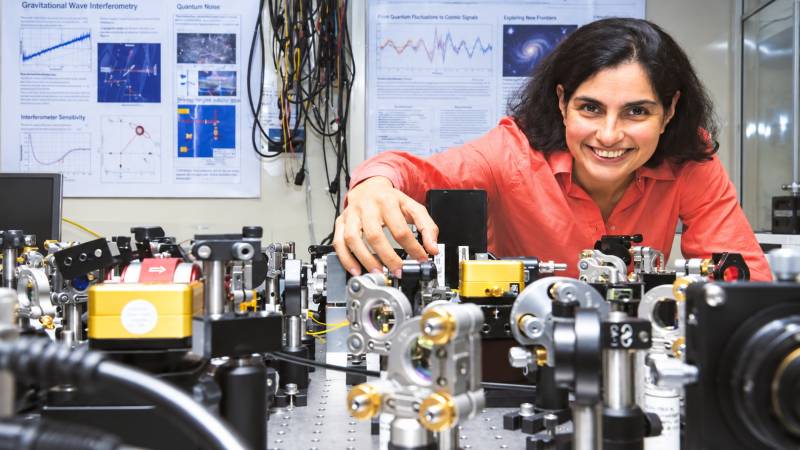
For Karachi’s scientific community, the final days of September 2026 promise something more than another entry on the academic calendar. They bring the return of Professor Nergis Mavalvala, one of the world’s leading experimental physicists, Dean of the Massachusetts Institute of Technology’s School of Science, and a scientist whose career has been closely associated with the development of gravitational-wave astronomy. She is returning to the city in which she grew up, before an extraordinary academic journey carried her from Karachi to Wellesley College, MIT, Caltech, LIGO and eventually to the leadership of one of the world’s foremost centres of scientific research. The symbolism of the visit is difficult to miss. A young woman who once explored the physical world through curiosity, tools and mechanical objects in Karachi would eventually help push experimental physics towards measurements of almost unimaginable sensitivity. Now, decades later, she returns not merely as a distinguished visitor but as a scientist whose work belongs to one of the defining developments of twenty-first-century physics.
On Tuesday, September 22, Mavalvala is scheduled to speak at the University of Karachi’s Chinese Teachers Memorial Auditorium at 9:30am as part of the ORIC Distinguished Lecture Series. Her lecture, “Listening to the Universe Above the Quantum Din,” is being organised by the University’s Office of Research, Innovation and Commercialisation in collaboration with the Department of Physics and the Institute of Space Science and Technology. Three days later, on Friday, September 25, she will deliver Habib University’s 10th Yohsin Lecture, titled “The Joy of Discovery: Curiosity, Science, and the Pivotal Role of Universities.” Since both lectures are still to take place, their precise arguments and emphases naturally remain to be heard. Yet their titles themselves are revealing. They point towards the two great dimensions of Mavalvala’s professional life: on the one hand, the experimental physicist working at the frontier where gravitational-wave detection meets quantum measurement; on the other, the scientist and academic leader concerned with curiosity, discovery and the institutional conditions in which knowledge flourishes.
Mavalvala was born in Lahore and raised in Karachi. She attended the Convent of Jesus and Mary before leaving Pakistan in 1986 to study in the United States. At Wellesley College, she studied physics and astronomy, graduating in 1990, before proceeding to MIT for doctoral work. There is something particularly compelling about the trajectory of a child growing up in Karachi who delighted in taking things apart, understanding how they worked and repairing bicycles, and who would eventually become an experimental physicist working with some of the most sensitive measuring instruments ever constructed. Seen in retrospect, her early fascination with mechanical objects and bicycle repair appears almost prophetic. Those ordinary childhood activities contained many of the instincts later demanded by experimental science: curiosity about mechanisms, confidence in working with one’s hands, patience with failure, mechanical intuition, and the determination to keep adjusting a system until its behaviour becomes intelligible.
At MIT, Mavalvala worked with Rainer Weiss, one of the central figures in the development of laser interferometry for gravitational-wave detection. Her doctoral research involved an early gravitational-wave detector prototype and problems of interferometer alignment and control. She completed her PhD in physics in 1997, subsequently worked at Caltech and the LIGO Laboratory, and returned to MIT as a faculty member in 2002. What followed placed her within one of the most remarkable scientific enterprises of modern times. Einstein’s general theory of relativity transformed our conception of gravity. Instead of treating gravity simply as a force acting between masses, general relativity describes matter and energy as shaping spacetime itself. Extremely violent movements of massive astronomical objects can therefore produce disturbances in spacetime that propagate outward as gravitational waves.
The theoretical prediction was extraordinary, but the experimental challenge was even greater. By the time gravitational waves reach Earth, the distortions they produce are fantastically small. Detecting them required an instrument capable of measuring changes in distance far smaller than the dimensions of an atomic nucleus. That instrument became the Laser Interferometer Gravitational-Wave Observatory, or LIGO. Its major detectors employ perpendicular arms approximately four kilometres long. Laser beams travel through the arms, are reflected by highly isolated mirrors and are recombined. A passing gravitational wave produces an infinitesimal difference in the relative lengths of the arms, which can alter the interference pattern of the laser light. The principle can be explained in a few sentences, but making it work required decades of technical refinement. Seismic vibration, thermal motion, laser instability, environmental disturbances and eventually quantum fluctuations themselves had to be understood and controlled to extraordinary levels.
Then, on September 14, 2015, LIGO detected a signal generated by the merger of two black holes more than a billion years earlier. When the discovery was announced in February 2016, gravitational waves ceased to be solely a prediction of general relativity. Humanity had detected them directly. The significance extended far beyond confirming Einstein. For centuries, astronomy had depended primarily on electromagnetic radiation—visible light and, later, radio waves, infrared, ultraviolet, X-rays and gamma rays. Gravitational-wave astronomy provided an entirely different messenger from the cosmos. Phenomena that might be invisible or difficult to study through ordinary light could now become accessible through disturbances in spacetime itself. Humanity had acquired, in a metaphor particularly appropriate to Mavalvala’s forthcoming Karachi lecture, a new way of listening to the universe.
Mavalvala was a longtime participant in the LIGO scientific effort and contributed to technologies associated with increasingly sensitive gravitational-wave measurements. Her doctoral adviser Rainer Weiss, together with Barry Barish and Kip Thorne, received the 2017 Nobel Prize in Physics for decisive contributions to LIGO and the observation of gravitational waves. Mavalvala was not herself a Nobel laureate, an important distinction in any accurate account of her career, but her research formed part of the much larger collaborative scientific enterprise that made gravitational-wave astronomy possible. The title of her forthcoming University of Karachi lecture, “Listening to the Universe Above the Quantum Din,” is especially evocative. Without anticipating what she will actually say, the title resonates with one of the central themes of her research: what happens when an experimental instrument becomes so sensitive that the quantum nature of light itself becomes part of the measurement problem.
At ordinary scales, we tend to imagine a laser beam as smooth and continuous. At sufficiently precise scales, however, light reveals its quantum character. Photons do not arrive with perfect regularity, and quantum fluctuations introduce fundamental uncertainty into measurement. As gravitational-wave detectors become more sensitive, such effects cease to be merely theoretical curiosities. They become part of the practical limits of the experiment. Mavalvala has been among the important researchers exploring squeezed states of light as a means of addressing aspects of quantum noise. The idea is subtle. Quantum uncertainty cannot simply be eliminated, but under appropriate conditions it can be redistributed. The uncertainty associated with one quantity can be reduced, or “squeezed,” while greater uncertainty is tolerated in another quantity. Her group and collaborators helped demonstrate how such techniques could improve interferometric measurement, including a 2008 quantum-enhanced prototype gravitational-wave detector.
Great science needs brilliant individuals, certainly. But it also needs functioning laboratories, continuity of funding, serious mentorship, merit, intellectual freedom, collaboration, institutional memory and the willingness to tolerate repeated failure before a breakthrough arrives.
The concept subsequently became relevant to operating gravitational-wave observatories. Quantum squeezing has been used to reduce noise and improve the astrophysical reach of LIGO, while later developments introduced frequency-dependent squeezing to extend these improvements across a broader observational range. Whether Mavalvala chooses to explain these developments technically, historically or conceptually in Karachi remains to be seen. But the title of the lecture offers the prospect of a fascinating intellectual journey: from black holes billions of light-years away to the quantum fluctuations of photons inside a terrestrial laboratory. Few examples illustrate the unity of modern physics more beautifully. At one end lies the almost unimaginably large: black holes, spacetime and the architecture of the cosmos. At the other lies the almost unimaginably small: photons, quantum uncertainty and fluctuations in light. In a gravitational-wave detector, these two domains meet.
Mavalvala’s scientific interests extend beyond gravitational-wave astronomy into quantum measurement science and optomechanics. Her research has explored techniques involving laser cooling and the control of mechanical systems, including mirrors, in order to investigate how quantum phenomena can become observable in objects far larger than the individual atoms and particles with which quantum mechanics is most commonly associated. This touches one of the deepest conceptual questions in physics. Quantum mechanics works extraordinarily well, yet the everyday world does not appear to us as a superposition of possibilities. Where, therefore, does apparently classical behaviour emerge from an underlying quantum description? Extremely sensitive mechanical experiments allow physicists to approach that boundary experimentally rather than merely philosophically. This intersection of gravity, astrophysics, optics, precision measurement and quantum mechanics helps explain the unusual breadth of Mavalvala’s scientific career.
There is another dimension to her career that may become especially relevant three days later at Habib University. Mavalvala’s professional evolution has taken her from laboratory research into academic leadership. In 2015 she became associate head of MIT’s Department of Physics. In September 2020, she was appointed Dean of the MIT School of Science, the first woman to hold that position. Her second Karachi lecture bears the title “The Joy of Discovery: Curiosity, Science, and the Pivotal Role of Universities.” Again, its detailed argument will only become known when the lecture is delivered. But the title itself invites a conversation that is especially relevant to Pakistan. What is a university ultimately for? Is its purpose exhausted by degrees, employability statistics, rankings, immediate commercial outcomes and the number of papers produced each year? Or must a serious university also preserve something less easily quantified: curiosity?
The phrase “Joy of Discovery” is important because discovery begins before application. It begins with somebody being interested enough in a question to pursue it even when the eventual answer, and perhaps even its practical usefulness, is unknown. The history of gravitational-wave astronomy itself provides an extraordinary background against which such questions can be considered. Einstein was not developing general relativity because somebody needed a gravitational-wave observatory. For decades, gravitational waves remained overwhelmingly a theoretical phenomenon. Yet the attempt to detect them eventually required innovations in lasers, optics, vibration isolation, control systems, materials, computing and quantum measurement.
Fundamental science and practical innovation are therefore not necessarily rivals. Frequently, the second emerges from the first in ways that cannot be predicted in advance. That is why the role of universities matters. The lecture title suggests an opportunity to reflect upon universities not merely as institutions for transmitting established knowledge, but as places that create conditions for questions whose answers do not yet exist. For Pakistani universities, this conversation could scarcely be more timely. Our higher-education institutions operate amid financial constraints, bureaucratic pressures and an understandable demand to demonstrate measurable outcomes. But truly consequential research often requires precisely what contemporary institutional systems find difficult to provide: time, continuity, intellectual freedom, tolerance of failure and sustained investment without a guaranteed short-term result.
Mavalvala’s contributions have received substantial international recognition. She received the MacArthur Fellowship in 2010, was among members of the LIGO collaboration associated with the 2015 Special Breakthrough Prize in Fundamental Physics, and was elected to the US National Academy of Sciences in 2017. Wellesley College later honoured her with its Alumnae Achievement Award. Yet perhaps the most meaningful way to understand her scientific career is not through a catalogue of honours. She belongs to a generation of experimental physicists who helped transform gravitational waves from mathematical predictions in equations into observable signals arriving from the universe. That transformation took decades and required far more than individual brilliance. LIGO depended upon theoretical physicists, experimentalists, optical scientists, engineers, technicians, computer scientists, students and institutions working together across generations.
This may ultimately provide one of the most important contexts for Mavalvala’s Karachi visit. The student who left Pakistan for Wellesley in 1986 returns four decades later as Dean of the MIT School of Science, a member of the National Academy of Sciences and a scientist associated with a development that transformed modern astronomy. For young students sitting in the auditorium at the University of Karachi, that trajectory carries an obvious message: geography need not determine the limits of intellectual ambition. But there is a second, more difficult message. Nations should not be satisfied merely to celebrate their talented people after those individuals have found elsewhere the laboratories, resources and intellectual ecosystems required for world-class research. The deeper challenge is to create institutions at home in which similarly ambitious scientific journeys can begin and grow.
Great science needs brilliant individuals, certainly. But it also needs functioning laboratories, continuity of funding, serious mentorship, merit, intellectual freedom, collaboration, institutional memory and the willingness to tolerate repeated failure before a breakthrough arrives. That is why Nergis Mavalvala’s return to Karachi deserves to be seen as more than a distinguished scientist coming home. On September 22, the title of her University of Karachi lecture invites us towards one of the profound problems of experimental physics: how to hear extraordinarily faint signals from the cosmos when even quantum mechanics contributes to the noise. On September 25, the title of her Habib University lecture appears to widen the lens: why curiosity matters, why discovery remains joyful, and what universities must do to keep both alive. We will know the precise contours of those conversations only when Mavalvala delivers the lectures. Perhaps that anticipation is itself appropriate. Science, after all, begins not by pretending that the answer is already known, but by recognising that there is something worth listening for. And for a few days this September, Karachi will have the privilege of listening to a scientist whose career has been devoted, quite literally, to finding new ways of listening to the universe.