

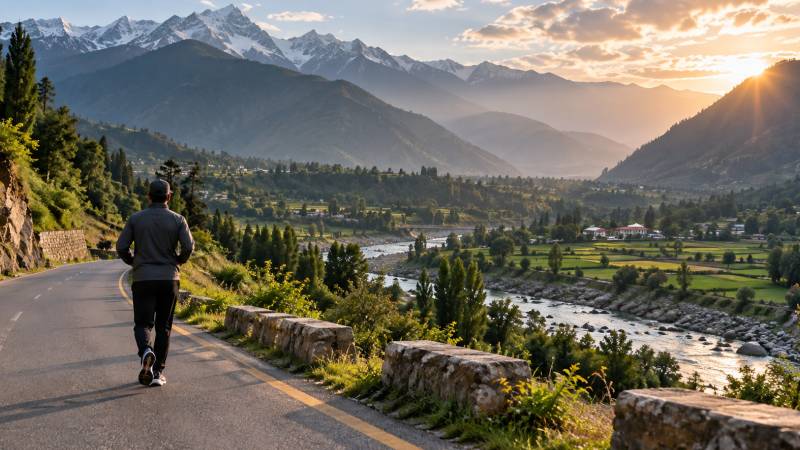
Every morning, before the valley fully wakes, I lace up my shoes and step onto the familiar path that leads from my door towards Shandala and on to Odigram. The air is still cool, the distant peaks of Swat hold the last traces of night, and the road unfolds like an invitation. What begins as a simple daily walk or jog quickly becomes something rarer: a meeting between an alert mind and living landscape. In those kilometres I find a quality of enjoyment that no screen, no indoor routine, and no hurried schedule has ever matched.
There is a particular beauty that appears only when the body moves and the mind stays awake. The eye registers the soft green of early fields, the silver glint of the river in the distance, the way light climbs the slopes of the surrounding hills. At the same time the mind turns over yesterday’s unfinished thoughts, rearranges them, and sometimes lets them dissolve. The scenery does not merely decorate the walk; it becomes the quiet partner of thought. One does not interrupt the other. Instead they deepen each other until a moment arrives when both seem to expand at once. That is the peak.
I have noticed this peak most clearly on the stretch between Shandala and Odigram. The road rises gently, the valley opens, and the rhythm of jogging settles into a steady cadence. Ideas that felt tangled indoors suddenly arrange themselves. A decision that had seemed complicated grows simple. Sometimes no decision is needed at all; the mind simply rests inside the movement and the view. The enjoyment is not loud. It is complete. Body, breath, landscape and thought form a single experience that feels larger than the sum of its parts.
Modern life works hard against this kind of fullness. We sit more than we move. We fill silence with noise and attention with notifications. Even when we walk, many of us walk with headphones or phones, turning the path into another scrolling session. The result is a thinning of experience. Nature becomes background, the body becomes a vehicle, and the mind remains trapped in the same loops it carried from the house. The daily road to Shandala-Odigram has taught me the opposite possibility: when attention is given freely to both the outer scene and the inner process, ordinary kilometres turn into something close to abundance.
This is not nostalgia for a slower past. It is a practical observation. The mind that thinks while the body walks in open air returns clearer, lighter, and more capable. Problems shrink to their proper size. Gratitude appears without effort. Even fatigue feels clean. In a region as richly green and dramatically shaped as Swat, the opportunity is especially generous. The same path that serves daily exercise can also serve as a daily restoration of perspective.
I do not claim that every walk reaches the same height. Some mornings the mind is restless, the weather dull, or the body tired. Yet the practice itself remains reliable. Showing up, moving, and keeping the inner eye open is enough. Over time the peaks become more frequent, and the ordinary stretches themselves grow richer. What began as exercise has become a form of quiet wealth.
In a time when many people feel mentally crowded and emotionally thin, the simple combination of nature and an engaged mind offers a remedy that costs nothing and requires no special equipment. The road to Shandala-Odigram is my particular version of that remedy. Others will find their own paths, their own early mornings, their own stretches of green and stone. The essential thing is the same: to walk, to notice, and to let the thinking brain meet the living world without interruption. That meeting, when it arrives fully, is one of the purest forms of enjoyment still available to us.