

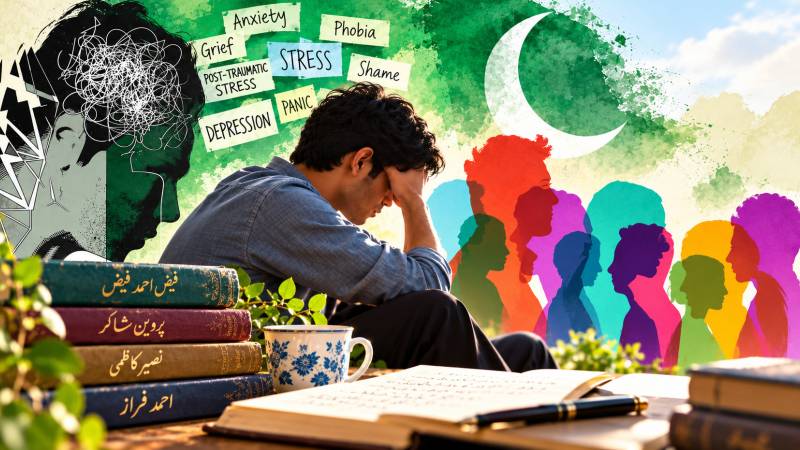
Ask almost any young Pakistani how they are, and the answer arrives before the question ends: “Alhamdulillah.” “Theek hoon.” It is a reply built on good manners and genuine faith. It is also, very often, a locked door. Behind such doors, the numbers should trouble us. In a school-based study of 1,124 adolescents in Rawalpindi, roughly one in six screened as a probable case of depression and one in five as a probable case of anxiety, with girls reporting higher levels of anxiety than boys. A 2026 analysis puts the treatment gap for psychological disorders above 90%. Our young people are not failing to speak. The world around them is failing to listen.
This is not merely a personal struggle; it is a systemic silence. The Commonwealth Youth Council’s Are You Okay? campaign identifies three barriers: the internal stigma that whispers, “I should handle this myself”; the social shame that warns, “People will gossip”; and the systemic failure that says, “I can’t afford help.” In Pakistan, sharam (shame), izzat (honour) and the stigma surrounding mental health reinforce each barrier, while the system offers little help in overcoming them. Clinical frameworks, however well-intentioned, often falter for want of cultural translation. A young person who is drowning cannot be expected to adopt the vocabulary of the DSM-5. They need a bridge. For us at Dil & Dastaan, a literary civic community in Lahore, that bridge is literature.
When a young person cannot say, “I am depressed,” we can point them towards Faiz Ahmed Faiz. When grief resists explanation, we turn to Parveen Shakir, Nasir Kazmi or Ahmad Faraz. Urdu poetry lends us the vocabulary our society has withheld. It gives shape to the formless ache. The poem speaks first, so the reader does not have to. Literature offers relief, along with the quiet reassurance that someone else, decades ago, felt something similar and survived to write it down.
The World Health Organization estimates that about 32.4 million people in Pakistan need mental health support, yet only around 5 per cent can access services, leaving a treatment gap of roughly 95 per cent. The country has just 0.19 psychiatrists per 100,000 people, compared with an average of seven in high-income countries. The government has now launched its National Mental Health Policy 2026–2035, which favours integrated, community-based approaches. As one commentary in The News argues, however, even a larger specialist workforce will leave millions without access to care in places where no psychiatrist or psychologist is within reach.
This is where community spaces matter. At Charagar, young people from every province meet online to talk openly about taboos, stereotypes and the silences they have grown up with. Because the space is online, a young person in a town without a nearby specialist can still find a place where saying, “I am struggling,” is ordinary rather than shameful. This is the Commonwealth Youth Council’s Ask, Listen, Connect, Act approach at the community level: the circle asks and listens, then connects young people with the help that the system is only beginning to provide.
Through online community circles, Urdu poetry, creative writing, sketching and journaling, and initiatives such as Charagar, Dil & Dastaan, and the Commonwealth Youth Council’s Ask, Listen, Connect, Act framework, young Pakistanis are finding culturally rooted ways to express emotional distress, challenge mental health stigma and build supportive spaces that encourage honest conversations and connect them with professional help.
The name Charagar comes from an old Urdu word for someone who tends to another’s pain, and the circle honours that meaning modestly. We are not therapists, and we begin by making that clear. We are witnesses. That is the philosophy behind Charagar, our mental health and wellness circle. We do not diagnose conditions; we bear witness. In a recent circle, we asked, “How are you, really?” The dominant answer was neither “depressed” nor “anxious”. It was “exhausted” or “sar mein dard hai” (my head hurts). These words are telling. They offer a socially acceptable way of saying, “I am not okay,” and represent the first crack in the wall.
What does witnessing look like? It looks like a verse by Faiz or Parveen Shakir being read aloud, allowing a young person who cannot say, “I am struggling,” to say instead, “This is how it feels.” It looks like the UN Youth Office’s Real People, Real Talk conversation cards, which gently guided us towards discussions of childhood and belonging. And it looks like one rule we did not break: listen without fixing. No advice, no silver linings, no rush to fill a pause. We let silence, poetry, art and literature do the heavy lifting.
Words are not the only way out of silence. For those who find speaking harder than any verse can address, we offered paper and pencils. They could sketch, doodle or write a few private lines, with no audience and no grade. Putting a feeling on a page gives it an outline, and a feeling with an outline is easier to examine and, in time, to share. A WHO review of more than 3,000 studies found that the arts play a significant role in preventing ill health and promoting well-being. Drawing and writing do not replace professional care, but they cost almost nothing, require no appointment and can be practised at a kitchen table at midnight.
The approach is also easy to replicate. Schools could set aside an hour for journaling and sketching. Universities could host reading circles alongside counselling services. Publishers and newspapers could provide platforms for young writers. None of this requires a clinic; it all begins with permission to be honest. We cannot wait for the system to change overnight. We must build community-led, culturally rooted spaces and shift from doing things for young people to building solutions with them. To my fellow youth leaders and professionals: let’s stop using “exhausted” as a shield. If you are struggling, you are not alone. You may simply not have found the words yet. Perhaps a line of poetry or a pencil sketch will help you find them. And we are here to listen.
Ask. Listen. Connect. Act.