

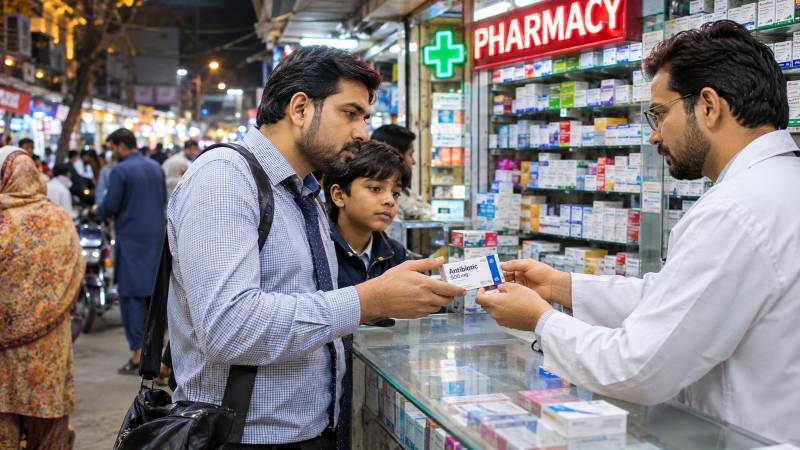
It is a little after nine on a winter evening in a crowded Karachi neighbourhood, and the local pharmacy is the busiest shop on the street. A father, still in his office clothes, explains that his son has had a fever since morning. He does not ask for a doctor. Instead, he asks for "a strong antibiotic". The pharmacist reaches for a strip of tablets without a second thought. No prescription is required, no test is ordered, and the course is cut to three days because that is what the father can afford. By the third evening, the fever has disappeared, and the leftover tablets are placed in a kitchen drawer for the next emergency.
The scene is ordinary enough to escape notice. Yet, repeated thousands of times across Pakistan, such transactions contribute to one of the gravest threats facing modern medicine: antimicrobial resistance (AMR). AMR occurs when bacteria, viruses, fungi and parasites develop the ability to survive medicines designed to eliminate them. Alexander Fleming, who discovered penicillin at St Mary's Hospital in London in 1928, warned in his 1945 Nobel Prize speech that careless use of antibiotics could produce resistant microbes. Eight decades later, his warning has become a global health crisis.
From 18 to 24 November, the world observes World AMR Awareness Week, a campaign led by the World Health Organization (WHO), the Food and Agriculture Organization, the UN Environment Programme and the World Organisation for Animal Health. It is an opportunity to examine how resistance develops and why Pakistan has particular reasons to be concerned. The science behind AMR is relatively straightforward. Every dose of an antibiotic kills susceptible bacteria while allowing resistant ones to survive and multiply. These survivors can pass resistance to subsequent generations, making infections increasingly difficult to treat. Using antibiotics for viral illnesses, stopping treatment prematurely or administering them routinely to healthy livestock all accelerate this process.
Resistance itself is not new. What is alarming is the speed at which it is spreading. Medicines take years to develop, while bacteria can evolve resistance within a few generations. The latest figures are sobering. In 2021, bacterial AMR was associated with more than 4.7 million deaths worldwide. The WHO's 2025 surveillance report, based on data from more than 100 countries, found that one in six laboratory-confirmed bacterial infections in 2023 was resistant to antibiotic treatment. Between 2018 and 2023, resistance increased in more than 40 per cent of monitored pathogen-antibiotic combinations.
More than 40 per cent of E. coli and over 55 per cent of Klebsiella pneumoniae infections are resistant to third-generation cephalosporins, commonly used to treat serious infections. Even carbapenems, once considered last-resort antibiotics, are losing effectiveness. In the WHO's South-East Asia and Eastern Mediterranean regions, roughly one in three reported infections was resistant. The economic consequences are equally alarming. The WHO estimates that resistant infections could cost US$412 billion annually in healthcare expenditure by 2035, alongside another US$443 billion in lost productivity. The World Organisation for Animal Health warns that AMR could cause up to 39 million deaths by 2050 and cost the global economy more than US$3.4 trillion annually.
Behind these figures are increasingly familiar medical tragedies: surgical wounds that become untreatable infections, cancer patients who succumb to hospital-acquired bacteria and children whose pneumonia no longer responds to conventional medicines. The problem is compounded by inadequate surveillance. Nearly half of all countries reported no data to the WHO's monitoring system in 2023. This year's awareness week carries the theme "One Health, one action: Prevent AMR now." The One Health approach recognises that human, animal and environmental health are interconnected. Antibiotics administered to poultry in Punjab can contribute to resistant bacteria entering the food chain, while untreated hospital wastewater can carry resistant organisms into groundwater and surrounding communities.
Addressing AMR therefore requires cooperation between doctors, patients, veterinarians, farmers, governments and environmental authorities. The objective is not simply to preserve antibiotics but to prevent infections and protect the wider ecosystem. There has been some international political progress. In 2024, the United Nations General Assembly adopted a political declaration on AMR, setting a target of reducing deaths associated with bacterial AMR by 10 per cent by 2030. It also aims to ensure that at least 70 per cent of human antibiotic consumption comes from the WHO's Access group of safer, narrower-spectrum antibiotics. The World Health Assembly subsequently adopted an updated Global Action Plan on AMR for 2026–2036.
Whether these commitments translate into meaningful action remains the central question. Pakistan has already experienced what an AMR crisis looks like. In November 2016, doctors in Hyderabad began reporting typhoid cases resistant not only to conventional first-line medicines but also to ceftriaxone, a widely used injectable antibiotic. It was the world's first large outbreak of extensively drug-resistant (XDR) typhoid.
Sindh recorded 11 cases in the final two months of 2016, 730 in 2017 and 4,825 in 2018. By August 2019, the number had reached 10,365 across 23 districts, with approximately two-thirds reported in Karachi. Travellers subsequently carried the strain to Britain and the United States, while researchers documented its spread into Punjab and other areas. At the time, the WHO identified azithromycin as the only reliable and affordable oral antibiotic remaining for treating the strain. A disease once routinely treated with antibiotics had become a serious public health challenge.
Typhoid is only one part of Pakistan's wider AMR problem. Speaking last December, microbiologist Dr Syeda Sadaf Akbar estimated that between 200,000 and 300,000 people in Pakistan die annually from AMR, directly or indirectly. She also placed Pakistan 29th among 204 countries in terms of antibiotic resistance. Prof Saeed Khan of Dow University of Health Sciences told The Express Tribune that studies indicate 40 to 70 per cent of ICU patients in major hospitals carry infections caused by multidrug-resistant organisms, including E. coli, Klebsiella, Acinetobacter and Pseudomonas.
Pakistan also has a significant burden of tuberculosis. Patients with drug-resistant TB can face 18 to 24 months of expensive treatment, with a considerably higher risk of failure. In February 2026, federal health officials released a national priority pathogen list, the first of its kind in the WHO's Eastern Mediterranean Region. They warned that resistance could claim more than 262,000 Pakistani lives over the next 25 years without improvements in infection control, prescribing practices and diagnostics.
The reasons are not difficult to identify. Antibiotics remain widely available without prescriptions, often dispensed by pharmacies in response to patients' demands. According to The News, antibiotics account for approximately Rs185 billion of Pakistan's pharmaceutical market, while more than 70 per cent of antibiotic prescriptions fall into high-risk categories of overuse.
A 2026 study of outpatient clinics in Multan also identified primary healthcare facilities and over-the-counter sales as significant sources of inappropriate antibiotic use. Doctors sometimes prescribe broad-spectrum antibiotics for viral infections because patients expect immediate treatment. Patients discontinue medication when symptoms disappear, while others save leftover tablets for future illnesses. Unqualified practitioners dispense antibiotics without proper diagnosis. Meanwhile, inadequate infection-control practices in hospitals allow resistant bacteria to spread through contaminated equipment and poor hygiene.
The problem extends beyond human healthcare. A study published this year identified antimicrobial-resistant E. coli within an integrated poultry production chain in Pakistan, raising concerns about exposure through food. Researchers have also highlighted weak legislation and enforcement governing antibiotic use in livestock, alongside inadequate nationwide surveillance of agricultural practices.
Wastewater presents another serious threat. Specialists attending a national symposium in Islamabad last November reported finding resistant pathogens in hospital effluents, wastewater and community sewage. Without effective treatment, these organisms can re-enter homes and water supplies. In a country where millions still lack access to safe drinking water, the connection between poor sanitation and resistant infections is particularly concerning. AMR does not remain confined to hospitals; it moves through food, water and the environment.
Pakistan has, however, taken some steps towards addressing the crisis. The country adopted a National Action Plan on AMR based on the One Health approach, with the current plan covering 2024–2029. Support from international partners, including the UK's Fleming Fund, has helped establish laboratories, surveillance networks and trained personnel. Vaccination is another important intervention. The typhoid conjugate vaccine, alongside vaccines against pneumococcus, rotavirus and measles, is part of the national immunisation programme. Preventing infections reduces the need for antibiotics in the first place.
At last year's Islamabad symposium, Dr Muhammad Salman, chief executive of the National Institutes of Health, described AMR as a "silent pandemic" and argued that Pakistan needed to move beyond establishing systems towards sustaining them. Participants acknowledged persistent weaknesses in enforcement, provincial coordination, antibiotic stewardship and funding. The national plan exists. What remains is to make it effective.
The government must enforce restrictions on non-prescription antibiotic sales, strengthen hospital infection-control systems and invest in microbiology laboratories. Provinces must coordinate surveillance and share reliable data. Livestock and poultry producers need clear regulations governing antibiotic use, alongside veterinary support that prioritises vaccination and biosecurity over routine medication. Clean water and proper sanitation must also become public health priorities. These interventions may not be politically glamorous, but they are considerably cheaper than treating a generation of untreatable infections.
Individuals also have a role to play. Doctors must resist prescribing antibiotics for illnesses they cannot treat. Pharmacists should refuse sales without prescriptions. Patients must follow their doctors' instructions, avoid sharing medicines and never self-medicate. Parents should ensure their children receive recommended vaccinations, while farmers should consult veterinarians before administering antibiotics to livestock.
Teachers, religious leaders and journalists can help communicate the risks to communities that conventional public health campaigns often struggle to reach. Return, then, to that pharmacy in Karachi. Imagine the same father standing at the counter a few years from now. His son has another fever, but this time the antibiotic does nothing. A doctor orders a culture test, and the results reveal that the infection is resistant to several available medicines. Treatment becomes expensive, hospitalisation follows, and the family faces a crisis that could have been prevented. This is not science fiction. It is already happening in Pakistan's hospitals.
The leftover tablets in the kitchen drawer did not cause the crisis alone, but they played their part, alongside unnecessary prescriptions, inadequate sanitation and the misuse of antibiotics in agriculture. World AMR Awareness Week will pass, as such campaigns do, but the microbes will continue evolving. Fleming gave humanity a medical miracle, and we have spent decades weakening its effectiveness. Whether we preserve it for future generations depends on the choices made by governments, healthcare professionals and ordinary citizens today.