

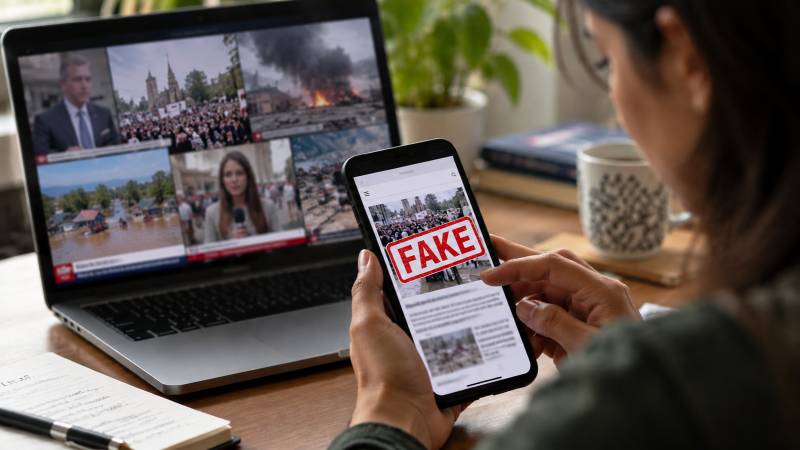
Human civilization has travelled a remarkable distance from the age when information was a privilege of kings, scholars and religious institutions to an era when almost every individual carries an extraordinary repository of knowledge in a pocket. A smartphone can provide access to scientific discoveries, political developments, medical advice and events unfolding thousands of kilometers away. Yet this unprecedented accessibility has produced a disturbing paradox. Never before has humanity possessed so much information, and perhaps never before has distinguishing truth from falsehood demanded such constant vigilance. The same technology that allows a student in Karachi to attend a lecture delivered at a European university also permits a fabricated statement, manipulated photograph or misleading scientific claim to travel around the world within seconds. Information has become abundant, but understanding remains scarce. Against this backdrop, the United Nations observes Global Media and Information Literacy Week from October 24 to 31, reminding the world that access to information alone does not guarantee an informed society.
The significance of this international observance extends far beyond the familiar warnings about fake news. In 2021, the United Nations General Assembly formally recognized Global Media and Information Literacy Week, emphasizing the importance of factual, timely, accessible and science-based information. Its 2026 theme, “We All Play a Part – Media and Information Literacy for the People,” acknowledges that protecting the integrity of information cannot remain the exclusive responsibility of journalists, governments or technology companies. Every citizen who creates, interprets or distributes information participates in shaping the collective understanding of society. UNESCO has therefore adopted a decentralized approach this year, bringing together educators, researchers, policymakers, journalists, young people, digital creators and civil society organizations. Events extending from Cairo and Nairobi to Montreal, New Delhi and other cities reflect a growing recognition that information literacy is not simply an educational subject. It has become an essential condition for meaningful citizenship in a technologically interconnected world.
The scale of the problem is illustrated by UNESCO’s 2024 study, Behind the Screens, which examined the practices of 500 digital content creators across 45 countries. The findings were unsettling: 62 percent did not systematically verify information before sharing it, while approximately 42 percent considered popularity indicators, including likes and views, important measures of credibility. These figures expose a fundamental weakness in contemporary information culture. Public approval has increasingly become a substitute for factual verification. A scientifically accurate explanation receiving a few hundred views may be overshadowed by an emotionally charged fabrication attracting millions. Algorithms reward engagement, but engagement is not synonymous with accuracy. A sensational claim about a disease, political conspiracy or technological discovery often travels faster than the careful explanation required to assess it. The digital marketplace has created an uncomfortable competition between evidence and excitement, with excitement frequently enjoying the commercial advantage.
Artificial intelligence has introduced another dimension to this struggle. Generative systems can produce persuasive essays, photorealistic images, synthetic voices and videos depicting events that never occurred. A fabricated recording may appear to show a public figure making an inflammatory statement, while an artificial image may portray a natural disaster in a location untouched by any such calamity. These possibilities complicate an assumption on which human communication has long depended: that seeing and hearing constitute persuasive evidence. Technology is increasingly capable of manufacturing both. Yet artificial intelligence should not be portrayed exclusively as an instrument of deception. It can assist researchers, translate educational material, improve accessibility and support investigative verification. The essential distinction lies between using AI to strengthen human judgement and allowing it to replace judgement altogether. A convincing answer generated by a machine is not automatically a correct one, and the confidence of its language offers no guarantee of reliability.
The danger becomes particularly evident in public health, where false information can have consequences extending beyond intellectual confusion. During the COVID-19 pandemic, societies witnessed how rumours about vaccines, treatments and disease transmission could undermine public confidence and complicate medical responses. Similar vulnerabilities persist in discussions concerning antimicrobial resistance, nutrition, environmental contamination and emerging infections. An unsupported claim about a supposedly miraculous treatment may persuade patients to abandon established medical advice. Misleading statements about antibiotics may encourage inappropriate consumption, contributing to a problem that already threatens healthcare systems worldwide. Media literacy is therefore inseparable from scientific literacy and public health education. Citizens need to understand not only the information presented to them but also the difference between a peer-reviewed study, preliminary findings, commercial promotion and an individual's unsupported opinion. When scientific uncertainty is honestly communicated, it represents intellectual responsibility rather than scientific failure.
Global Media and Information Literacy Week 2026 highlights the urgent need to combat misinformation, strengthen critical thinking and promote responsible digital citizenship, emphasising that in an age of artificial intelligence and unprecedented information access, an informed society depends on the ability to question, verify and share information responsibly.
The political implications are equally serious. Democracy presupposes that citizens can examine competing arguments, assess evidence and make reasonably informed choices. When public opinion becomes vulnerable to coordinated manipulation, this foundation weakens. UNESCO’s 2023 survey with Ipsos found that 85 percent of respondents across the countries studied were concerned about online disinformation. The concern is understandable. Fabricated documents, selectively edited speeches, organized trolling and deceptive digital campaigns can influence perceptions long before corrections reach the public. Yet responses to disinformation must be designed carefully. Governments have legitimate responsibilities to address incitement, fraud and coordinated manipulation, but the fight against falsehood must not become a convenient justification for suppressing legitimate disagreement. Media literacy and freedom of expression should reinforce each other. A society protected from misleading claims through education, transparency and independent scrutiny is better served than one in which authorities alone determine what citizens may believe.
Pakistan provides an especially important setting for examining these questions. According to DataReportal’s Digital 2026 assessment, the country had approximately 117 million internet users and 79.9 million active social media user identities in October 2025. The figures demonstrate the extraordinary expansion of digital participation, although social media identities should not be confused with unique individuals. Millions now receive news, political commentary, educational content and religious discussions through online platforms. This transformation has enlarged opportunities for expression, particularly among younger generations. However, the speed of digital expansion has not necessarily been matched by systematic education in source verification, digital ethics or responsible communication. Political polarisation, emotionally charged religious messages, fabricated notifications and misleading health claims can circulate within informal networks where trust is based more on personal familiarity than documentary evidence. A forwarded message from a respected acquaintance may seem credible even when its original source is entirely unknown.
The architecture of social media helps explain why such material flourishes. Digital platforms are not neutral channels through which all information travels with equal visibility. Recommendation systems select content according to signals that may include previous interactions, predicted interests and engagement. As users repeatedly encounter material consistent with their existing beliefs, they may become increasingly isolated from alternative interpretations. The resulting echo chambers can deepen social divisions and make correction difficult. Psychological tendencies further complicate matters. Confirmation bias encourages individuals to welcome information supporting their opinions while resisting contradictory evidence. Repeated exposure can make a false claim seem familiar and therefore credible. Emotional messages, particularly those invoking fear, anger or group identity, can bypass careful reasoning. These mechanisms are not confined to any nationality, educational class or political persuasion. They reveal a universal vulnerability of human cognition that modern technologies can amplify on an unprecedented scale.
An encouraging development is that Pakistan has begun recognising media and information literacy as a distinct educational and policy priority. In March 2025, UNESCO collaborated with the Higher Education Commission and the University of the Punjab on a proposed course outline for integrating media and information literacy into graduate programmes in media and communication studies. Further policy discussions took place during 2025, including a national dialogue in Islamabad addressing digital inequalities, access to verified information and the need for systematic instruction. In 2026, UNESCO-supported activities under the Digital Citizens for Peace initiative engaged young journalists, media students and content creators in responding to hate speech and disinformation. These efforts deserve encouragement, but their real value will depend on whether they develop into sustainable institutional practices rather than remaining isolated workshops. Educational reform must reach beyond metropolitan universities to schools, teacher-training institutions and underserved communities where the consequences of unreliable information may be equally severe.
The 2026 global observance recognizes that the responsibility extends to families and ordinary citizens. Parents who guide children through online spaces, librarians who teach information searches, community organizations that explain digital fraud, and content creators who verify claims all contribute to the same objective. UNESCO’s planned activities include discussions on formal education, digital content creation, policymaking, youth engagement and the development of media-literate cities. Its youth hackathon particularly emphasizes the capacity of younger generations to design practical responses instead of remaining passive recipients of institutional guidance. This emphasis is timely. Young people are not merely victims of digital manipulation; they are also capable of developing innovative verification tools, educational campaigns and alternative communication practices. Their participation can transform media literacy from a defensive exercise into a constructive public movement.
Nevertheless, an important distinction must be maintained between individual responsibility and institutional accountability. Advising users to verify information is necessary, but it cannot absolve digital platforms of responsibility for systems that financially reward misleading or inflammatory material. Likewise, expecting every citizen to investigate every claim independently is unrealistic. Effective responses require trustworthy public institutions, accessible scientific information, transparent platform governance, independent journalism and appropriate legal safeguards. Information literacy should empower people rather than transfer the entire burden of digital safety onto them. This is particularly relevant for elderly citizens, children, linguistic minorities and communities with limited access to quality education. An inclusive information society must make reliable knowledge understandable and available across languages, literacy levels and socioeconomic circumstances.
Global Media and Information Literacy Week 2026 is a call to strengthen critical thinking, responsible communication and respect for truth in an increasingly digital world. Pakistan should use this occasion to promote media literacy across schools, universities and public institutions. As artificial intelligence makes distinguishing fact from fabrication more difficult, technological solutions alone will not suffice. Scientific reasoning, intellectual honesty and the willingness to question and verify information are essential. Information may travel at the speed of light, but wisdom requires reflection. An informed society depends not merely on access to knowledge, but on the ability to question, verify and share it responsibly.