

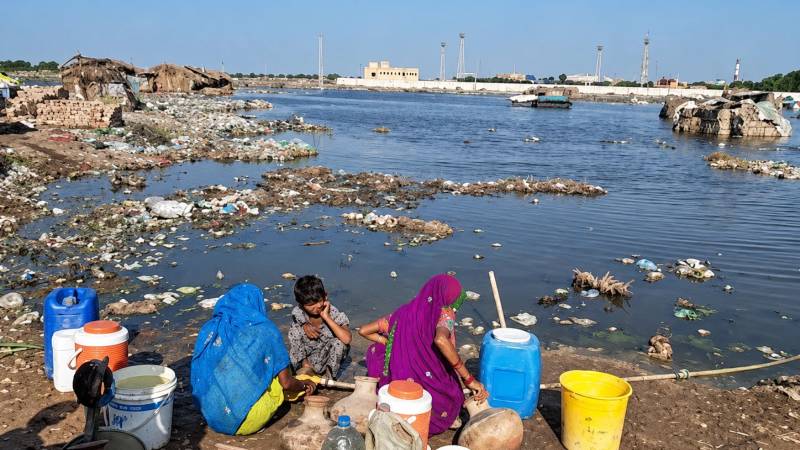
In coastal areas of Sindh, water can arrive both as a disaster and as a desperate need, communities face two threats at once. Floods can inundate homes, fields and roads, while freshwater scarcity and seawater intrusion leave wells saline and farmland increasingly difficult to cultivate. When floodwaters recede, the crisis does not necessarily end. Families are often left with damaged homes, degraded land, lost livestock and fewer reliable sources of drinking water. This is the paradox of Pakistan's Indus Delta: too much water when people cannot control it, and too little usable freshwater when they need it most. The challenge is no longer simply water availability. It is increasingly about whether water is stored, drained, distributed and governed in ways that protect people and livelihoods.
The scale of vulnerability in coastal Sindh is striking. The Asian Development Bank’s (ADB) assessment of the coastal districts of Badin, Sujawal, and Thatta describes these communities as among the poorest in Pakistan, with livelihoods heavily dependent on agriculture and fishing. Nearly 60% of households experience flooding every year, while recovery can take most of the year, trapping families in repeated cycles of loss. Multidimensional poverty exceeds 80% in Sindh’s coastal districts, with combined poverty headcount of approximately 84% (range: 82-86%).This is not simply an environmental problem. It is a development problem. When a flood destroys a crop, it removes income. When salinity damages agricultural land, it reduces future earnings. When fisheries decline, another source of employment disappears. When drinking water becomes harder to obtain, women and children often bear much of the burden. The human consequences are already visible. Childhood stunting in Sujawal stands at 73%, among the highest district-level rates reported in Sindh. Thatta and Badin also recorded very high rates, at 62% and 60% respectively, according to the underlying district-level data.
Female literacy in the same coastal districts remains below 20%. Yet women are central to household resilience, including obtaining water, managing food and caring for livestock. The paradox therefore has a clear gender dimension: those carrying much of the household burden of water insecurity often have the least access to education, assets and decision-making power. The economic cost extends far beyond the coastline. Sindh's economy cannot be separated from its water systems. Agriculture remains central to the province's economic development and is one of Pakistan's major sources of employment and economic activity. The coastal economy, however, extends beyond farming. Fishing, livestock, mangroves and small-scale trade all depend on functioning freshwater and coastal ecosystems. When these systems deteriorate, the economic damage spreads.
The 2022 floods demonstrated the scale of Pakistan's exposure. According to the UNDP, the Post-Disaster Needs Assessment estimated more than $14.9 billion in direct damages and about $15.2 billion in economic losses. Sindh was the worst-affected province, accounting for close to 70% of total damages and losses. The coastal water problem, therefore, should not be viewed as a local environmental issue. It affects food production, rural employment, fisheries, public finances and migration, and ultimately national economic resilience. One reason for this growing vulnerability is that Pakistan's water system was largely designed around managing river water for irrigation. Coastal Sindh now faces a more complex combination of floods, salinity, land degradation, seawater intrusion and climate variability.
The ADB identifies land subsidence, flooding, erosion and saline intrusion as interconnected pressures in Badin, Sujawal and Thatta. The delta also depends on freshwater from the Indus. The Sindh Forest Department notes that the Indus Delta's mangroves are almost entirely dependent on freshwater discharge from the river and that reduced freshwater availability has contributed to ecological degradation. The department estimates the mangrove ecosystem at about 600,000 hectares and says it supports commercially important fisheries and the livelihoods of more than 100,000 people associated with fishing.
Historically, declining freshwater flows have also been linked to increasing salinity in the delta. World Bank research has documented how reduced freshwater discharge alters the salinity regime and contributes to degradation of the mangrove ecosystem. The result is a vicious cycle. Less freshwater allows salinity to move inland. Salinity damages agricultural land and freshwater resources. Declining agricultural productivity increases pressure on fisheries and other natural resources. Environmental degradation then leaves communities even more vulnerable to floods and storms.
The measure of success should not be how much water Pakistan moves through its canals. It should be whether that water leaves behind healthy land, productive farms, functioning fisheries, safe drinking water and communities better able to withstand the next climate shock.
Pakistan’s coastal water crisis reflects the country’s broader struggle with water scarcity, as per-capita availability has dropped from about 5,260 cubic meters in 1951 to less than 1,000 cubic meters today, with government estimates projecting only 899 cubic meters by 2025. Climate change intensifies this challenge, with the World Bank warning of a potential 6.5-9% reduction in GDP by 2050, alongside an additional 4.6% loss from agricultural water shortages. These pressures are already evident in coastal Sindh, where water insecurity threatens agriculture, health, and infrastructure simultaneously. While large-scale infrastructure such as drainage, irrigation, and storage is urgently needed, relying on it alone risks shifting problems rather than solving them. A truly resilient response must integrate infrastructure with ecosystem management and local participation to ensure sustainable water governance and climate adaptation.
First, drainage and flood infrastructure need to be modernized. Natural drainage channels (Dhora) and waterways should be restored and maintained so that water does not remain trapped after extreme rainfall. Second, freshwater and coastal ecosystems need to be managed together. Maintaining adequate freshwater flows to the delta is essential not only for communities but also for mangroves, fisheries and the ecological functions that protect the coast. Third, mangrove restoration should be treated as natural infrastructure, not merely as tree planting. Healthy mangroves provide habitat, support fisheries and form part of the natural defense of vulnerable coastal communities. Fourth, local communities must have a meaningful role in water governance. Farmers, fishers and women should not simply be recipients of water policies. Their knowledge and experience should inform decisions about water management, disaster preparedness and local investment.
The goal should not be to rebuild the same vulnerable house, road or livelihood after every flood. Resilience should mean changing the conditions that repeatedly produce vulnerability. For Sindh's coast, this is ultimately a governance challenge. The province does not need to choose between flood protection and freshwater security. It needs to manage them as parts of the same system. The Indus must deliver water not only to fields upstream but also enough freshwater downstream to sustain the delta. Floodwater must be drained or stored safely rather than allowed to become a prolonged livelihood disaster. Mangroves must be recognized as productive natural infrastructure. Farmers and fishers need alternatives when climate shocks undermine their traditional livelihoods. And women, who often manage household water under the most difficult conditions, need a meaningful voice in water-related decisions.
Pakistan's broader water crisis makes this increasingly urgent. The country has moved from relative water abundance toward scarcity, while climate change is making floods and droughts more unpredictable. In coastal Sindh, that national problem becomes painfully visible: water can destroy a family's livelihood while the absence of usable freshwater can prevent that same family from recovering. That is the real paradox. The answer is not simply to find more water. It is to manage the water we have differently: capture it when it arrives, drain it where necessary, conserve it when scarce, protect freshwater from salinity, restore the ecosystems that buffer communities, and give local people a greater voice in how water is governed.
The measure of success should not be how much water Pakistan moves through its canals. It should be whether that water leaves behind healthy land, productive farms, functioning fisheries, safe drinking water and communities better able to withstand the next climate shock. For Sindh's coast, the choice is increasingly clear: manage water as a connected system, or continue paying the cost of failing to do so, flood after flood and drought after drought.