

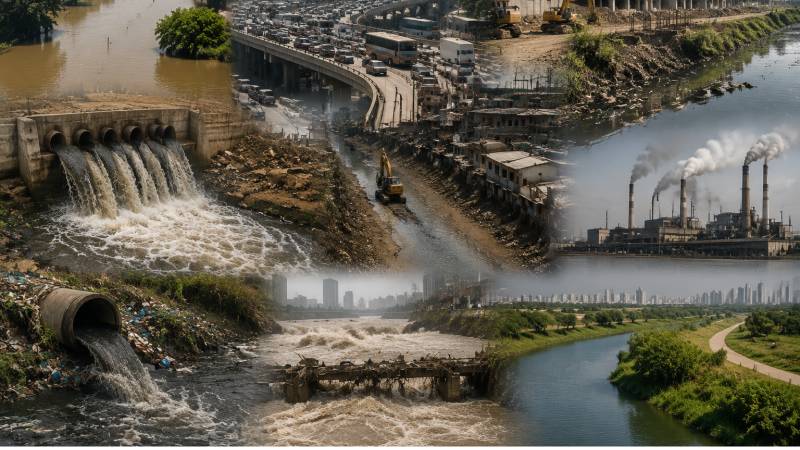
The few days of rains in central Punjab districts have once again caused massive inundation of rain water along Deg Nala from district Narowal to Lahore and downstream to Sheikhupura; hundreds of square kilometers of land is now under water.
After few days of incessant rains in the last week of July, all major and minor Nalas that flow from District Narowal and drain in river Ravi, including Deg Nala, Minor Deg, Bhair and their smaller tributaries as well as all irrigation drainage channels in the entire area overflew from their bank. It is the spill over water as well as the rain water that has created the current flood situation.
All natural drains are filled to capacity and draining maximum water they can carry in River Ravi near Baloki. There was a discharge of up to 40,000 cusecs in Deg Diversion channel on 28th of July; however large swathes of land are still inundated and there is up to 7 feet of standing water in many places.
There are very obvious reasons for the massive inundation in the entire area particularly in the whole sixty kilometers radius along Lahore-Sialkot Motorway.
In 2025, River Ravi and Chenab were in medium to high flood in the month of August and there was widespread inundation in the housing societies and other developed areas inside or adjacent to the banks of both rivers, as well as near the seasonal nalas. This year in 2026, there is low flood in all rivers in the Indus basin and average rainfall but despite an average monsoon, there is widespread inundation in the catchment areas of the seasonal nalas in three districts of Punjab including Lahore, Gujranwala and Sheikhupura.
The main reason for the inundation on the east side of Lahore, some kilometers towards Sialkot is primarily because of the Lahore-Sialkot Motorway M11 which has effectively blocked the natural drainage of water towards Ravi. The sixty kilometer Motorway demonstrates a design flaw and it is sheer oversight on the part of the planners and the Motorway construction company that there is no provision in the road design for the natural drainage of the rain water or sheet flow after rain from the east side of the road to west and south west.


There are a few culverts present under the M11 Motorway at various places along the road but these are not sufficient to carry the spill over or stagnant water. Even where the water is draining out of the culverts there is construction or dwellings on the other side of the road which creates further hurdles.
Along the GT Road there are mosques,markets and houses built across the existing culverts or drainage channels, consequently blocking any onward water flow and causing ponding. There has been no attention given to these encroachments going on along the rivers and nalas and the massive construction along the roads has practically made it impossible for the water to discharge naturally.
During the Raj the British had constructed hundreds of culverts under the railway lines and bridges for the natural drainage of rain water. Many of these historic structures exist even today, locally referred to as ‘so moria pul’ meaning (bridge with a hundred holes). Over time, urban expansion and rising populations prompted authorities to seal these culverts. Even if they were to be opened now, it would be of little consequence, as newer road networks have completely obstructed the original channels of natural water flow.
On a much bigger scale in 2025 when the three rivers Ravi, Chenab and Sutlej were in medium to high floods, the Motorways blocked the natural drainage of the flood waters in many parts of Punjab. In the south of Punjab the M5 Motorway blocked the Sutlej flood waters for over a month in Tehsil Jalal Pur Pirwala, as the water failed to drain naturally into the Chenab river. The M2 Motorway at Qadirabad, near Pindi Bhattian completely blocks the Chenab flood waters and creates ponding on a large swath of land. This is the result of ill planning and design flaws in major road infrastructure in Pakistan.
A comprehensive report on floods 2025 “Pakistan at Flood Tipping Point” by Revive Earth gives a detailed analysis on the real reasons of flooding in Pakistan year after year which results in the loss and damage of billions of dollars and also damages the natural ecosystems of the entire region.
The M2 Motorway at Qadirabad completely blocks the Chenab flood waters and creates ponding on a large swath of land. This is the result of ill planning and design flaws in major road infrastructure in Pakistan.
The Irrigation Department of Punjab, as per usual, is presently busy doing routine maintenance work and making sure that the drains that come under its jurisdiction are working as per their capacity but as explained earlier that this is not the viable solution for the problem created by relentless ill planned infrastructure along the nalas which has obstructed water ways on the ground as well as massively damaged underground water channels.
The underground water channels which are spread beneath the surface are a network of fine capillaries carrying water by utilizing the gravitational pull along the slope to naturally drain water in the larger channels and ultimately end up in the rivers. When the whole delicate and intricate network created by nature is brutally damaged by senseless development and ill planning the result is always a disaster which is anything but natural. This is completely analogous to severing the delicate arteries and veins of a human being—an intricate network of big and small channels that can never be fully restored to its original state, even with surgery.
The Irrigation Minister Punjab Kazim Pirzada is clueless about the solution to this massive and complex phenomenon and when asked how he is going to tackle this, he said that “ we have many solutions; we can always dig a bore and drain water through the bore”. If this is the level of expertise that the Punjab irrigation department is working under, then one should not have too much hope for any improvement. The Chief Minister Punjab should pay urgent attention to the current situation, hand over the department to a competent minister who has the ability to solve complex problems and is not afraid to ask the help of experts when and where it is needed.
The other most horrific fact is that although the water experts, environmentalists, river right advocates and climate change experts have been crying hoarse for decades yet the governments of Pakistan have not taken any steps for the filtration of waste water from the urban centers and industries that is draining into the rivers of the Indus Basin. After 80 years of the birth of Pakistan, the rivers are still cursed to carry the unfiltered raw sewage and solid waste that is being dumped into them.
The Government of Pakistan has always stated that the rivers are a matter of national security and crucial for the agri-based economy of Pakistan yet no government is bothered to pay due attention to the fact that the rivers are being polluted and violated every single day, especially in Punjab; land of five rivers.
The rivers are the lifeline of the Planet on which we all live and the harbinger of all life on it. Our rivers in the Indus basin carry pristine water from the melting glaciers in the Himalayas to the plains, where they have sustained and nurtured many civilizations that have thrived on their banks for thousands of years and these pure waters are being polluted mercilessly by dumping sewage and waste in them.
Using the rivers as major sewage drains is a criminal negligence on part of all governments and it is the responsibility of the incumbent governments of Khyber Pakhtunkwa, Punjab, AJK and Gilgit Baltistan to take immediate action for the protection and preservation of all rivers in the Indus.
No sewage waste water, urban solid waste or industrial waste of any kind must end up in any river unfiltered. The industries that are dumping solid or industrial waste of any kind in the rivers must be closed immediately until they make sure that they have fully functional filtration units installed. All urban waste water must be filtered before it is drained into any river. All private housing societies must have their separate filtration units and no society should be given an NOC before ensuring that they have the proper filtration and disposal Units.
All Major roads and Highways need to have well effective rainwater drainage systems constructed for the drainage of rain and flood water to ensure that there would be minimal inundation on both sides. The road or other infrastructure constructed without drainage systems would not only cause inundation after every rainfall but also damage the road infrastructure itself.
Secondly the sewage, solid and industrial waste including plastic waste landing in rivers ultimately drains in the oceans which is the major cause of ocean damage. The ocean surface is the largest body that does the carbon sequestration and controls the temperature and the weather patterns. The layer of pollution and microplastics on the surface of oceans is causing the warming of the oceans and seriously harming aquatic life. Climate change is a direct result of the damage that is being caused to the ecosystems and the causes are all anthropogenic activities. If the governments in Pakistan claim to have climate change and environmental protection as their priority then they must immediately take steps to stop the pollution in the rivers.