

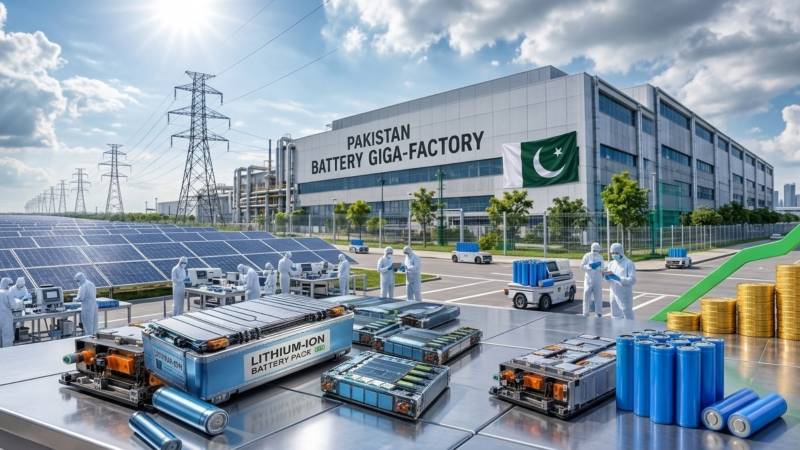
Pakistan’s proposed $2.25 billion battery Giga-factory presents a question that goes well beyond manufacturing lithium-ion cells: can an economy constrained by foreign-exchange shortages, expensive electricity and a shallow industrial base turn an emerging energy market into a globally competitive manufacturing industry? The opportunity is real. So are the risks. The difference between the two will be determined not by the investment headline, but by the economics beneath it.
According to The News International, Margalla Heavy Industries Limited (MHIL), a military-owned enterprise, has signed an agreement with Chinese partners and a Pakistani private investor for a battery manufacturing facility at Taxila. Engineering Development Board (EDB) chief executive Hamad Ali Mansoor says the building is ready and machinery installed, but production awaits government approval of a dedicated battery manufacturing policy. The identities of the investors have not been disclosed publicly in the reporting reviewed.
That distinction matters. An announced investment is not the same as capital deployed; installed machinery is not proof of commercially viable production; and domestic manufacturing does not automatically translate into economic gain. The project deserves serious consideration, but its scale makes independent scrutiny essential.
Pakistan has a compelling reason to develop battery manufacturing. Households and businesses are adopting solar power and storage partly because grid electricity has become expensive. Industrial users need reliable power, while electric mobility could create another market for cells, packs and associated electronics. Batteries can also help manage fluctuations in renewable generation and supply electricity during peak periods.
Yet the country’s electricity market is not expanding in a straight line. Pakistan’s Economic Survey 2024-25 recorded electricity consumption of 80,111 gigawatt-hours during July-March FY2025, a 3.6 per cent decline from the corresponding period a year earlier. High tariffs, off-grid solar adoption, conservation and subdued industrial activity were among the factors identified. This is not an argument against batteries. It is a warning that demand must be modelled around changing consumer behaviour, not simply extrapolated from population and growth projections.
The EDB estimates that battery energy storage demand could reach 100,000 megawatts by June 2030 if GDP growth reaches at least 5 per cent, and 80,000 megawatts if growth remains below 3 per cent. It also estimates that grid stabilisation alone could require 3,000-5,000 megawatts of storage. These are substantial projections, but the public reporting does not provide enough methodological detail to independently validate them. The News
There is also a technical issue that cannot be brushed aside. Megawatts measure the rate at which a battery can deliver power; megawatt-hours measure how much energy it stores. A 1,000-megawatt storage system capable of discharging for four hours requires 4,000 megawatt-hours of storage. A system delivering the same power for two hours has half that energy capacity. Battery-cell production is generally discussed in terms of energy capacity, such as gigawatt-hours per year. Until the project’s proposed output, storage duration and production units are clearly specified, comparisons between projected demand and factory capacity remain incomplete.
The government needs an independently reviewed demand model separating residential backup systems, commercial and industrial storage, grid-scale installations and electric-vehicle batteries. These markets overlap, but they are not interchangeable. Each has different technical requirements, purchasing cycles, price sensitivities and potential customers. A forecast that combines them without transparent assumptions risks turning an ambitious market estimate into the justification for an oversized factory.
The most immediate industrial opportunity may lie in replacing finished-product imports while building the capabilities required for more sophisticated manufacturing. Pakistan imported an estimated 1.25 gigawatt-hours of lithium-ion battery storage packs in 2024, according to the Institute for Energy Economics and Financial Analysis. Its Analysis warns that widespread adoption of decentralised storage could also intensify financial pressures on a grid already burdened by fixed costs and long-term power purchase commitments.
This creates a two-sided economic challenge. Domestic batteries could reduce dependence on imported equipment, but they will not solve Pakistan’s power-sector problems on their own. If consumers leave the grid because electricity is unaffordable, the resulting reduction in sales can push fixed costs onto those who remain connected. Storage policy must therefore be coordinated with tariff reform, grid modernisation and a more sustainable structure for recovering electricity costs.
Nor should every import be treated as a loss that localisation automatically corrects. Imports give consumers access to established technologies, competitive prices and reliable products. Replacing them with more expensive domestic goods behind permanent tariff barriers could transfer costs to households and businesses without creating a genuinely productive industry. The test is whether Pakistani manufacturers can progressively compete on cost, quality and reliability, not whether they can sell under protection.
Pakistan's proposed $2.25 billion battery Giga-factory offers an opportunity to reduce import dependence and build industrial capacity, but investment commitments, technology transfer, competitive production and export performance will determine whether it becomes manufacturing breakthrough or an expensive industrial gamble
China’s participation offers a potential shortcut into a technically demanding industry. Its manufacturers possess established supply chains, production experience and access to markets that Pakistan cannot reproduce overnight. But importing Chinese machinery is not the same as acquiring Chinese industrial capability.
The agreement must be assessed through its commercial substance. How much of the reported $2.25 billion is committed equity, debt, machinery, infrastructure or planned future expenditure? Who carries the financial risk? What technology will be licensed or transferred? Will Pakistani engineers receive substantive training? Will domestic suppliers gain access to production processes, quality systems and procurement contracts? Which customers have committed to buying the output?
These are not peripheral questions. They determine whether Pakistan develops a durable industrial base or remains dependent on imported components assembled locally. The government should require clear disclosure to the relevant regulators, independent engineering verification and measurable technology-transfer obligations. Confidential commercial details need not all be made public, but public incentives and strategic claims must be open to meaningful scrutiny.
The project’s headline figure also requires reconciliation with the EDB’s estimate that four or five factories, each costing $1 billion to $1.25 billion, would be needed to serve projected demand. The figures may reflect different scopes, capacities or phases, but the public reporting does not yet establish how they fit together. The News: A credible feasibility assessment should explain the difference rather than leave investors and policymakers to infer it.
Pakistan should resist the false choice between immediately manufacturing everything domestically and remaining an assembly market indefinitely. Industrial development is usually cumulative. Battery-pack integration, battery-management systems, power electronics, thermal controls, testing and safety certification can create local expertise while cell manufacturing scales up. Recycling and materials recovery can follow where reliable feedstock, technology and commercially viable operating models exist.
Cell production should remain a strategic objective, but its economics depend on reliable power, skilled labour, high yields, consistent quality, access to inputs and sufficient production scale. A factory operating below capacity can struggle even when demand is growing. The policy must therefore encourage local value addition without pretending that every component can be produced competitively from the first day.
Government support should be conditional, time-limited and tied to measurable outcomes: verified production, improving productivity, skilled employment, export performance and progressively greater domestic value addition. Export requirements are especially important because a manufacturer that can survive only behind domestic protection has not demonstrated international competitiveness. Incentives should be reviewed against published milestones, with consequences for missed commitments.
The same discipline must apply to claims about local minerals. Geological potential is not equivalent to commercially recoverable reserves, and the existence of deposits does not establish that domestic extraction and processing will be cost-effective. Any upstream strategy needs verified resource assessments, environmental safeguards, credible extraction economics and transparent financing.
Pakistan’s battery strategy should ultimately be judged through a national economic ledger. It should account for foreign exchange saved after imported machinery and components are included, export earnings actually received, fiscal concessions granted, productive jobs created, technology transferred and productivity achieved. These indicators offer a more honest assessment than investment announcements or factory capacity alone.
The government should also establish independent monitoring, publish progress against agreed milestones and prevent incentives from becoming permanent entitlements. Where public support is justified by strategic benefits, those benefits must be defined and measured. Where commercial targets fail, the policy should permit support to be revised or withdrawn.
Pakistan has a genuine opportunity to turn rising demand for energy storage into industrial capability. But the country cannot afford to confuse a large project with a successful industrial policy. The proposed Giga-factory should be neither dismissed before its economics are examined nor celebrated before its performance is demonstrated.
The decisive question is what Pakistan will retain when the machinery has been installed, the incentives have expired, and the first production targets have been tested. If the answer includes competitive products, skilled engineers, export customers and a stronger domestic supply chain, the investment could mark a meaningful shift in the country’s industrial trajectory. If it produces only expensive local output dependent on protection, the headline investment will have concealed a familiar failure. Pakistan does not merely need to manufacture batteries. It needs to master the economics of making them.