

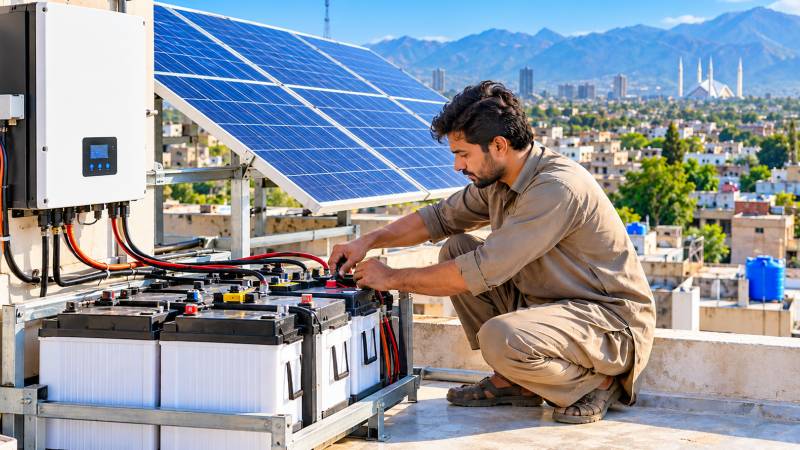
A battery stores electricity. In Pakistan, it increasingly stores something else: protection against an uncertain power system. Households and businesses are turning to batteries to cope with high tariffs and unreliable supply. Individually, these are private responses. Collectively, they are reshaping the economics of Pakistan’s power sector through their effects on electricity demand, grid finances, industrial competitiveness, and the distribution of energy costs.
According to a Renewables First study published in July 2026, Pakistan imported an estimated 4.6 gigawatt-hours of lithium-ion battery storage in 2025, around 220 per cent more than in the preceding year. Cumulative imports between 2018 and 2025 reached approximately 7.6GWh, with about 60pc arriving in 2025 alone.
Pakistan’s solar rush is becoming a battery rush. Falling technology costs, rooftop solar, expensive grid electricity, and unreliable supply are driving this change. But its pace also signals declining confidence in the future cost and dependability of grid electricity. Repeated tariff increases and unreliable supply may lead consumers to expect more of the same. Economists call this, adaptive expectations. For many households and businesses, batteries are a way to prepare for that possibility and a warning to the power sector that confidence in the grid is weakening.
A household considering a battery looks beyond its latest bill to future tariffs, solar compensation, and interruptions. Businesses must also account for lost production, idle labour, and higher operating costs. Battery becomes more than an energy device; it becomes insurance against financial, operational, and policy uncertainty.
These expectations are being reinforced by changing financial incentives. The shift from net metering towards net billing did not create the battery boom, but it may accelerate it. When grid electricity costs more than the credit received for surplus solar generation, consumers have a stronger reason to store daytime electricity for later use. Net billing changes the reward for exports; batteries make greater self-consumption possible.
Viewed through game theory, this relationship resembles a coordination problem. Consumers decide whether to rely on the grid or invest in private reliability, while power-sector institutions decide whether to restore confidence through better service or recover falling revenue through higher charges. Each side’s response changes the incentives facing the other.
A self-reinforcing cycle can follow. Solar and batteries reduce grid purchases, but capacity payments and network costs do not decline at the same pace. Falling sales increase pressure on tariffs and fixed charges. These increases confirm consumers’ expectations and encourage further investment in private energy systems.
A battery stores electricity. In Pakistan, it increasingly stores something else: protection against an uncertain power system. Consumers have made their move by investing in private reliability. The state’s next move should be to restore confidence in the grid.
What is individually rational may therefore become collectively damaging. Customers may remain connected but use the grid mainly as backup, leaving its costs to be recovered from a shrinking revenue base. The burden will not be shared equally. Affluent households and large businesses can afford solar-plus-storage systems; poorer households, tenants, and small businesses often cannot. Pakistan risks developing a dependable private system for those able to pay and a financially stressed public grid for those unable to leave.
The wider economic effect is mixed. Batteries can reduce interruptions and industrial downtime, extend the use of solar power beyond sunset, and displace imported fuels. Yet, battery imports require foreign exchange, while businesses financing their own electricity security have less capital available for machinery, employment, and expansion.
The value of this investment should therefore be assessed against the fuel imports it displaces, the production losses it prevents and its effect on grid finances — not simply against the battery import bill. Pakistan should not try to reverse this transition, but it can determine whether batteries weaken the public grid or become part of a more flexible electricity system.
Policy must begin with measurement. Consumer-owned batteries should be incorporated into demand forecasts and power-system planning. Credible estimates of installed storage, charging patterns and behind-the-meter consumption are essential because historical grid demand no longer reveals consumers’ full electricity requirements.
Better information must be matched by better incentives. Time-of-use tariffs may accelerate rather than slow battery adoption. Their value lies in guiding how batteries are used: lower daytime prices can encourage charging when electricity is abundant, while higher evening prices encourage discharge during costly peaks. Private storage could therefore become a tool for managing peak demand rather than simply a means of grid withdrawal.
This could turn the coordination problem into a win-win opportunity. With suitable meters, market rules, and payments, consumer-owned batteries could support grid stability, and provide ancillary services. Consumers would earn a return on their investment, while the power sector would gain a more flexible grid. Tariff periods should reflect system conditions and be reviewed seasonally. Over time, distributed batteries could also support the grid, although this would require smart meters, technical standards, aggregators, and clear market rules.
Restricting batteries would not address the underlying problem. Consumers are responding to real costs and risks. Policy should instead turn privately owned batteries from grid withdrawal instruments into resources that improve system reliability and efficiency. Pakistan’s battery rush does not mean consumers no longer need a national electricity system. It means they are no longer willing to depend on it unconditionally.
Consumers have made their move by investing in private reliability. The state’s next move should be to restore confidence in the grid. That requires changing not only tariffs and regulations, but also consumers’ expectations about whether the national electricity system will remain affordable, dependable, and worth using.