


Pakistan is preparing to privatize some of its electricity distribution companies at precisely the moment when the electricity business itself is undergoing the most profound transformation in a century. The need for reform is beyond dispute. Circular debt continues to grow, tariffs have become increasingly unaffordable, industrial competitiveness has deteriorated, consumers are moving rapidly towards rooftop solar and batteries, and the traditional utility model is under stress. The status quo cannot continue.
But the national debate is starting in the wrong place. It is focused on whether privatization is desirable when the more important questions are what exactly is being privatized, what rights and assets are being transferred, what market the new owners will operate in, and whether the electricity sector is economically viable in its present form. Unless these questions are answered before final bids are invited and binding agreements are signed, Pakistan risks completing a transaction without completing a reform. Perhaps another IPP will happen with government guaranteed returns and no market risk.
This distinction matters because privatization is not an objective in itself. It is only one instrument available to improve efficiency, governance, investment and service quality through market development and competition. The objective must be a financially sustainable and competitive electricity sector that provides reliable and internationally competitive power, supports industrialization and exports, integrates new technologies, protects consumers and creates incentives for investment rather than recurring bailouts. If privatization delivers those outcomes, it deserves support. If it merely changes ownership while leaving the underlying market architecture untouched, the country may discover that it has privatized yesterday's grid while retaining yesterday's problems. And the private sector will exact a price as well as government guarantees that will endanger the taxpayer. The Government therefore has an opportunity to do something more ambitious than sell several companies. It can use the process to redesign the sector around transparency, competition, flexibility, independent regulation and the emerging Future Grid. The decisions taken now will shape the value of the distribution businesses, the burden ultimately carried by taxpayers and consumers, and the ability of Pakistan's economy to compete for decades.
What Exactly Is Pakistan Selling?
The first problem is the absence of a sufficiently clear public description of the transaction. FESCO, IESCO and GEPCO are being advanced as the first major distribution-company privatizations. Advisers have been appointed, investors have been invited into the process and due diligence is proceeding. Yet the public record still does not provide a simple, comprehensive answer to the most basic question: what exactly will the buyer acquire?
A distribution company is not merely a collection of poles, wires and transformers. It owns or controls grid stations, substations, control centres, offices, warehouses, workshops, training facilities, residential colonies, rights-of-way, communications systems, billing platforms and extensive customer information. It may also own strategically located land accumulated over decades. Some of that land is essential to network operation; some may be surplus; and some may possess commercial or redevelopment value far in excess of its current use as utility property.
The treatment of that land is therefore central to valuation. Will it remain in the company and pass to the purchaser? Will strategic and surplus properties be separated before sale? Will land remain in state ownership and be leased to the privatized utility? What happens to development rights if a substation is relocated or a depot becomes redundant? Will independent valuations be published, and will the public be able to see how real-estate value has been reflected in the transaction price? These are not peripheral legal details. They determine what the taxpayer is transferring.
The same uncertainty surrounds the commercial rights attached to the companies. The electricity business is changing rapidly. A future distribution company may not earn its principal value merely by delivering centrally generated electricity to captive consumers. It may become an open network operator, a retail supplier, an aggregator of rooftop solar and batteries, an operator of electric-vehicle charging infrastructure, a provider of demand-response and flexibility services, a digital energy platform and a controller of valuable real-time customer and network data. If those rights are included in the transaction, the purchaser is acquiring much more than today's regulated distribution business.
The issue becomes especially sensitive because sophisticated bidders cannot value these companies without detailed information on assets, liabilities, regulatory assumptions, employee obligations, litigation, land title, future commercial rights and the expected market structure. If bidders have been given material information that has not been placed in the public domain, the Government should explain why Parliament, consumers, industry and taxpayers do not have access to the broad transaction architecture. If bidders have not been given such information, then it is difficult to understand how credible valuations can be prepared. Either way, the current information gap weakens confidence in the process.
There is no commercial reason for the Government to publish bidder-specific confidential information or commercially sensitive negotiations. But there is every reason to publish the structure of the transaction: what is being sold, what is being retained, how land is treated, which liabilities remain with the State, what future commercial rights accompany the sale and what regulatory obligations will bind the new owners. The public does not need to see every data-room document to understand the basic bargain being made in its name.
This is particularly important because the strongest distribution companies may also have the greatest future option value. Their territories contain dense industrial and commercial loads, affluent residential customers, growing solar adoption and some of the strongest potential markets for batteries, electric vehicles and digital energy services. A valuation based only on today's regulated cash flows could therefore understate the long-term value of the franchise. Conversely, a buyer constrained to operate only a conventional wires business under rigid regulation may attach much less value to those future opportunities. The Government must define the future business before it can credibly claim to have maximized the value of the sale.
The broader principle is straightforward. Public assets should not be transferred through a process that is understood in detail by advisers and bidders but only in outline by the public that owns them. Transparency is not an obstacle to privatization. It is the foundation of a transaction that can survive political change, legal scrutiny and future technological disruption.
Privatization Cannot Fix a Broken Market
The second issue is more fundamental. Even a perfectly transparent transaction cannot succeed if the market into which the companies are sold remains structurally flawed. Pakistan's electricity crisis is often presented as a failure of public ownership, implying that private ownership will automatically produce a viable sector. That diagnosis is too convenient.
The sector reached its present condition because the policy framework rewarded investment more than efficiency, capacity more than productivity, administrative regulation more than competition and construction more than market development. Changing ownership without changing that framework risks treating symptoms while leaving the disease intact.
This is why the future role of NEPRA should be at the centre of the privatization debate. Investors are not buying unregulated commercial companies. They are buying businesses whose revenues, investment recovery, quality obligations, allowed returns and competitive position depend overwhelmingly on regulatory decisions. Tariffs, capital expenditure, performance targets, open access, supplier choice, network charges, distributed generation and consumer protection all sit within the regulatory framework. The economic value of the business is inseparable from the quality of the regulator.
Pakistan's experience with the IPP model should be treated as a warning. Private investment itself was not the problem. Pakistan needed generation and private investors responded rationally to the incentives offered. The deeper failure was that the broader market did not evolve alongside private generation. Governments accepted extensive protections against political risk, exchange-rate movements, demand uncertainty and payment risk because the immediate priority was to attract capital and add capacity. Over time, those protections accumulated into a system in which consumers became the residual bearers of risk.
Capacity obligations rose, the rupee depreciated, demand forecasts proved optimistic, transmission expansion lagged and distribution losses persisted. The regulatory system increasingly found itself allocating and recovering these costs rather than creating mechanisms to reduce them through competition and productivity. The result was not simply an IPP problem; it was a market-design problem reinforced by regulatory weakness and, at times, the appearance of regulatory capture in which the survival and guaranteed returns of incumbent participants received greater protection than the competitiveness of consumers and industry.
This history matters because privatization can repeat the same error in a new form. A private monopoly operating under an unchanged regulatory philosophy does not necessarily serve consumers better than a public monopoly. It may improve collections, reduce theft and invest more effectively, but if the regulatory structure continues to socialize system costs and preserve administrative pricing, consumers may simply face more efficient collection of an inefficient tariff.
The current Competitive Trading Bilateral Contract Market is a step toward competition, but it is being introduced into a system heavily encumbered by long-term contracts, legacy capacity obligations and administrative arrangements. Genuine competition cannot flourish if most generation has already been committed and if new market participants cannot freely access networks, choose suppliers and discover prices through transparent trading. CTBCM should therefore be treated as an opening rather than the end-state.
The Government should state clearly whether privatized DISCOs will remain integrated distribution-and-supply monopolies, become neutral wires companies with open access, compete as retailers, or participate in a phased transition that separates network operation from energy supply. Each structure has different implications for valuation, incentives and consumer welfare. Selling the company first and deciding the market structure later is precisely the sequencing mistake Pakistan should avoid.
The same applies to NEPRA. Privatization should be accompanied by a redesign of regulation around outcomes rather than cost pass-through. Performance-based regulation should reward lower losses, higher reliability, faster connections, improved service, innovation and efficient capital deployment. The regulator should protect consumers from monopoly power while giving investors predictable rules and a credible route to earn returns through performance rather than guaranteed recovery of every cost.
Without that shift, privatization risks becoming another chapter in the same story: contracts are optimized, investors are protected, ownership changes, but the electricity market remains unable to deliver internationally competitive power. The reform must therefore begin with the market and the regulator, not end with them.
Selling the Strongest Businesses While Retaining the Weakest Liabilities
The third issue is the sequencing of privatization itself. The Government's logic for starting with FESCO, IESCO and GEPCO is understandable. These companies have relatively lower losses, stronger recoveries, better customer profiles and more attractive commercial territories than several other DISCOs. They are easier to sell and likely to generate greater investor interest.
But what is convenient for completing a transaction is not automatically optimal for the taxpayer. The stronger companies are precisely those that are best placed to generate future value. Their customer bases include major industrial, commercial and high-income residential demand. Their network economics are better. Their collection records are stronger. Their territories are likely to be among the earliest markets for electric vehicles, batteries, distributed generation and sophisticated energy services.
Meanwhile, some of the weakest distribution companies remain with the State. HESCO, SEPCO, PESCO and QESCO continue to carry higher losses, weaker recoveries, governance challenges and greater dependence on public support. If the best franchises are privatized while the weakest liabilities remain in public hands, Pakistan risks socializing the losses while privatizing the upside.
This concern extends beyond distribution. The public sector continues to carry the financial consequences of legacy generation assets and large ongoing projects. Neelum-Jhelum was intended to be a flagship source of low-cost hydropower, yet delays, cost escalation, technical failures and repeated shutdowns have turned it into a major public-sector burden. Whatever the engineering causes, the liability remains with taxpayers and electricity consumers.
Dasu is strategically important and could eventually provide valuable low-cost hydropower, but the project also represents a large future financial commitment. Delays, cost escalation and financing needs must be considered against the structure of the electricity market into which the project will be commissioned. If grid demand continues to grow slowly while rooftop solar and storage expand quickly, Pakistan could again add large centralized capacity to a system already struggling to absorb and pay for existing obligations. The problem is not that hydropower is undesirable; it is that generation planning has too often been detached from demand, transmission capability and market reform.
These public liabilities do not disappear when a DISCO is sold. Capacity payments remain. Circular debt remains. Weak DISCOs remain. Public hydropower obligations remain. The State may therefore sell some of the sector's healthiest cash-generating franchises while retaining a disproportionate share of yesterday's financial mistakes.
That outcome may still be defensible if the Government can demonstrate that privatization of the stronger companies creates enough value, efficiency, investment and demonstration effects to improve the entire sector. But that case must be made explicitly. It should not be assumed. The public should see the analysis comparing alternative sequences: privatizing strong companies first, restructuring weak companies first, using management contracts or concessions, separating wires from supply, or creating regional combinations that spread risk.
There is also a political-economy concern. Pakistan's privatizations have often been criticized for concentrating valuable public assets in the hands of a small number of already powerful business groups. The electricity networks are particularly sensitive because they are natural monopolies with large customer franchises, strategic land and potentially valuable future digital rights. If the process is not transparently competitive and carefully regulated, privatization could deepen concentration of economic power rather than create competition.
The objective should not be to enrich existing conglomerates by transferring scarce public franchises at valuations based on yesterday's business model. Nor should the objective be to retain inefficient public monopolies indefinitely. The objective should be to create competitive markets, broaden participation, attract new technology and capital, and ensure that gains from efficiency are shared with consumers and the economy.
This again points back to transaction design. The Government should disclose bidder qualification criteria, competition safeguards, limits on cross-ownership where necessary, treatment of related-party transactions and mechanisms to prevent a privatized monopoly from becoming an entrenched private rent. A successful sale is not measured by how quickly an asset changes hands. It is measured by whether the post-privatization market becomes more competitive, productive and accountable.
The Future Grid Has Already Arrived
The fourth issue is technological. Pakistan is attempting to privatize conventional electricity distributors just as the traditional utility model is being disrupted by rooftop solar, batteries, electric vehicles, digital platforms and artificial intelligence. The World Economic Forum and leading international energy institutions increasingly describe the future grid not as a passive network of wires but as an intelligent platform coordinating millions of distributed assets in real time.
In that system electricity no longer flows only from large power stations to passive consumers. Homes generate electricity. Commercial buildings store it. Factories adjust demand according to prices. Electric vehicles become mobile batteries. Batteries provide balancing and ancillary services. Artificial intelligence optimizes generation, consumption and storage continuously. Consumers become producers and traders. The distribution network becomes the platform through which all these activities interact.
Connectivity therefore becomes the defining asset. The most valuable part of a future utility may not be its physical network alone, but its relationship with millions of customers, access to real-time data, communications infrastructure, software systems and ability to coordinate distributed resources. This is why the question of future commercial rights is inseparable from privatization value.
Pakistan is already moving toward this future, not because policy has planned it but because consumers are responding to price signals. High grid tariffs have accelerated rooftop solar adoption. Industries are installing large solar systems to remain competitive. Commercial centres, hospitals, universities and housing societies are increasingly considering batteries and hybrid systems. As battery costs fall, the ability to reduce grid purchases will grow further.
This creates the risk of a utility death spiral. Distribution networks have high fixed costs that do not disappear when electricity sales fall. If the best-paying consumers purchase fewer units from the grid, the same network costs must be recovered over a smaller sales base. Tariffs rise, making solar and storage even more attractive. More customers reduce grid purchases, and the cycle reinforces itself.
The social consequences are serious. The consumers most able to invest in solar and batteries are generally industries, commercial users and higher-income households. The consumers left carrying a growing share of network costs are more likely to be small businesses and lower-income households that cannot finance their own energy systems. An unmanaged transition could therefore make electricity progressively less affordable for those least able to escape the grid.
The answer is not to resist solar or punish consumers for responding rationally to high prices. The answer is to redesign the grid so distributed energy becomes an asset rather than a threat. Batteries should participate in balancing markets. Rooftop solar should be integrated into local network planning. Demand response should be rewarded. Time-of-use and eventually more dynamic pricing should signal when electricity is scarce or abundant. Electric vehicles should eventually provide flexible charging and storage services. Distribution companies should earn returns for enabling these services rather than depending entirely on growth in kilowatt-hour sales.
This is the essence of the Future Grid: flexibility rather than excess capacity, intelligence rather than administrative control, connectivity rather than isolated infrastructure, and markets rather than directives. It also changes how privatization should be valued. If the buyer receives the right to build these future businesses, those rights must be recognized in the transaction. If the State intends to preserve open competition in energy services, the privatization documents must say so.
A national Future Grid strategy should therefore precede or accompany privatization. It should define the long-term role of network operators, retailers, aggregators, storage providers, microgrids and consumers. It should specify data access, interoperability, open standards, cybersecurity, smart metering and the treatment of distributed energy. Without such a framework, the country is effectively selling a platform before deciding what the platform is allowed to become.
This is why the phrase 'privatizing yesterday's grid while the world builds tomorrow's' is not rhetorical. It describes a genuine valuation and policy risk. Pakistan could transfer valuable network franchises on the assumption that their future resembles their past, only to discover later that the largest economic opportunities lay in digital and distributed services that were never properly valued or competitively allocated.
The Economics of the Sector Must Be Fixed First
The fifth issue is the underlying economics of the electricity system. Privatization is being discussed as though the distribution companies can be made viable independently of the sector around them. They cannot. A DISCO can be efficiently managed and still operate in a market burdened by unaffordable generation costs, excess capacity, weak industrial demand, circular debt and declining grid sales.
Pakistan presents an unusual combination. Electricity consumption per capita remains low compared with most industrializing economies, yet the country has substantial installed capacity relative to demand. Industrial tariffs are high relative to many regional competitors, while capacity payments consume a large share of system costs. Circular debt persists despite repeated tariff increases, and the highest-value consumers are investing in self-generation. This is not a conventional shortage problem; it is a structural mismatch between supply, demand, pricing and productivity. The following table captures the contradiction in simplified form. The figures are indicative and should be updated from official and international sources before newspaper or academic publication.
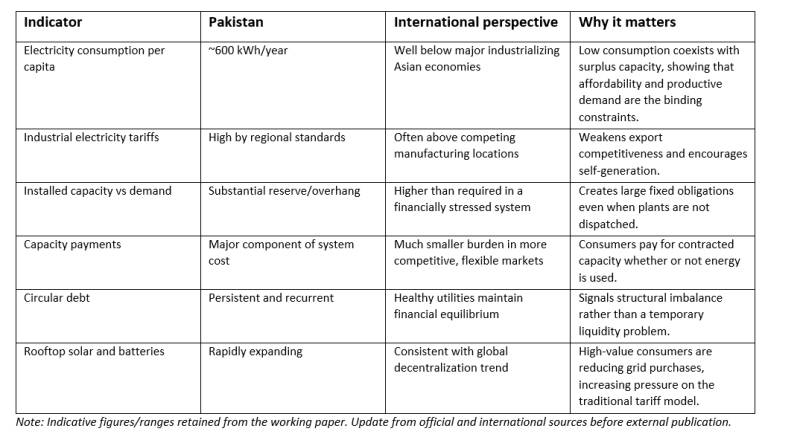
Low per-capita consumption should ordinarily imply enormous room for demand growth. Yet productive demand has been constrained because electricity has become too expensive. The result is a sector that has invested as though preparing for an industrial boom while simultaneously making grid electricity less attractive to the industries expected to drive that boom. The relevant measure is therefore not simply how many megawatts Pakistan has installed or how many units it generates. It is how effectively electricity is converted into GDP, exports, manufacturing, employment and productivity. On this broader measure, the sector performs poorly. A large share of revenue is absorbed by financing costs, capacity charges, losses, taxes, cross-subsidies and circular debt rather than translated into competitive energy for productive activity.
This weakness is compounded by the absence of a serious, economy-wide demand-side programme. Pakistan has spent decades focusing on supply: new power plants, fuel infrastructure, transmission projects and distribution investment. Much less policy attention has gone to industrial energy efficiency, building codes, appliance standards, demand response, smart metering, flexible industrial loads and conservation. A system with excess capacity may appear to have little need for conservation, but that misses the point. Efficiency reduces the cost of producing GDP and allows demand to shift away from expensive peaks. Demand response and efficiency are tools for improving system utilization, not merely reducing annual consumption.
The same applies to storage. Pakistan increasingly has periods when solar generation depresses daytime grid demand while evening peaks remain expensive. Batteries can shift energy across the day, provide frequency services, reduce curtailment and support local networks. Yet storage is still treated as a peripheral technology rather than foundational infrastructure. The State and multilateral development institutions should increasingly finance systems, platforms and flexibility rather than simply another round of generation projects.
The capacity overhang also requires a transparent strategy. Existing contracts cannot simply be wished away, and arbitrary renegotiation would damage investor confidence. But the Government can create a credible roadmap for competitive dispatch, retirement of uneconomic plants where contractually possible, refinancing or restructuring of selected obligations, better utilization of low-cost generation, and reduction of taxes and surcharges that make electricity artificially expensive. Industrial demand should be restored through genuinely competitive system costs, not temporary subsidies that shift the burden elsewhere.
Most importantly, generation planning must be integrated with demand, transmission, storage and distributed resources. Neelum-Jhelum and Dasu illustrate why project-by-project planning is no longer sufficient. Every large project should be evaluated not only on its standalone generation cost but on its full system value: when it produces, what transmission it requires, what capacity it displaces, what flexibility it contributes and whether expected demand will exist when it enters service.
No private owner of FESCO or IESCO can solve these problems alone. They are sovereign policy responsibilities. Privatization should therefore occur within a clear sector-reform programme rather than being used as a substitute for one.
Transparency Is What Makes Reform Durable
The sixth issue is political durability. Decisions on the structure of privatization, the assets included, the treatment of land, the future regulatory model and the allocation of commercial rights appear to be developing largely through advisers, ministries and confidential bidder processes. That may be administratively convenient, but major reforms designed behind closed doors rarely stand the test of time.
Pakistan has repeatedly experienced privatizations and long-term contracts that became politically contested after governments changed. Investigations followed, courts became involved, policies were reversed and investors faced uncertainty. The country paid for that uncertainty through higher risk premiums and weaker investment. The lesson is not to avoid reform; it is to build reforms that are sufficiently transparent and well reasoned that future governments have little incentive or justification to reopen them.
Transparency therefore protects investors as much as it protects taxpayers. A transaction that commands broad public legitimacy is more valuable than one permanently exposed to allegations that assets were undervalued or rights were transferred without scrutiny. The Government should want bidders to acquire assets whose legal and political foundations are strong enough to survive electoral cycles.
The solution is a comprehensive White Paper before final bids. It should identify the assets and liabilities included in each transaction; treatment and valuation of land; treatment of rights-of-way and strategic network assets; employee and pension obligations; customer-data governance; post-privatization tariff methodology; future role of NEPRA; roadmap for open access and competition; treatment of solar, batteries and distributed resources; rules governing future retail and energy-service businesses; and the State's plan for legacy liabilities and weaker DISCOs.
The White Paper should also explain why FESCO, IESCO and GEPCO are being sold first and compare the chosen structure with realistic alternatives. It should disclose the valuation methodology, even if bidder-specific valuations remain confidential. It should make clear how public value is being protected from the possibility that the real-estate, customer-franchise or future-platform value of the companies exceeds the value of their current regulated earnings.
Parliament should debate the framework. Provincial governments should be consulted where their interests are affected. Industry and consumer groups should have the opportunity to comment. Independent economists and energy experts should be able to test the assumptions. This is not an argument for endless consultation or paralysis. The Government can establish a defined, time-bound process. The objective is to expose the structure to scrutiny before it becomes irreversible.
The process should also contain safeguards against excessive concentration of economic power. The country should encourage broad and credible competition among strategic investors, infrastructure funds, institutional investors and qualified consortia rather than allowing the transaction to become another opportunity for a small circle of conglomerates to acquire protected franchises. Where necessary, cross-ownership rules and competition safeguards should be applied so that privatization expands markets rather than replacing public monopolies with private ones.
The broader reform agenda must be equally explicit. NEPRA should be strengthened as an independent economic regulator focused on consumer welfare, competition and performance. CTBCM should evolve into a genuine competitive market with meaningful open access. Distribution should progressively become a neutral platform for multiple suppliers and energy services. Smart metering, storage, demand response and digital infrastructure should be accelerated. Network tariffs should evolve so customers pay fairly for the grid services they use without creating incentives to abandon the network altogether.
A serious national conservation and efficiency programme should finally become part of electricity policy. Pakistan should adopt and enforce stronger appliance standards, building codes and industrial energy-management programmes. Time-of-use pricing should be expanded, and eventually more granular pricing should encourage demand to move toward periods of abundant low-cost electricity. These measures reduce the need for costly peak capacity and improve the conversion of electricity into economic output.
At the same time, industrial competitiveness must become an explicit objective. Electricity policy should be judged by whether it enables Pakistan to manufacture and export competitively, not simply by whether utilities recover their costs. A financially balanced power sector that prices industry out of global markets is not an economic success. The country needs tariffs that reflect efficient system costs, transparent network charges and market-based energy prices rather than accumulated inefficiencies shifted onto captive consumers.
Finally, the Government should publish a Future Grid roadmap extending at least twenty-five years. It should describe how centralized generation, distributed solar, batteries, electric vehicles, flexible industrial demand, artificial intelligence, data platforms and competitive retail markets will interact. Only then can the country properly value the distribution businesses being privatized today. The test of reform is not whether the Government completes a sale. It is whether the transaction leaves Pakistan with a sector that is more competitive, affordable, innovative and financially sustainable than before. That outcome requires clarity before privatization, not explanations after it.
Conclusion: Reform the System Before the Sale Defines It
Pakistan should not abandon privatization. The existing electricity-sector model has failed too comprehensively for ownership reform to be dismissed. Private capital, professional management and new technology can make an important contribution. But privatization must be placed in the correct sequence and within a much larger reform programme.
The country first needs to decide what kind of electricity market it is building. It needs a regulator capable of protecting consumers and encouraging competition. It needs a strategy for the overhang of capacity payments and circular debt. It needs to integrate large public projects such as Neelum-Jhelum and Dasu into system-wide planning rather than treating each project in isolation. It needs a demand-side strategy, a national storage strategy and a Future Grid architecture that recognizes the rapid migration of consumers toward solar, batteries and digital energy systems.
Only then can it determine the true value of FESCO, IESCO, GEPCO and the other distribution companies. Their value lies not only in today's cash flows but in land, customer relationships, network rights, data and the possibility that they become the principal platforms of tomorrow's energy economy. Those assets should not be transferred under terms that are known in detail only to a small circle of officials, advisers and bidders.
The Government therefore has a clear path available. Publish the transaction architecture. Publish the treatment of land and future commercial rights. Explain the regulatory model. Explain why the strongest companies are being sold first. Disclose how the State will deal with the weakest DISCOs and legacy generation liabilities. Set out the Future Grid strategy. Invite scrutiny before final bids, not after the contracts become irreversible.
If the analysis is strong, transparency will strengthen the transactions. If weaknesses are identified, correcting them before sale will protect both the public and investors. Either way, Pakistan gains. The choice is not between privatization and the status quo. The real choice is between privatization as a narrow asset sale and privatization as part of a comprehensive redesign of the electricity sector. The first may produce a transaction. The second could produce a transformation.
Pakistan has spent decades building generation, expanding networks and accumulating obligations. The next phase must be about making the system economically productive, digitally intelligent and competitive. Electricity is no longer merely a utility service; it is becoming the operating platform of the modern economy. The countries that prosper will be those that build the smartest, most flexible and most connected electricity systems. Pakistan still has the opportunity to do so. But first it must stop asking only who should own the grid and decide what kind of grid it wants to build.