

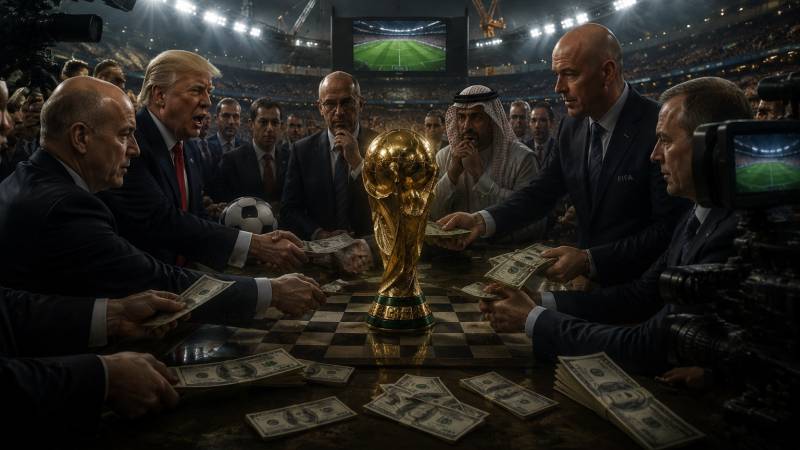
Around the globe, millions of fans have been gripped by football fever, with the World Cup bringing together the best footballers from across the world. Even before the first match, people were eagerly waiting to see the old guards of the game, Messi, Ronaldo, Neymar and Modric, claiming that this tournament would be their last dance. Similarly, Yamal was the name on everyone’s lips, with the Spanish teenage superstar hyped up as the one to watch. But amidst the high-voltage matches and silky dribbling, the World Cup is a reminder that the event is subject to capitalist ideas, with money becoming a major driving force.
Like most World Cups, this edition had a fair share of controversial decisions, leaving fans fuming. A common accusation that follows is that the refereeing department favours the “bigger” team at the expense of the “smaller” one. At an event where all teams are considered equals, the notion arises from stardom, financial pull and political power that the country may possess.
Over the last few decades, the financial landscape of football has been overhauled, transforming into a globally-followed industry with billions of dollars involved. This rapid increase in financial muscle is often attributed to some key revenue streams that are becoming more significant with each passing day. With the World Cup, FIFA is targeting a record revenue of $3.9 billion, banking on broadcasting and marketing rights coupled with ticketing revenue. These broadcasting rights not only provide financial security for the tournament but also create a global audience, enhancing the worldwide popularity of football, as evidenced by trends from previous World Cups.
For this year’s edition, FIFA had forecasted nearly 6 billion global engagements across TV, streaming and digital platforms for the entire tournament, raising the bar from the 5 billion during Qatar 2022. The previous final, where an inspired Mbappe stood against the Messi-led Argentina, with the latter lifting the trophy, attracted an estimated 1.5 billion viewers from over 200 countries. And with Messi anticipated to be the centre of attention for this year’s final, few were left puzzled when names like Justin Bieber, Madonna and Chris Martin became the talk of the town, putting football at the back of the mind.
With the World Cup, FIFA is targeting a record revenue of $3.9 billion, banking, on broadcasting and marketing rights coupled with ticketing revenue. If you have watched a football match, you know the half-time break is considered an opportunity to buy food and refresh yourself. However, this year, the half-time break had the football enthusiasts perplexed as it saw Ronaldo and Ronaldinho driving Madonna around in a car, Justin Bieber singing with a guitar and Shakira performing.
With the World Cup, FIFA is targeting a record revenue of $3.9 billion, banking, on broadcasting and marketing rights coupled with ticketing revenue.
The criticism towards the Super Bowl-inspired half-time show at the World Cup final was brutal, with England Legend, Wayne Rooney vocal about his disapproval. When asked about his favourite part of the show, he said, “I’m going to be honest, mine was when it finished.” Later, he echoed the sentiments shared by football fans, as he claimed, “I just want the football to come back on.” From the beginning, the infamous half-time show was subject to scrutiny as it clashed with a long-standing rule of football, as the additional performances meant the break lasted more than 25 minutes. Why is this an issue? Well, the International Football Association Board (IFAB) has declared 15 minutes as the maximum break players are entitled to.
In an era where commercial revenue remains a key pillar in the financial prospects of football, the accusation of favouring teams comes into the spotlight. While fans were complaining about the excessive ticket pricing at the World Cup, after the round of 16, ticket prices were significantly slashed ahead of the quarter-finals. The demand for major matches took a major hit, as one of the hosts, the USA, and the glamorous Portugal team found themselves eliminated. From a staggering $2950, the price dropped to around $1200, with most believing that this would not have happened if Pulisic and Ronaldo made it to the quarter-finals.
Aside from the financial aspect, the tournament had a fair share of controversy arising from political circumstances. Some weeks ago, the USA football team celebrated the historic milestone of qualifying for the Round of 16, but soon, President Trump found himself in the headlines. In an unexpected twist, after an appeal by President Trump, FIFA reversed their decision of a one-game ban on Folarin Balogun, declaring the striker eligible to play against Belgium. Trump added fuel to the fire by confirming that he called FIFA President Gianni Infantino for the review and later added, “Thank you to FIFA for doing what was right, and reversing a great injustice!”
After the initial red card, post-match, FIFA made it clear that the US team had no route to appeal the suspension and that Balogun would be unavailable to play against the Belgians. However, the reversal raised questions about Trump's relationship with the FIFA chief. The subsequent drama highlights how political interference has crept into the game, challenging the claims of neutrality. World Cups, historically, have had their fair share of controversies, but there is no known precedent for a political leader pressuring FIFA over refereeing decisions, let alone directly being involved to improve a team's chances of advancing.
To sum it up, this edition of the World Cup was packed with controversies that can be attributed to capitalist and political interests, raising clouds of doubt over the integrity of the tournament. As a passionate fan, these episodes stain the happiness of football, where each decision is looked upon with a sense of suspicion. With the next edition four years from now, there is a glimmer of hope that circumstances change for the better.