

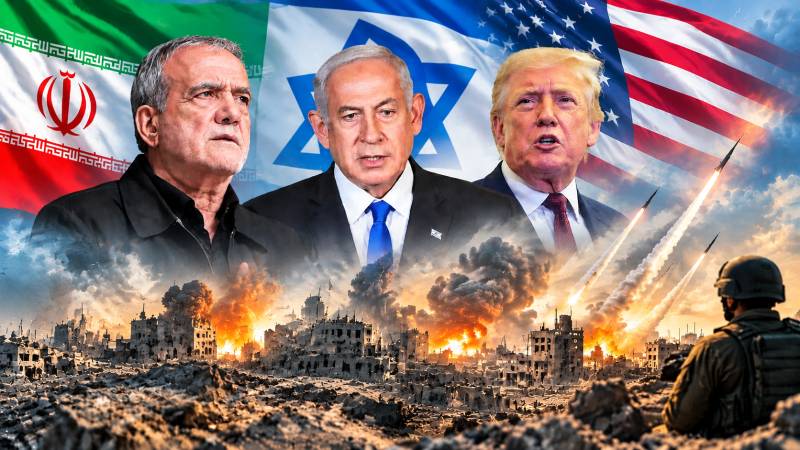
The latest US-Iran exchange and Benjamin Netanyahu's avowed shift from containment to persistent prevention make the 1996 strategy paper newly relevant not as a secret script for history, but as the genealogy of a security model that risks turning war into the arrangement itself
Arshad Zaman’s recent writ-up, A Clean Break: The 1996 American Blueprint for Israel to Lebanonize the Region, performs a useful service by returning attention to a document often mentioned but seldom actually read. His central evidence is genuine. A Clean Break: A New Strategy for Securing the Realm was prepared in 1996 by an American study group led by Richard Perle for the newly elected Israeli Prime Minister Benjamin Netanyahu. It recommended abandoning the prevailing “land for peace” approach in favour of balance-of-power politics, weakening Syria, removing Saddam Hussein from power in Iraq and restoring pre-emption as an instrument of Israeli strategy.
The document has acquired new relevance in September 2026. A month of relative military quiet between the United States and Iran has ended in another cycle of strikes and counter-strikes. US forces have attacked Iranian radar, missile and mine-deployment capabilities around the Strait of Hormuz; Iran has replied with missiles and drones against US positions, including in Jordan. President Donald Trump says the renewed campaign will not last long, while leaving open the prospect of further heavy strikes. The contradiction captures the central problem of a conflict in which every pause is treated as an interval for rebuilding and every rebuilt capability as a reason to attack again.
That problem is sharper because Netanyahu himself has publicly announced a change in Israel’s security doctrine. In June he said Israel now “initiate[s]”, attacks and surprises adversaries before they can act. In July, speaking in Dimona, he described a “new concept” in which defensive envelopes are pushed inside Gaza, Lebanon and Syria and defined the new path as one of “initiative, action, and attack, not containment”. This is an avowed shift from deterrence and retaliation towards forward defence and persistent prevention.
Arshad Zaman does not claim that every subsequent Middle Eastern war mechanically followed the 1996 paper. He notes that ‘A Clean Break’ was never formally adopted as Israeli government policy and calls it a “mindset more than a fixed template”. His stronger point concerns continuity of personnel: Perle, Douglas Feith and David Wurmser later entered influential American policymaking circles associated with the Iraq War.
There is scholarly support for examining that continuity. Carnegie noted in 2003 that the three had advocated Iraqi regime change before assuming positions of influence in Washington. Brian Schmidt and Michael Williams examined the connection between neoconservative ideas, the Bush Doctrine and the Iraq War; Muhammad Idrees Ahmad’s study likewise gives neoconservative networks an important role after 9/11. This evidence matters, but it cannot bear more weight than it supports.
Calling ‘A Clean Break’ an “American blueprint” requires qualification. It was written by Americans, not by the United States government. The Iraq War had a broader genealogy. Saddam Hussein’s removal formally became US policy through the bipartisan Iraq Liberation Act of 1998.
September 11 transformed American perceptions of vulnerability; the 2002 National Security Strategy enlarged anticipatory self-defence. Intelligence failures, exaggerated claims about weapons of mass destruction, unipolar power and ideological confidence in regime transformation also contributed. Dov Waxman, among others, accepts neoconservative influence while rejecting the claim that the war was principally undertaken for Israel.
The defensible position lies between denial and conspiracy: ‘A Clean Break’ belongs to the intellectual genealogy of interventionist thinking, but history is not reducible to one memorandum. The more important question is why its reasoning has proved so durable.
The defensible position lies between denial and conspiracy: ‘A Clean Break’ belongs to the intellectual genealogy of interventionist thinking, but history is not reducible to one memorandum. The more important question is why its reasoning has proved so durable.
The 1996 document replaced comprehensive peace with balance-of-power politics, territorial compromise with strategic initiative and reconciliation with “peace through strength”. It proposed strikes on Syrian targets and “hot pursuit” into Palestinian-controlled areas. The language of 2026 travels further. Netanyahu’s doctrine treats the reconstitution of hostile capability itself as a danger to be prevented before it matures. This can produce tactical superiority. It can also abolish the distinction between war and peace.
That warning does not come only from Israel’s critics. The Institute for National Security Studies has cautioned that a conception of “absolute security”, in which every emerging threat must be eliminated early, drives Israel towards continuous war and repeated strikes without an exit mechanism.
Chatham House describes Netanyahu’s “Super-Sparta” vision as an attempt to institutionalise permanent low- or medium-intensity warfare. Carnegie’s Nathan Brown describes an emerging approach of dominance without settlement and war not as a bridge to a political arrangement but as the arrangement itself.
Israel’s security concerns, arising mainly out of its own destructive policies, cannot be endorsed, but at the same time does not deserve mere dismissal. No society should be expected to live with terrorism, missiles or threats of destruction. Iran has armed regional proxies, threatened shipping and US forces, and used missiles and drones in ways that deepen insecurity. Syria under the Assad dynasty was profoundly repressive; Saddam Hussein was a brutal dictator. Acknowledging these realities does not establish the opposite proposition: that weakening neighbouring societies indefinitely produces lasting security.
Iraq remains the most powerful test. Saddam was removed within weeks, but state institutions collapsed, sectarian conflict exploded, extremist organisations found space to grow and Iranian influence increased.
Destroying power is easier than constructing legitimate authority. Syria tells a related story. Its catastrophe arose from dictatorship, revolt, repression, jihadist mobilisation and interventions by several regional and global powers. The outcome nevertheless exposes the flaw in imagining fractured neighbours as strategically convenient. Failed states export refugees, weapons, militancy, criminal networks and insecurity.
The renewed US-Iran fighting illustrates the same security dilemma in real time. Washington attacks capabilities it says Tehran is rebuilding; Tehran retaliates and threatens the maritime artery on which much of the world’s energy trade depends; retaliation becomes justification for another strike. Each side can describe its next act as defensive because the preceding act was hostile. When security means preventing an adversary from ever regaining threatening capacity, military action has no natural stopping point.
There is also a political-economy dimension. ‘A Clean Break’ linked military strength with economic restructuring. Three decades later the larger question is the economics of permanent mobilisation. Who bears the fiscal cost of repeated campaigns, enlarged defence industries, reconstruction and disrupted trade? What happens when public resources and scientific capacity move towards weapons while housing, education, health and ecological protection deteriorate? Hormuz has shown how quickly a security doctrine can become a global inflation, shipping and development problem.
Security is ultimately a human condition, not a military balance sheet. An older ethical wisdom, stated in universal rather than sectarian terms, offers another starting point. Human life has equal worth. Justice cannot vary with the identity of the victim. Collective guilt is indefensible. Agreements should be honoured. Power requires restraint most when retaliation is possible. Decisions involving life and war demand consultation. Wealth carries social obligations, and accumulation cannot be called successful when large populations are denied the conditions necessary for human development. These principles belong to humanity, not to one religion or civilisation.
Applied to the Middle East, they require reciprocity. Israel is entitled to protection from violence directed at its people. Palestinians are entitled to political freedom, dignity and viable statehood. Iran is entitled to security against externally imposed regime change while accepting verifiable restraints on activities that threaten neighbours. Arab states should not be reduced to battlefields for competing powers. Nuclear risks require rules applied consistently rather than selectively. No people acquire durable security through the permanent humiliation of another.
Peace is also an economic institution. Societies with functioning government, opportunity and political participation are harder for extremists to capture. A region connected through trade, energy, water management, infrastructure, science and human mobility acquires interests in stability that missiles cannot create. Deterrence remains necessary in an imperfect world, but deterrence without a political horizon becomes management of recurring war.
The lasting value of Arshad Zaman’s article lies less in proving that a 1996 blueprint was executed line by line than in reminding us that ideas have consequences. Strategic doctrines migrate from think tanks into governments. Personnel carry assumptions with them.
Crises create openings for ideas previously considered too radical. The danger begins when a doctrine becomes immune to evidence: if every hostile reaction proves that greater coercion was necessary, policy can never fail because its failures merely justify more of the same.
Three decades after ‘A Clean Break’, the issue is no longer whether somebody possessed a master plan. The urgent question is whether a doctrine of permanent prevention can produce a peace worth having. The latest US-Iran exchange suggests the opposite. Peace through domination keeps manufacturing the insecurity it promises to eliminate. The clean break humanity needs is from that idea itself.