

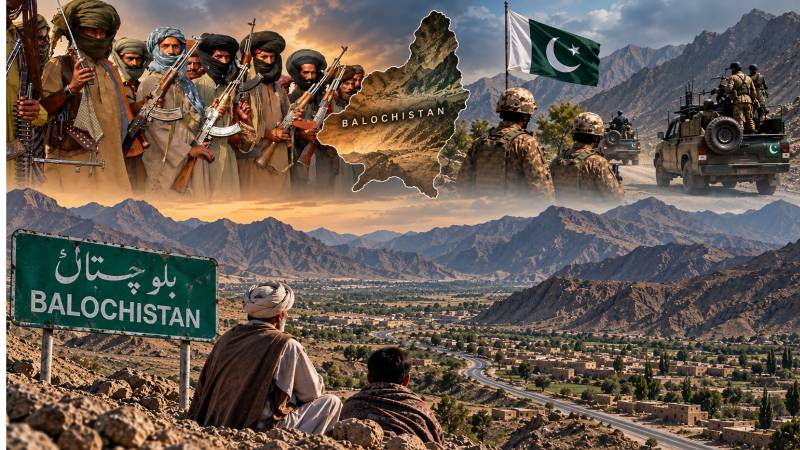
Game theory begins with a simple insight that people do not make decisions in isolation. They make them while anticipating what others will do. A government deciding whether to negotiate considers whether an insurgent group will exploit concessions. An insurgent group considering disarmament asks whether the state will honour its commitments once weapons are surrendered. A political leader deciding whether to compromise worries that rivals will interpret compromise as weakness. Each player therefore chooses a strategy not merely according to what it wants, but according to what it expects others to do.
This may make game theory particularly useful for understanding Balochistan. The conflict is not simply the result of insufficient development, security failures, separatism, resource disputes or political grievances. It has also become a repeated strategic game built around distrust. After successive confrontations since 1948, neither the state nor many Baluch actors believe that unilateral accommodation will necessarily be reciprocated. Islamabad fears that greater concessions could encourage separatism or be used by militant groups to regroup. Baloch nationalists and communities, meanwhile, may fear that restraint, participation or disarmament will merely restore the state’s bargaining advantage without addressing underlying grievances.
That distrust has deep historical roots. The roots of the Balochistan problem go back not to the 1970s but to the earliest years of Pakistan. In 1948, the accession of Kalat was opposed by Prince Abdul Karim, brother of the Khan of Kalat, triggering the first armed Baloch rebellion and establishing an early dispute over autonomy, political representation and relations with the centre. Further insurgencies in 1958–59 and the 1960s deepened these grievances, particularly under the highly centralized One Unit system. The dismissal of Balochistan’s elected provincial government in 1973 led to the major 1973–77 insurgency, while a new phase emerged in the early 2000s and intensified after the killing of Nawab Akbar Bugti in 2006. By 2026, the conflict had become more sophisticated and violent, with separatist groups mounting increasingly coordinated attacks and the state responding through extensive security operations. This history is central to the strategic dilemma: every broken compact, rebellion and security operation has shaped what each side expects the other to do next.
The resulting equilibrium resembles the classic prisoner’s dilemma. Both sides could be better off through cooperation, but neither trusts the other sufficiently to move first. The rational defensive response becomes continued coercion, resistance or hedging. Individually rational behaviour then generates collectively irrational outcomes in terms of recurring violence, underdevelopment, alienation and insecurity. The challenge is therefore not merely to persuade the parties to trust each other. After almost eight decades of conflict, that is unrealistic. The challenge is to change the rules and payoffs of the game so that cooperation becomes rational even in the absence of trust. That requires several changes.
The first is to move the relationship away from a zero sum game. Much of the Balochistan dispute has been framed, explicitly or implicitly, as a contest over control. Greater provincial autonomy can be perceived by the centre as diminished state authority, while stronger federal control can be perceived locally as a loss of political autonomy. Resource extraction may be viewed nationally as development but locally as exploitation if communities surrounding those resources see few direct benefits.
This is precisely the type of game that needs to be converted into a positive sum arrangement. Natural resources provide an obvious example. Rather than repeatedly renegotiating who should benefit from gas, minerals, ports or future resource projects, Pakistan could establish transparent and constitutionally protected revenue-sharing formulas allocating benefits among the federation, the province, the producing district and perhaps a future generations fund. The percentages would require negotiation, however, the principle is more important.
The state fears that concessions will weaken its authority or encourage further demands. Local actors fear that cooperation without guarantees will leave them exposed to repression or abandonment.
A resident living close to a major project should be able to see a direct relationship between the wealth generated beneath or around his community and the quality of local schools, healthcare, water, infrastructure and employment. When local communities can gain directly from development, cooperation acquires a measurable economic payoff. When they cannot, resistance can remain rational.
The second challenge is what game theorists call the commitment problem. Even if the federal government promises political accommodation, development spending or greater local authority, why should distrustful actors believe those promises will survive a change of government or security leadership. Conversely, if an armed group announces a ceasefire, why should the state assume that the pause will not simply allow militants to regroup? The answer is not a single grand bargain. It is incremental, reciprocal and verifiable cooperation.
Instead of asking one party to make irreversible concessions first, the process should proceed through carefully sequenced exchanges. The state might review specified cases of non-violent political detainees while participating groups observe a geographically defined ceasefire. A transparent resource sharing mechanism could be implemented while attacks on economic infrastructure cease in designated areas. Rehabilitation or amnesty arrangements for legally eligible combatants could proceed alongside independently verified demobilization. Each stage would occur only after agreed obligations from the previous stage had been substantially met. Neither side would therefore need blind faith in the other. Trust would gradually emerge from behaviour. In other words, verification should substitute for trust until trust has had time to develop.
The third requirement is to recognize that Balochistan is not a two player game. There is no single “Baloch side”, just as there is no single Pakistani state actor. Constitutional nationalist parties, tribal leaders, civil society, younger activists, affected families, business groups and several armed organizations have different objectives. Balochistan itself contains significant ethnic and regional diversity. On the other side, the federal government, provincial government, military, bureaucracy, political parties and economic institutions also possess distinct incentives.
The correct framework is therefore a multi-player negotiation, with several interconnected tracks rather than one all encompassing conference. One track should address constitutional and political questions. Another should deal with security and reconciliation. A third should address natural resources, development and fiscal arrangements. A fourth should deal specifically with disappearances, detention, justice and human rights. These tracks would ultimately feed into one settlement, but separating them makes it harder for failure on one issue to destroy progress everywhere else.
A fourth lesson from game theory concerns spoilers. Peace processes frequently fail because actors who benefit from continued confrontation can provoke actions designed to destroy negotiations. A militant organization may attack precisely when dialogue begins, knowing that an indiscriminate security response could recreate anger and demonstrate that accommodation is impossible. Conversely, security hardliners can cite any renewed attack as proof that political engagement is futile. A successful strategy therefore has to reward moderates more heavily than extremists.
Baloch political actors who renounce violence must have meaningful political space and the ability to deliver tangible outcomes for their constituents. Communities that cooperate with constitutional politics should see improvements in services and economic opportunity. Individuals willing to leave militant organizations should, where legally and ethically appropriate, have credible reintegration pathways. At the same time, political accommodation cannot mean tolerance of attacks on civilians. The governing principle should be clear that political dissent, including radical constitutional demands expressed peacefully, belongs inside politics. Whereas, terrorism and violence against civilians do not. This distinction is essential because suppressing peaceful dissent can unintentionally strengthen the argument of those who claim that violence is the only effective form of opposition.
The fifth element is credible verification. Promises that cannot be measured are easily disputed. Pakistan could therefore establish an independent Balochistan Reconciliation and Compact Commission comprising mutually credible retired judges, constitutional experts, provincial representatives, federal nominees and respected members of civil society. Its role would not be to exercise executive authority or internationalize the issue. It would simply publish whether agreed commitments had been implemented. If a development allocation was promised, how much was actually transferred? If cases involving detention or disappearances were to be reviewed, how many were completed? If local employment targets were agreed for major projects, what proportion was achieved? If ceasefires were declared, which party violated them and how often? Once behaviour becomes observable, defection becomes more costly.
A sixth game theory principle is the importance of the shadow of the future. Cooperation becomes more likely when players value future gains more highly than immediate victories. This principle has profound implications for Balochistan’s development strategy. If a young person sees little possibility of good education, employment, political influence or social mobility, the opportunity cost of instability may be relatively low. But if that same person can credibly expect access to better schools, university scholarships, technical training, jobs connected with local industries, entrepreneurship finance, functioning local government and modern infrastructure, the calculation changes.
The challenge is therefore not merely to persuade the parties to trust each other. After almost eight decades of conflict, that is unrealistic. The challenge is to change the rules and payoffs of the game so that cooperation becomes rational even in the absence of trust.
This is why investments already directed toward education and water security in Balochistan matter, but isolated projects are insufficient. In 2025, for example, the World Bank approved $194 million for education and water projects in the province, including programs aimed at improving schooling and water resilience. Such investments become strategically powerful only when communities perceive them as part of a durable political and economic settlement rather than periodic development packages.
The seventh principle is reciprocity with forgiveness. Repeated game experiments have shown why strategies resembling “tit-for-tat” can sustain cooperation where you begin cooperatively, reciprocate cooperation, respond to defection, but leave open the possibility of returning to cooperation. The purpose is to create a system in which both sides know that cooperation will be rewarded, violations will carry consequences, but the door to renewed cooperation will remain open. Applied to Balochistan, this means avoiding both unconditional concessions and permanent retaliation. Cooperation should produce reciprocal cooperation, violations should produce proportionate and legally bounded responses and renewed compliance should allow the process to resume. Otherwise, one violent incident can give spoilers permanent veto power over peace.
All of this should ultimately culminate in a long term Balochistan Compact, perhaps spanning twenty years and embedded in constitutional, parliamentary and fiscal institutions rather than depending upon whichever government happens to hold office. Such a compact could contain five broad bargains. Politically, it would strengthen genuine provincial and local authority, credible electoral participation and constitutional representation. Economically, it would establish transparent resource sharing, major human capital investment, infrastructure and meaningful local employment. On security, declining violence would permit progressive normalization while the state retained its legitimate responsibility to protect citizens. On justice, credible institutions would address allegations of disappearances, unlawful detention and abuses. On reconciliation, eligible individuals willing to abandon violence would have pathways back into lawful political and economic life.
The current equilibrium is self-reinforcing: state distrust produces coercion; coercion deepens local distrust; distrust encourages resistance; and resistance generates further coercion. Each round validates the fears behind the last. A better equilibrium would allow credible concessions to produce restraint, tangible political and economic dividends, greater confidence and, ultimately, a return to constitutional politics. Not every separatist actor will reconcile, and Pakistan must protect civilians. Parliament condemned major terrorist violence in Balochistan in February 2026. An effective strategy must isolate irreconcilable violence while depriving it of the grievances, exclusion and mistrust from which insurgencies draw strength.
Game theory cannot solve Balochistan’s quagmire by itself. It does, however, change the way the problem is understood. Instead of asking only which side is historically right or which side must surrender first, it asks a more practical question. What institutional arrangements would make continued cooperation more rewarding than continued conflict? The real objective is therefore to construct a system in which even deeply distrustful actors discover that keeping an agreement serves their interests better than breaking it. If Pakistan can achieve that, Balochistan can gradually cease to be a security dilemma and become what it should always have been, a political question negotiated within a functioning federation.