

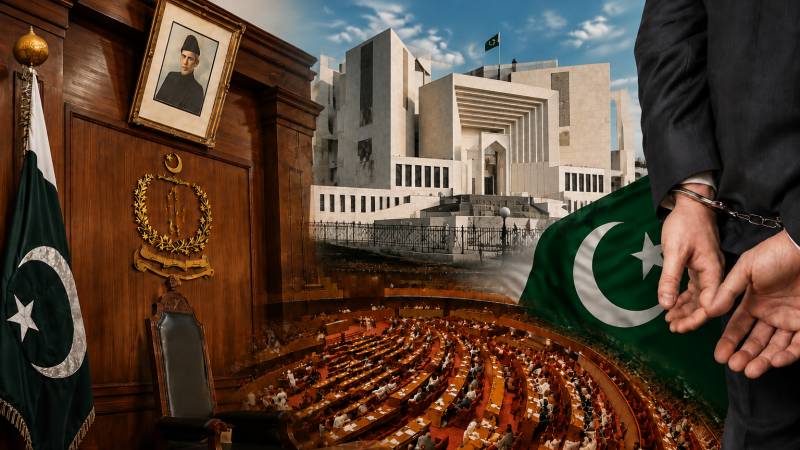
Pakistan holds elections. It has a constitution, a parliament and a press that argues loudly on television every night. By every formal measure, it is a democracy. Yet nearly eight decades after independence, the state remains shattered, badly governed and chronically unstable. This is not an argument that democracy is a bad idea. It is an argument that Pakistan, as it stands today, is not ready for it. Before a country can run a democracy effectively, it needs politically literate citizens, strong institutions and a competent professional administration insulated from the whims of whoever wins the next election. Pakistan currently has none of these in sufficient measure. Its own history shows what happens when democracy arrives before a state is ready to carry it.
The first problem is the citizen. The Pakistani state reports respectable literacy figures, but official literacy simply means that a person can read a sentence and sign their name. It says nothing about whether that person can judge a party manifesto, understand why the rupee is losing value or weigh the true cost of a populist promise against its likely delivery. Sociologist Seymour Martin Lipset argued that stable democracy tends to follow economic development and mass education rather than precede it because effective voting requires a basic level of political literacy. Poverty and undereducation make that difficult to build. Pakistan has not reached this baseline. Elections are still frequently shaped by biradari loyalty, patronage networks and personality rather than by any serious evaluation of governing competence. This is precisely the kind of outcome Lipset's theory would predict.
This leads to a deeper problem in the gap between popularity and competence. Plato compared the state to a ship that needs a trained navigator rather than the sailor the crew happens to like most. The same logic applies to politics. A charismatic leader can win a landslide by promising immediate relief from inflation or humiliation at the hands of rivals without possessing a realistic plan to deliver either. Classical elite theorists such as Gaetano Mosca and Vilfredo Pareto made a similar argument in another form. They believed that every political system, democratic or authoritarian, is ultimately run by a small elite. The real question is whether that elite rises through competence or through its ability to win crowds. In a weakly institutionalised democracy, the second kind of elite is often more likely to succeed. Popularity can therefore become a substitute for ability.
The clearest theoretical support for this argument comes from Samuel Huntington's 1968 classic, Political Order in Changing Societies. Huntington argued that political stability depends on the balance between two speeds. One is how quickly people demand political participation and the other is how quickly state institutions can absorb that demand. When participation grows faster than institutions can adapt, the result is not stable democracy but disorder. Huntington described such a system as a praetorian state in which the army, the street and the courts compete for political power because no institution is strong enough to act as the final arbiter. He pointed to Ayub Khan's Pakistan as an example of a modernising regime that sought to build administrative capacity before widening political participation. The logic was simple. Order had to come before ballots could produce stable government.
Before a country can run a democracy effectively, it needs politically literate citizens, strong institutions and a competent professional administration insulated from the whims of whoever wins the next election.
Pakistan's own history provides a strong example of this approach. Ayub Khan seized power in October 1958 and built his government around the Civil Service of Pakistan(CSP). The CSP consisted of trained and examination-selected administrators descended from the old Indian Civil Service. It came close to what the German sociologist Max Weber described as rational legal bureaucracy. Officials were selected on merit, protected from excessive political pressure and judged primarily on competence rather than loyalty. The CSP staffed roughly sixty percent of the country's key federal and provincial posts. Under this arrangement, Pakistan's economy grew at close to 6.8 percent a year through the 1960s. Investment increased, inflation remained near 3 percent and industrial output expanded by close to nine percent annually. At the same time, the Green Revolution, driven by new seed varieties and tubewell irrigation, brought millions of farmers into the cash economy. Pakistan's Second Five Year Plan was also studied closely by other developing states seeking to replicate its model, including South Korea. Whatever the wider flaws of Ayub's system, the period demonstrated the importance of administrative capacity and long-term planning.
The problem emerged when political control began to weaken that administrative structure. Zulfikar Ali Bhutto came to power in December 1971 on a wave of genuine and hard-won popular support. He embodied what political theorist Jan Werner Müller describes as populism's central claim that the leader speaks for the people against a corrupt old order. Whatever the merits of that claim, Bhutto's treatment of the civil service moved in the opposite direction from Ayub's model. Within months of taking office, his government compulsorily retired around 1,300 senior civil servants. His 1973 administrative reforms then abolished the CSP, removed constitutional tenure protections that had shielded civil servants from political interference and introduced lateral entry. This allowed officials to reach senior posts through interviews rather than competitive examinations. In practice, the system became a channel for appointing party loyalists rather than the fresh technical talent it had promised. Even Zia ul Haq's military government, despite having no political sympathy for Bhutto, later reinstated several dismissed CSP officers. This illustrated the damage caused when professional institutions are exposed too quickly to political pressure. It was precisely the institutional weakness Huntington had warned about.
Pakistan was not the only country to experience this pattern. South Korea under Park Chung Hee, Taiwan under successive Kuomintang governments beginning with Chiang Kai Shek and Singapore under Lee Kuan Yew all industrialised rapidly under firm authoritarian rule combined with highly capable and insulated bureaucracies. Scholars of the developmental state, particularly Chalmers Johnson, have argued that this combination of political control and technocratic competence allowed these states to pursue long-term strategies without being constantly disrupted by short-term electoral pressures. None of these countries became genuinely democratic at the beginning of their development. Political institutions and middle classes matured first and political liberalisation came later. Pakistan's own most productive decade followed a similar pattern until its administrative machinery began to be weakened. The comparison suggests that institutional capacity can matter more than electoral competition during the early stages of state development.
None of this means that Pakistan should abandon democracy forever. It means that Pakistan tried to run before it had learned to walk. Across the theories discussed above, the same sequence appears repeatedly. Build state capacity first and widen political competition after. Pakistan therefore needs a period of firm and competent governance built around a depoliticised and professional civil service. It also needs serious investment in education and civic literacy so that citizens can understand policies, evaluate political promises and hold governments accountable. Democracy cannot function effectively when institutions are too weak to withstand political pressure and citizens are not equipped to judge political choices. Order is not democracy's opposite. In Pakistan's case, it may be the only road that can lead to a democracy strong enough to survive.