

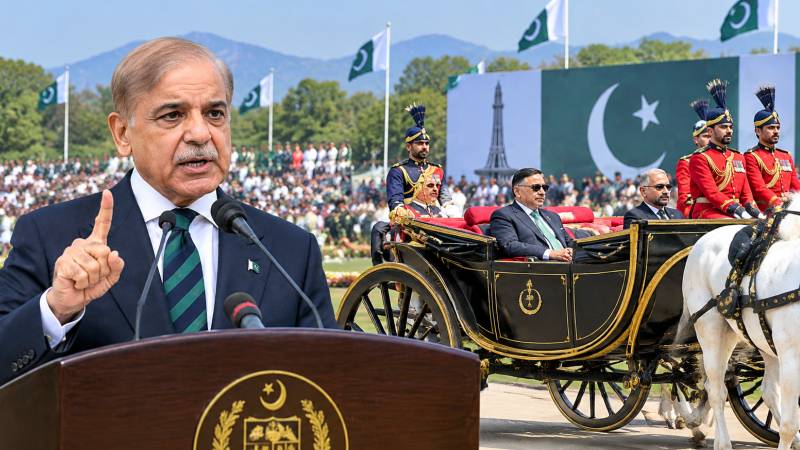
Our prime minister Shahbaz Sharif was right to admonish two senior bureaucrats for their display of pomp, pageantry and self-aggrandisement during the Independence day parade in Islamabad on August 14.The incident raises a question far more important than the conduct of two individuals: whom were these senior public servants trying to impress? While ordinary citizens stood for hours under a scorching summer sun, made to applaud a spectacle of personal grandeur, with senior bureaucrats riding in a presidential horse-drawn carriage reserved for the country's highest public office. It was a colonial-era mindset on full display, at a moment when the country is caught in an economic meltdown, when inflation and fuel prices are crushing households, and when public frustration is at a boiling point.
There was no need, and no justification, for this extravagance. They were under no compulsion to accept such a ride.They could- and in the spirit of public service, should have declined this exhibition of privilege and authority. But it seems our bureaucrats find it hard to resist the taste of power, privilege and authority once it is offered to them. A mere warning, therefore, hardly seems sufficient. Had such conduct displayed by the officers at a lower rung of bureaucracy, exemplary punishment would have followed swiftly. Senior officers, however, remain conveniently insulated from accountability; a pattern that repeats itself far too often in this country.
It is telling that Interior Minister Mohsin Naqvi chose to defend the display rather than address the public's legitimate concerns. Citizens have every right to know how their money and resources are being used, and a vague explanation does nothing to answer that outcry. This is the quiet transformation that plays out again and again: officers in junior positions appear humble, attentive, and approachable. Once elevated to senior offices, many forget that their power flows from the people they are meant to serve; the very people who sustain their salaries and privileges. Ordinary citizens, in turn, rarely receive a smile or a patient hearing.
What the country needs is genuine change, not cosmetic gestures designed to win cheap popularity.
I recall a painful personal experience that illustrates this disconnect. A few years ago, I visited the SSP Shikarpur to seek redress for a public grievance. I waited nearly two and a half hours. He was not in any official meeting, the privileged and well-connected moved through his office with ease, while I sat outside. When I was finally allowed in, he did not even glance at my application. He tossed the petition aside without appending a single remark. I left with the distinct feeling that it was my time, not his that had been wasted, even though his salary comes from the taxes I pay. This is the treatment reserved for the common citizens, while the influential persons are met with deference and patient ears from the same officials who claim to serve the public. Such experiences reinforce the disturbing perception that public offices are accessible to those who command influence, rather than to those whose taxes sustain the state. That is why the debate over pomp and show must not become another political gimmick designed merely to win public applause.
Talk of austerity from the top is not worth much unless it is genuinely practised. If humility, restraint, and a rejection of ostentation truly took hold in the highest offices, the effect would ripple downward and reshape the culture of public service at every level. The people are the ultimate masters of this land and its resources. They should sit at the top of every priority list not be made to run from pillar to post for even the smallest of services, while officials and representatives hide behind heavy security, speaking of the public while remaining inaccessible to them.
Europe and several Asian nations became economic powerhouses through growth, export expansion, technological innovation, accountability, and strong institutions. They invested in their people rather than burdening them. Pakistan, by contrast, carries trillions of rupees in foreign and domestic debts with little to show for it in the daily lives of ordinary citizens, who remain weighed down by that burden. Nations do not rise through pageantry and hollow displays of state power, they rise through disciplined, accountable governance rooted in simplicity and genuine public service. Many European leaders live modestly, without grandeur or heavy security, reflecting real respect for public trust. China, Japan, South Korea, Singapore, and Taiwan stand as economic anchors in Asia because of sound planning, close engagement with their citizens, and the discipline of their leadership and bureaucracy. Even Vietnam, rebuilding from the devastation of war and blood, now significantly outperforms Pakistan with one of the fastest-growing economies in the world.
Pakistan's leadership culture, in sharp contrast, remains entangled in privilege and distance from the people it serves. Lavish lifestyles funded by public money, sprawling motorcades that disrupt daily life, and layers of security that isolate rulers from the ruled all point to a troubling disconnect. Political cycles too often turn on vendetta rather than vision, with each side pursuing the opponents it once escaped, a cycle of retribution that serves no one and must come to an end if the country is to achieve real stability and progress. Suspicion and revenge will not carry Pakistan towards the standard set by its Asian peers.
What the country needs is genuine change, not cosmetic gestures designed to win cheap popularity. Real change begins with sacrifice at the top. Only when the leadership and bureaucracy that shape public policy feel the same pains as the people they govern will meaningful improvement follow.
The moment demands a fundamental shift in priorities: swift, efficient, and dignified public service delivery, with citizens placed at the very centre of decision-making. Both political leadership and the bureaucracy must internalise a simple truth, their power and privilege come from the people, and they are duty-bound to serve every citizen without distinction of class or status. Bureaucratic reform, shaped with genuine public participation, is essential to instil this understanding: that officials exist to serve the people and resolve their grievances, not to act as instruments of the ruling elite.
This is the unbreakable bond that politicians and bureaucrats alike must commit to rebuilding, one that trades pomp for presence, and authority for accountability. It means sitting with the people's pains, not above them; measuring success by service and delivery, not by ceremony; and remembering, always, that they are the servants of those who sustain them, not their masters. Only then can there be real progress for the common citizen; the true maker of this country and rightful master of its land and resources.