

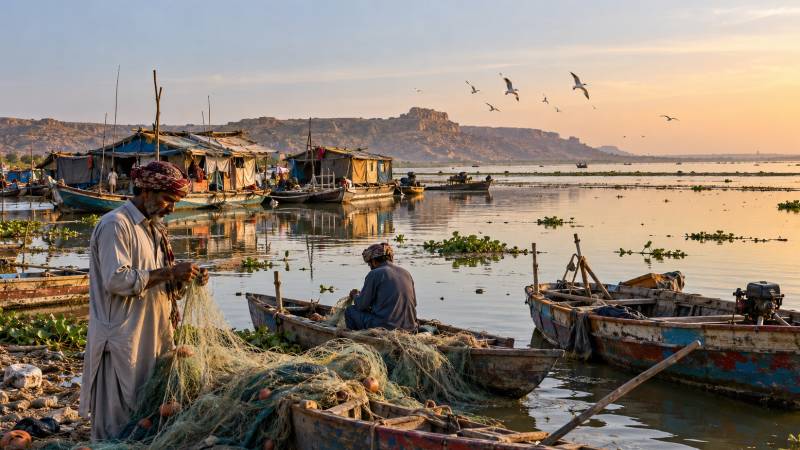
Manchar Lake, near Sehwan Sharif and spanning parts of Dadu and Jamshoro districts, is Pakistan’s largest natural freshwater lake. Its area changes with the seasons, from about 36 square kilometres to nearly 500 square kilometres during periods of heavy monsoon rainfall. For centuries, the lake has provided food, transport and livelihoods for the Mohana and other fishing communities who live on or around its waters. Today, however, this historic wetland faces a serious environmental crisis. Reduced freshwater inflows, saline drainage, pollution and falling fish stocks are damaging the ecosystem and making life increasingly difficult for local residents.
Manchar lake lies between the Indus River and the Kirthar mountain range. It receives water through natural and artificial channels. Run-off from the Kirthar hills, particularly the Gaj Nai, has historically supplied freshwater, while channels including the Aral Wah have connected the lake with the Indus system. The lake’s history is also linked to an old course of the Indus. The area around Manchar lake is archaeologically significant. Ancient settlements and sites, including Ghazi Shah, Wahi Pandhi and Ali Murad Mound, reflect the region’s long human history. In 1921, the lake was connected to Hamal Lake through the Main Nara Valley Drain (MNVD), a development that later became an important part of its environmental history.
Historical records indicate that more than 200 fish species were present during the 20th century. The lake also provided a habitat for aquatic plants and resident and migratory birds. Its traditional boats and floating homes and boat schools became distinctive features of Sindh’s cultural landscape. The lake’s decline accelerated as the natural flow of freshwater was disrupted. Irrigation development diverted water that would previously have reached Manchar, while agricultural drainage carried salts and other pollutants into the wetland. The MNVD became a major concern because it carries drainage water containing salts and pollutants. As freshwater inflows from the Indus and seasonal hill torrents declined, the lake’s ability to dilute these contaminants was reduced. The result has been severe deterioration in water quality and a loss of biodiversity.
Saving the lake means protecting its fish and birds, restoring its wetland environment and safeguarding the history, dignity and livelihoods of the people who have called its waters home.
A World Bank assessment described Manchar as having deteriorated so severely that it was considered a “dead lake”. The same assessment recorded a steep fall in annual fish production: from about 3,000 tonnes in 1950 to 300 tonnes in 1994 and less than 100 tonnes in more recent estimates. For generations, fishing was the main source of income for Manchar’s Mohana communities. Fish provided food and earnings, while boats served as homes, workplaces, Schools and a means of transport. As fish stocks declined, this traditional economy began to collapse.
According to the World Bank, only about 4,000 to 5,000 people remained living on the lake, compared with around 20,000 in the 1980s. Many families have moved elsewhere, including to Balochistan, because fishing can no longer support them. A 2021 study of 300 fishers found that environmental degradation had forced many to leave their traditional occupation. Many remained economically vulnerable after changing jobs some would be willing to return to fishing if the lake were restored and could once again support a sustainable livelihood.
The decline is also reflected in the types of fish still being caught. Several commercially valuable species have disappeared, and some fishers increasingly rely on low-value species such as dhayya, which may be sold for poultry or animal feed. Manchar’s crisis is therefore not just the loss of an industry; it is the erosion of a way of life. Reports in June 2026 indicated that Manchar was drying rapidly, exposing large areas of its bed. Falling water levels affected fishing, agriculture and tourism, while nearby communities faced difficulties obtaining water for drinking and irrigation. One report estimated that more than 30,000 people in nearby settlements were experiencing water-related problems.
The challenge, however, is not only the quantity of water but also its quality. Reports in October 2026 said the lake’s level had risen to around 112 feet Reduced Level (RL) after additional water entered from the Indus system. Yet the improvement in water quantity did not bring a comparable improvement in quality. Total dissolved solids (TDS), an indicator of dissolved substances and salinity, reportedly remained around 4,000, down from about 6,000 after the freshwater inflow. The same reporting said the lake was receiving around 2,000 cusecs of water daily through the MNVD, which carries saline and polluted drainage. As flows from the Indus declined, the lake became increasingly dependent on this source. The situation highlights a central problem: a lake can contain more water and still remain seriously polluted. Environmental degradation has become a daily economic struggle for families living around Manchar. The World Bank reported that incomes in fishing communities had fallen by about 40 per cent. At the same time, household expenses rose as families had to buy clean drinking water and cope with illnesses associated with contaminated water.
Recent reporting from the area said some residents were paying around Rs30 per jerrycan for tanker-supplied drinking water. Some fishermen now travel to coastal areas or elsewhere in search of fish because the lake no longer provides enough income. Pollution and water shortages also threaten farming around the lake, while the decline in environmental quality damages tourism and the area’s cultural landscape. Environmentalists have warned that about 300,000 acres of agricultural land in the wider area may be affected. Perhaps the most visible symbol of this change is the decline of the lake’s traditional boat culture. A community that once lived on the water is increasingly being forced to settle on dry land.
Manchar lake can still recover, but it must be treated as a living ecosystem, not merely as a water-storage reservoir. The Pakistan Council of Research in Water Resources (PCRWR) has identified reduced inflows, wastewater disposal and increasing eutrophication—the excessive growth of algae and aquatic plants caused by nutrient enrichment as major factors behind the lake’s decline. Sindh Irrigation Department has allocated an environmental flow of about 275 cusecs to help maintain the lake’s ecological health. It also records that more than 500 families continue to live in boat-based homes on the lake and depend on it for their livelihoods. An environmental flow alone, however, cannot solve the crisis if polluted drainage continues to enter the lake.
The 2022 floods also showed that freshwater can improve fishing conditions in some areas. The World Bank recorded reports from fishermen near Manchar of better catches after freshwater entered their areas following the floods. This underlines the close link between water quality, fish availability and household income.
Manchar lake is often pictured as a scenic landscape of boats, birds and water. Behind that image, however, is a much deeper story about the Indus River, Sindh’s wetlands and the communities that have depended on them for generations. The lake’s decline is at once a water-management problem, a fisheries crisis, a threat to livelihoods and a loss of cultural heritage. Fish production has fallen from about 3,000 tonnes to less than 100 tonnes a year in recent estimates, the number of people living on the lake has dropped sharply, and water quality remains poor even when levels rise. Manchar lake can recover, but recovery requires sustained political commitment, sound scientific management and practical support for the people who depend on it. The communities of Manchar are not separate from the ecosystem; they are part of it. Saving the lake means protecting its fish and birds, restoring its wetland environment and safeguarding the history, dignity and livelihoods of the people who have called its waters home for centuries.