

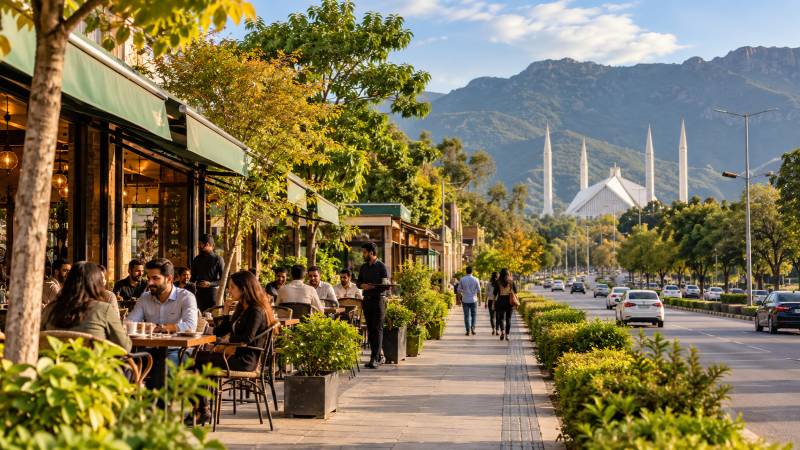
Islamabad’s administrators appear to have discovered a remarkable formula for urban improvement: remove the tables where people gather, uproot the greenery that makes the city bearable, and pour yet more concrete into underpasses and wider roads. The result may be faster movement at selected junctions. Whether it produces a better city is an entirely different question. The ongoing enforcement campaign against outdoor restaurant seating, including reported removals at Kohsar Market and at Quetta Chai in F-6 Markaz, is more than a dispute over chairs on pavements. It exposes a deeper failure to understand how cities create livelihoods, social life and economic value. The specific circumstances and permissions of individual establishments require verification; that is precisely why a transparent, case-by-case approach is essential.
Outdoor cafés are not an urban defect. They are part of the urban economy. They turn commercial centres into places where people want to linger, meet friends, conduct informal business and spend money. They create jobs for waiters, cooks, cleaners, guards, suppliers and delivery workers. In a country starved of employment, reducing a restaurant’s capacity by removing its outdoor tables is not a cosmetic intervention. It can undermine the economics of the business and the livelihoods attached to it. The employment impact has not been publicly quantified. No responsible commentator should invent a figure. But the mechanism is obvious: lower seating capacity can mean lower sales while rent, utilities and other fixed costs continue. Marginal enterprises suffer first. Quetta-style tea cafés are particularly important because they provide affordable gathering places, not merely premium dining for the affluent. They also offer a route into entrepreneurship for operators who cannot afford large indoor premises.
There is a genuine public interest in keeping footpaths accessible, protecting emergency routes and preventing private occupation of green belts. Nobody has a right to obstruct pedestrians merely by calling the obstruction a café. But it does not follow that all outdoor seating should be treated as an encroachment. Mark the pedestrian corridor, define the seating footprint, regulate hours and noise, charge a transparent licence fee and enforce the conditions. That is municipal governance. Confiscating furniture without a coherent citywide framework is not. The contradiction becomes particularly damaging when traders claim to have received permissions or paid fees before their installations were removed. Temporary licences do not confer permanent ownership of public land. Nevertheless, where a public authority authorises an investment, it owes the investor clear rules, proper notice, consistent treatment and a route to appeal. Regulatory uncertainty is an invisible tax on every small business.
Consider what successful cities do. Paris manages pavement terraces as a defining feature of street life, with rules on dimensions, hours and access. London uses pavement licensing to support hospitality and active streets. New York has a permanent outdoor-dining framework that permits sidewalk cafés under detailed design and accessibility requirements. These cities do not choose between pedestrians and restaurants; they design public space to accommodate both. Islamabad’s other obsession makes the inconsistency even starker. The capital is in a race to build underpasses, interchanges and wider roads. The CDA’s own announcements in 2026 identify further underpass projects and road extensions as priorities. Such works may relieve particular bottlenecks, but there is a serious danger in treating vehicle throughput as the primary measure of urban progress. A city is not a motorway with residential sectors attached.
Every additional lane and grade-separated junction has an opportunity cost: land, money, tree cover, pedestrian convenience and alternative investment in buses, safe crossings and public spaces. Expanding road capacity can also encourage additional driving over time, eroding the initial congestion benefit. Projects must therefore be evaluated against network-wide outcomes, not merely the speed at which traffic passes one intersection.
Outdoor cafés, proper pavements, cycling lanes, shade trees and public transport are not competing urban ambitions. They are mutually reinforcing parts of a liveable city.
What makes this obsession with vehicular movement even more perverse is that Islamabad has never developed a coherent, continuous network of footpaths designed for people actually to walk on. Pavements are missing, broken, obstructed or interrupted by dangerous road crossings. In many commercial areas, walking even a short distance means navigating parked cars, open drains and traffic. The city is quick to clear café chairs in the name of pedestrians, but far less energetic about providing those pedestrians with a safe, connected route to their destination. A footpath is not a decorative strip alongside a road; it is basic transport infrastructure.
Public transport is equally inadequate for the scale and geography of the capital. Islamabad does have Metrobus and feeder services, and pretending otherwise would be inaccurate. But these do not yet constitute a comprehensive, convenient citywide system that allows most residents to dispense with private vehicles. The result is a self-reinforcing cycle: poor last-mile connectivity pushes residents towards cars and motorcycles; more traffic is then used to justify more underpasses and road widening; and the resulting road design makes walking and cycling still less attractive.
Perhaps the greatest missed opportunity is the bicycle. Islamabad’s broad corridors, relatively low-density neighbourhoods, green setting and long stretches of pleasant weather offer substantial potential for everyday cycling, notwithstanding summer heat, monsoon rain and hilly sections. Yet there is scarcely a mainstream culture of cycling for commuting, because protected cycle lanes, secure bicycle parking and safe junctions are largely absent. A bicycle is among the cheapest forms of urban transport: it requires no petrol, imposes little road wear, uses a fraction of the space of a car and can make short trips affordable for students, workers and households who cannot maintain a private vehicle. Combined with dependable buses, cycling could provide inexpensive mobility for a much wider section of society. Instead, the capital keeps prioritising infrastructure for those who already own cars.
Outdoor cafés, proper pavements, cycling lanes, shade trees and public transport are not competing urban ambitions. They are mutually reinforcing parts of a liveable city. People will walk or cycle to a market when the journey is safe and the destination is inviting. Remove the greenery and cafés, neglect the footpaths and buses, and then build an underpass to handle the resulting traffic: this is not an integrated transport strategy. It is an expensive way of perpetuating the problem.
The environmental consequences are no longer hypothetical. In April 2026 the Islamabad High Court restrained tree cutting along Ataturk Avenue amid litigation over road expansion. In October, questions were raised over vegetation clearance at Kashmir Chowk; the CDA said 470 affected trees were being transplanted rather than felled. Transplantation may reduce losses, but it is not equivalent to preserving a mature tree in place, and survival and long-term canopy outcomes require independent monitoring.
Here lies the fundamental paradox. The administration says it wants a greener, more attractive capital. Yet mature vegetation is put at risk for road projects while outdoor café furniture and planters are treated as obstacles to civic order. Greenery is not simply decoration to be replanted around the next interchange. Mature trees provide shade, cool streets, support biodiversity and make walking possible in the summer heat. Their value is accumulated over decades. Nor is urban ambience a luxury. It is an economic asset. Streets with human activity attract visitors and support adjacent shops. Places where people can sit and interact generate informal social networks and a sense of safety through everyday presence. Removing that activity can leave commercial centres technically orderly but socially empty. Islamabad’s distinctive appeal has always been its combination of landscape, greenery and a relaxed public realm. Why deliberately weaken all three?
The sensible course is a moratorium on indiscriminate removals while CDA and the Metropolitan Corporation publish a transparent outdoor-dining policy. Every market should have mapped seating zones, minimum clear pedestrian widths, disability access, emergency corridors, fair fees, written permits and appeal rights. Existing approvals should be reviewed individually. Where permissions were issued improperly, the authorities must also examine their own responsibility rather than placing every cost on businesses. At the same time, the capital needs an independent audit of its road-building programme: actual travel-time benefits, induced traffic, tree losses, project costs and alternatives such as better buses, safer walking routes and parking management. Every proposed underpass should compete on economic and environmental merit against improvements that move people rather than merely cars. Publish the analyses and let residents judge the trade-offs.
Above all, count the workers. Before removing commercial seating, the city should measure the businesses affected, their employment and their loss of capacity. A public authority calculate the concrete required for an underpass should also be able to calculate the livelihoods endangered by its enforcement decisions. Islamabad does not need to choose between order and vibrancy, or between mobility and greenery. It needs competent planning that values all four. Paris has its pavement cafés. London and New York make room for outdoor dining. Islamabad has the climate, the setting and the entrepreneurial energy to do the same. What it lacks is a coherent philosophy of urban life.