

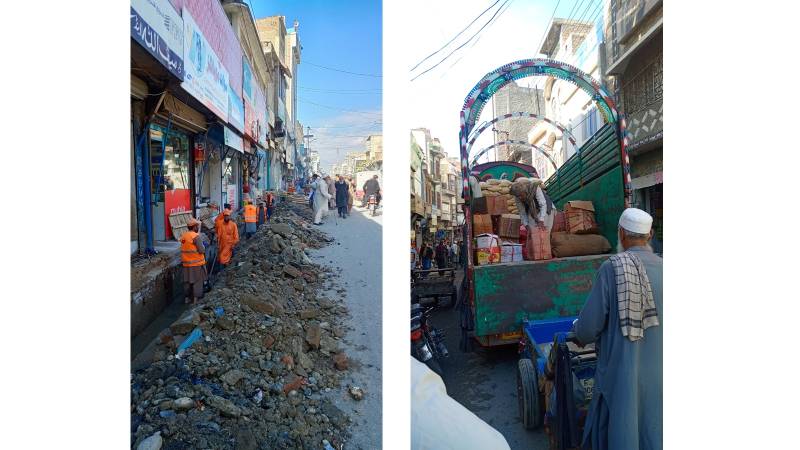
"Today, the drainage channels of Mingora Swat seem to be breathing again. They have suffered decades of neglect, ever since the former princely state merged with Pakistan."
This was the remark of a local resident, Shah Khalid, as we watched municipal workers clearing roadside drains near Grain Chowk the other day. For decades, these channels were choked with concrete, garbage, and construction debris. Watching water flow again felt like seeing the city take a fresh breath after years of suffocation.
Yet that moment of optimism raised a familiar question among residents: will this change last, or is it another temporary exercise that will soon fade away?
I raised similar concerns in an earlier article, ‘Reclaiming Mingora’, published in The Friday Times on the 25th of October 2026. Following the imposition of Governor’s Rule in Khyber Pakhtunkhwa on the 11th of October 2026, the district administration has become visibly more active. This piece examines whether the current drive is producing lasting change on the ground.
From Princely Order to Urban Congestion
To understand the challenge, one must look at how far Mingora has drifted from the city it once was. A few months ago, caught in a bumper-to-bumper traffic jam between Mingora and Saidu Sharif, I spotted a friend walking along the roadside and offered him a lift. He declined with a smile: "No thanks, I am in a hurry." In Mingora, walking had become faster than driving.
It was not always like this. During the former Swat State era, before its 1969 merger with Pakistan, Mingora was a smaller town where the administration maintained roads and public spaces with a discipline still remembered by older residents. After the merger, population growth, migration, and expanding commerce transformed Mingora into a commercial hub, yet its municipal institutions failed to evolve at the same pace. Political interference and weak enforcement allowed minor encroachments to harden into permanent structures. Today, footpaths have vanished beneath shop extensions and handcarts, while rickshaws compete for every remaining inch of road.
City drainage cannot be fixed in isolation from Swat’s wider ecology, as deforestation in surrounding hillsides like Kokarai, Jambil, and Marghuzar sends heavy sediment into valley streams and heightens flood risks
Against this backdrop, the recent administrative push has raised expectations. Anti-encroachment operations have cleared shop extensions and stairs in the main bazaar and meat and vegetable markets, with similar drives reported in Kabal, Kanju, Barikot, Matta, and Bahrain. Along with this, municipal teams have launched cleanliness drives and announced plans for digital mapping and sewerage improvements.
However, accounts from residents reveal a troubling gap between official action and daily reality. Soon after operations end, handcarts gradually return, goods spill back onto footpaths, and commercial vehicles block busy intersections like Taj Chowk for loading and unloading, often in front of traffic staff. Some residents even allege that municipal workers clear vendors during drives only to allow them back once teams depart. Whether or not these claims are true, they warrant investigation. There is little value in clearing a road in the morning if it is choked again by afternoon.
Mingora can learn from models that rely on gradual compliance and digital tracking rather than sporadic raids. In Lahore, municipal and enforcement mechanisms increasingly combine routine field checks with digital records, moving from initial requests and formal warnings to fines when violations persist. Because actions and notices are logged digitally, the process creates a clear record of warnings given and penalties imposed, reducing room for quiet compromises or selective leniency. Adopting a structured, digitally documented sequence of request, warning, and fine would give enforcement in Mingora far greater credibility than sudden sweeps that vanish overnight.
Buried Waterways, Civic Neglect, and Ecological Links
Unchecked municipal negligence has not only clogged existing streets; it has also erased vital parts of the city’s natural drainage. As local resident Sajid Aman has pointed out, an old water channel known as Gaagah once carried water from the Swat River towards the Mingora stream through the area now covered by New Road. Decades of unchecked construction and unjust permissions by the Tehsil Municipal Administration (TMA) allowed this historic watercourse to be encroached upon and buried. While the physical rehabilitation of Gaagah now appears difficult, given the dense settlements built over it, its disappearance remains a stark reminder of how institutional failure has worsened flooding and drainage woes in Fiza Gat, Naway Kalay, Banr, and New Road.
Beyond structural encroachments, everyday liveability in the city continues to suffer from neglected civic issues. Thousands of rickshaws, motorcycles, and other public transport vehicles emit thick black smoke and excessive noise; steel-cutting machines roar in nearby villages; and vegetable vendors using loudspeakers disturb neighbourhoods from morning till evening. Fixing these problems requires routine vehicle inspections, noise regulations, designated vending zones, and traffic police who enforce laws consistently rather than watching violations in silence.
This responsibility also extends beyond municipal limits. The drainage of the city cannot be separated from the wider ecology of Swat. Deforestation in surrounding hillside villages such as Kokarai, Jambil, and Marghuzar increases soil erosion, sending heavy sediment into valley streams and heightening flood risks. Urban development must respect the natural waterways and forests that have sustained Swat for generations.
Turning Operations into Permanent Institutions
Here, the Swat State era offers a lesson as a standard of administrative responsibility. Modern institutions possess far greater resources and technology than the former state ever did; they simply need the same commitment to treating public spaces as public property.
Success cannot be measured by bulldozers deployed or official photographs published; it must be judged by safe footpaths, smoother travel towards Saidu Sharif, and drains that hold up during heavy rain.
Temporary administrative authority must therefore be translated into permanent institutional capacity that survives beyond the tenure of any governor, commissioner, or deputy commissioner. Mingora does not need another short-lived campaign; it needs transparent, everyday urban management, accountable field officers, and citizens who respect shared spaces.
Clearing a road once is an operation; keeping it clear is governance. Removing an encroachment is an action; preventing its return is responsibility. The streams may have begun to flow again, but Mingora will only breathe freely when shopkeepers and handcarts vacate footpaths, intersections remain unobstructed, and residents can move through their city without constant noise, smoke, and congestion. That is the true test of governance in Swat.