

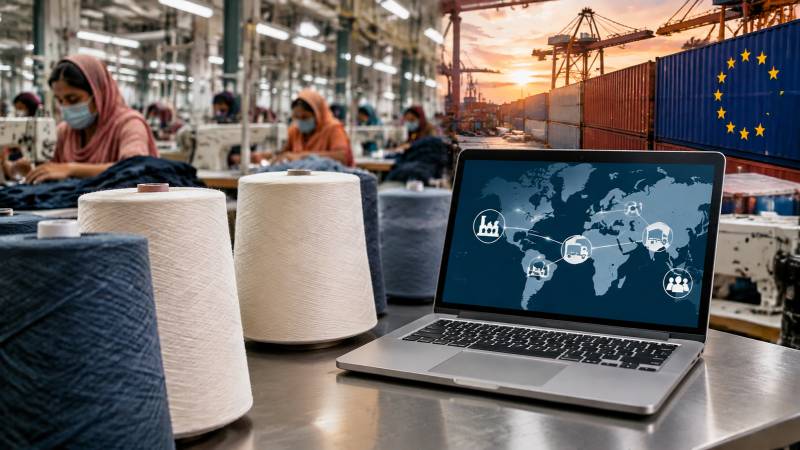
The prevailing consensus across Pakistan’s industrial elite frames the EU (European Union) Corporate Sustainability Due Diligence Directive (CSDDD) and Corporate Sustainability Reporting Directive (CSRD) as protectionist non-tariff barriers, designed to suppress developing export economies. This narrative is a dangerous, self-delusional trap. EU due diligence is neither an arbitrary administrative tax nor foreign regulatory overreach; it is an uncompromising, systemic stress, test of domestic industrial integrity; and this should not be confused with CBAM about which you can read in my previous CBAM-centric articles. International trade is undergoing an epochal realignment: global buyers are systematically detaching from the suppliers incapable of proving end-to-end operational transparency. Industrial survival requires dismantling historic complacency, replacing legacy mindsets with an unyielding institutional commitment to structural reform.
For decades, corporate balance sheets in Pakistan have been constructed through a narrow, retrospective lens dominated by historical cost accounting, standard fixed-asset depreciation, and short-term EBITDA maximization. This archaic model is blind to modern geopolitical realities. Corporate balance sheets must radically evolve to dynamically price non-financial liabilities, treating supply chain opacity, unverified carbon intensity, poor labor standards, and weak corporate governance as direct capital impairments. An unverified tier-3 yarn supplier, a coal-fired boiler operating without audited emissions data, or a sub-tier facility with compromised labor safeguards can no longer be hidden under arbitrary operational line items. In the emerging trade architecture, these governance blind spots represent real balance sheet destruction, raising borrowing costs, impairing credit ratings, and invalidating corporate solvency before international financiers and institutional off-takers.
The quantitative exposure facing Pakistani industry under this new regulatory regime is immediate and catastrophic. Over $8 billion in annual EU-bound goods exports, representing more than 30% of Pakistan’s total national merchandise export revenues, stand directly exposed to CSDDD compliance scrutiny and post-2028 preferential market access realignments. Within this fiscal footprint, upwards of 12,000 active buyer contracts across high-value sectors including textiles, apparel, leather, surgical instruments, and processed agribusiness face immediate suspension or total cancellation. European off-takers are legally prohibited from maintaining supply contracts with entities that fail to demonstrate verifiable traceability and transparent due diligence across their entire multi-tier supply chains. Retaining top-line revenues without an audited corporate spine is no longer viable; failing to overhaul operational mindsets from top to bottom means accepting the systematic disintermediation of Pakistan’s export capacity.
This existential challenge is severely compounded by a broken national governance model that privileges short-term domestic rent-seeking over long-term export competitiveness. A prime example of this failure was highlighted in the urgent representation addressed to Prime Minister Shehbaz Sharif by Fawad Anwar, Chairman of the Pakistan Textile Council (PTC). The PTC’s letter aptly warned of disastrous economic fallout if the government succumbs to protectionist pressure from domestic-focused trade associations seeking to exclude all yarns and fabrics falling under Chapters 52 and 55 of the Pakistan Customs Tariff from the Export Facilitation Scheme (EFS). Following the domestic lobby-driven removal of raw cotton, cotton yarn, and grey cloth from the EFS under SRO.1359(I)/2025, domestic yarn producers are attempting to force a blanket ban on imported inputs. Capitulating to these insular demands directly undermines the value-added export base, locking up vital working capital, inflating input costs, and crippling the liquidity of apparel manufacturers already struggling under exorbitant local energy and tax regimes.
A nation whose exporters cannot provide machine-readable, audit-ready data across tier-1 to tier-N supply chains will be systematically replaced by agile, compliant competitors, regardless of how cheaply it can produce raw commodities.
The PTC’s intervention exposes a broader structural blind spot in national industrial policy: a complete detachment from global material demand patterns. While global apparel consumption has decisively pivoted toward Man-Made Fibres (MMF), which accounted for 69% of global fibre production in 2024 compared to cotton’s declining 19% share, Pakistan’s export architecture remains heavily anchored in low-value cotton textiles. MMF-based products account for 63% of total global apparel trade, yet represent a paltry 12% of Pakistan’s textile export portfolio. In stark contrast, regional competitors like Bangladesh are aggressively retooling their industrial bases to raise their MMF export share to 40% by 2030. Because Pakistan possesses virtually no domestic production of advanced fibers such as viscose or lyocell, and its domestic polyester value chain suffers from scale and cost disadvantages against Chinese and ASEAN producers, value-added exporters must rely on imported MMF yarns and fabrics specified directly by global buyers. Restricting access to these essential inputs under the guise of protecting inefficient domestic spinners guarantees the structural liquidation of Pakistan’s most dynamic export houses.
This rent-seeking cartel model is functionally obsolete. If trade associations are to serve a national economic purpose, they must transform into rigorous compliance and competitiveness catalysts. Instead of lobbying federal ministries for protectionist trade barriers that lock value-added exporters out of global supply chains, associations must build shared technical infrastructure, establish sector-wide digital traceability platforms, and facilitate raw material access aligned with buyer specifications. Domestic trade bodies must recognize that lobbying for protectionism at home directly destroys the corporate credibility of Pakistani exporters abroad, signaling to European buyers that domestic industries are unwilling to compete on transparency, quality, and market efficiency.
In the emerging economic order, sustainable competitiveness has shifted entirely to institutional trust, supply chain predictability, digital traceability, and verifiable data integrity. Global brands are rationalizing vendor networks, exiting opaque origin markets in favor of jurisdictions offering seamless regulatory compliance and audited governance. National trade strategy must stop viewing regulatory compliance as a secondary administrative burden and start treating it as a core instrument of economic statecraft.
Within the Environmental, Social, and Governance (ESG) matrix, the "G" (Governance) must serve as the primary engine for all industrial evolution. Decarbonization ("E") and labor rights enforcement ("S") are not standalone marketing initiatives achieved through isolated capital expenditure; they are strictly downstream artifacts of uncompromised corporate governance. Without independent board-level oversight, dedicated compliance committees, digital MRV infrastructure, absolute data integrity, and robust anti-corruption protocols, environmental and social commitments remain legally dangerous cosmetic adjustments. Global auditors and European regulators will penalize greenwashing with severe legal sanctions and immediate market bans. Governance is the structural foundation that converts abstract sustainability goals into verifiable, legally binding corporate performance.
Corporate leaders must execute an immediate, top-to-bottom overhaul of their institutional mindsets, operational transparency, and balance sheet mechanics. Exporters must embed non-financial risk pricing into their core financial reporting, trade associations must discard protectionist rent-seeking in favor of global market alignment, and corporate boards must establish governance as the non-negotiable metric of enterprise value. The choice before industrial sector is binary: embrace transparent governance and rigorous due diligence immediately, or accept permanent exclusion from the world’s most lucrative markets.