

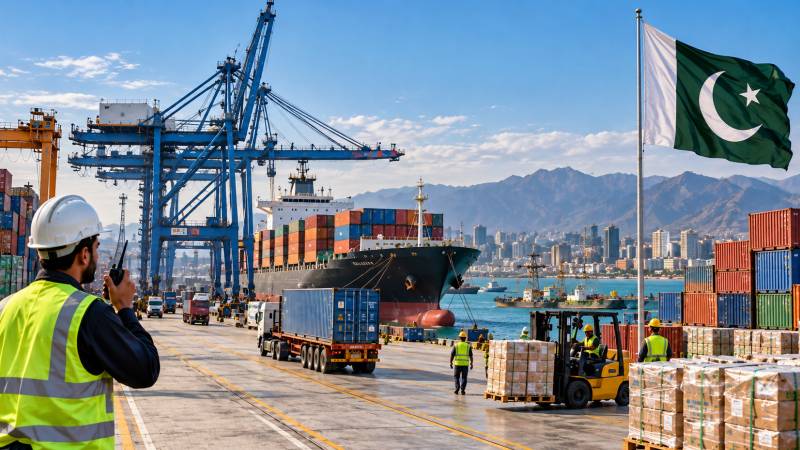
Pakistan’s export numbers are not a verdict on anyone’s character. They map unfinished work. Merchandise exports closed the last fiscal year near $30.1-30.8 billion. In the first quarter of the current fiscal year, they rose to $8.42 billion, up roughly 11 percent, yet the trade deficit still widened to $10.79 billion because imports moved faster. In September alone exports reached $2.94 billion, their strongest recent monthly performance, while the gap remained visible. These figures are neither triumph nor setback. They show that the gap between what the country needs and what its export machinery currently delivers remains wide. The useful question is what remains missing, and how the institutions that set the rules and the firms that earn the foreign exchange can close that distance together.
First, what is missing is time measured in years, not budgets. Capital equipment, supplier networks, workforce skills, and long-term buyer relationships do not mature inside a single fiscal year. Between 2005 and 2025, Pakistan’s export growth averaged about 3 percent a year. Vietnam expanded at roughly 14 percent, Bangladesh near 9 percent, and India near 8 percent over comparable periods. The difference was not the absence of effort on either side. It was the length of the policy horizon. A ten-year framework that locks in the tax treatment of export income, the principles governing industrial energy pricing, the rules for refunds, and the basic procedures of export facilitation would give both institutions and industry something solid to plan around. Ministries gain clearer revenue and energy forecasts. Exporters gain the confidence to place machinery orders and negotiate multi-year contracts with overseas buyers. Continuity across government changes is the scarcest input available, and therefore the most powerful.
Second, what is missing is cost competitiveness that both sides can measure and manage in the open. Industrial electricity has remained higher than the levels available to many regional peers. Captive gas has carried successive levies. These are observable facts, not points of contention. Recent reductions of four to four-and-a-half rupees per unit have provided useful relief. They need to be placed inside a transparent multi-year trajectory that the power sector and industry can both track. The same discipline applies to refunds. Claims that regulations require to clear quickly have at times accumulated into the hundreds of billions of rupees. Clearing the existing backlog and installing automatic interest for any future delay would release working capital that factories can immediately put into production, inventory, and technology. Institutions and exporters share a direct interest in seeing that capital move productively rather than remain locked in administrative accounts.
What is missing third is a shared operating system for the daily frictions that still consume time and money. Company registration, customs clearance, logistics coordination, inter-agency approvals, and documentation for the Export Facilitation Scheme continue to absorb hours that competitors in other countries do not pay. Digital connections between the Securities and Exchange Commission, the Federal Board of Revenue, and provincial authorities already exist in pieces. Completing those links, and publishing a short list of public performance metrics average refund processing days, average customs clearance times, and the energy-cost differential with peer countries—would turn coordination from an aspiration into routine practice. A small permanent cell that both the official and the private side trust, reporting quarterly and in public, can keep the numbers honest and the conversation practical.
Foreign direct investment remains modest, recently in the range of $1.6-1.7 billion. Investors, whether domestic or foreign, look for the same predictability that established exporters need. A ten-year commitment covering the core rules on tax, energy, profit repatriation, and dispute resolution would signal that Pakistan is prepared for the long game. The special investment facilitation mechanisms already in place have shown they can accelerate initial approvals. Extending that same reliability into the day-to-day operations of firms once they are established is the next practical step. The benefit flows equally to local manufacturers and to new capital entering the country.
Pakistan’s export challenge is not simply a question of increasing annual shipments; it is about creating a stable policy environment in which institutions and industry can plan, invest, innovate and compete over a decade rather than a single budget cycle.
The balance-of-payments arithmetic supplies quiet urgency without drama. Workers’ remittances have been strong, frequently exceeding $35-40 billion over twelve-month periods, and official reserves have recovered into the $18-21 billion range at recent peaks. Those buffers are valuable. They are not permanent substitutes for export earnings. Oil and intermediate imports rise whenever economic activity recovers. Structurally higher merchandise and services exports remain the only durable way to keep the external account steady. Institutions charged with protecting reserves and firms charged with earning foreign exchange therefore share the identical long-term interest: an economy that earns more of what it spends.
None of this requires inventing new institutions or new language. It requires treating the existing ones as partners in a single delivery task. Government sets the cost and regulatory environment and measures it openly. Exporters expand volume, raise value addition, and open new markets and measure those results openly. Both sides review the same scorecard. When energy costs move, both see the movement. When refunds slow, both see the delay. When the export basket shifts toward higher-value products, both see the progress. The conversation changes because the data is shared.
The practical sequence is clear and achievable. First, legislate or secure multi-party endorsement for a ten-year core architecture covering export taxation, energy pricing principles, and automatic refunds with interest. Second, finish the digital connections so that routine transactions no longer depend on discretionary speed. Third, publish the joint metrics every quarter and keep them public. Fourth, protect the framework from annual rewriting so that investment decisions can stretch beyond the next political calendar. Each step draws on capacity that already exists inside ministries and factories. Each reduces the distance between national need and current delivery.
Pakistan does not lack capable people in its public institutions or on its factory floors. It has lacked a durable agreement on the terms under which those people work together. The terms are now clear enough to write. A ten-year compact on costs, tax certainty, operational ease, and shared measurement would turn parallel efforts into a single direction of travel. The export numbers will respond when the planning horizon is long enough, and the daily friction is low enough. That work remains open, and it belongs equally to both sides.