

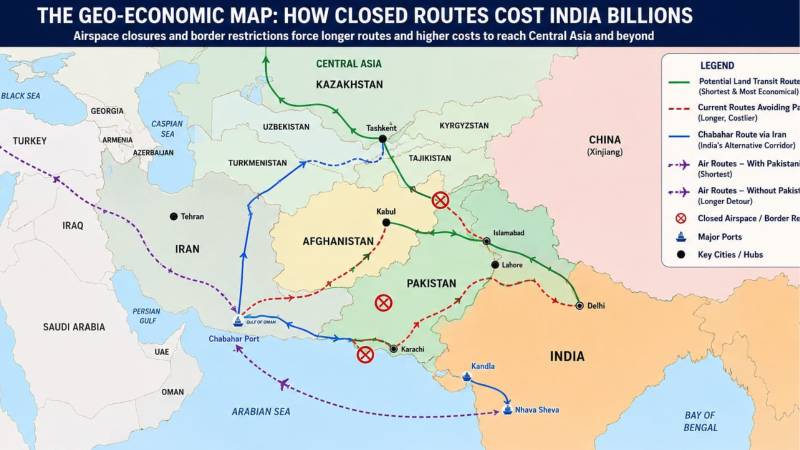
A map of South Asia explains a problem that diplomacy has failed to solve. India wants deeper commercial access to Afghanistan, Central Asia and markets further west. Pakistan sits directly between much of northern India and those markets. Yet instead of functioning as a bridge, this geography has increasingly become a barrier and both countries are paying for it, in figures that are no longer theoretical. When Pakistan closed its airspace to Indian-operated aircraft in April 2025, Air India calculated that keeping the restriction in place for a year could add roughly $600 million to its costs, through longer routes, extra fuel burn and additional crew requirements. That restriction was still complicating Indian international operations into 2026.
But aviation is only the most visible part of a larger story. India also lacks direct Pakistani land transit toward Afghanistan and the Central Asian republics, forcing New Delhi to lean on maritime and multimodal alternatives through Iran instead. These alternatives are strategically useful. They cannot erase geography. Call it a geography tax: money spent not because a destination is naturally distant, but because politics makes the shortest route unavailable. And India is not the only one paying it. Pakistan is losing overflight revenue, transit opportunities, and the chance to become the natural commercial bridge between South Asia and Central Asia. The real question isn't how much India loses because Pakistan closes its routes, it's how much the entire region loses because both countries have turned connectivity into a weapon. The most visible bill is in the sky
Pakistani airspace matters enormously to Indian carriers flying west from northern India. Once routes across Pakistan become unavailable, airlines must fly longer alternatives and every extra hour in the air means more fuel, more crew costs, and fewer commercially viable frequencies. This isn't a new problem. A comparable closure in 2019 cost Pakistan's own Airports Authority an estimated Rs 7.6 billion in lost overflight revenue. The 2025 closure repeated the pattern almost exactly: the Authority reported a Rs 4.1 billion revenue shortfall between April and June alone, as roughly 100 to 150 Indian flights a day were affected and Pakistan's transit air traffic fell by nearly 20 percent. Islamabad's Defence Ministry was careful to clarify that the figure reflects a revenue shortfall rather than an overall financial loss, since aeronautical charges themselves didn't change. That distinction matters but it doesn't change the pattern: this is now a recurring, self-inflicted cost each time relations sour, not a one-off.
Reopening Pakistani airspace would produce an immediate economic benefit for Indian aviation. But airspace isn't where the largest long-term opportunity sits. The bigger prize is on the ground. India's connectivity problem with Central Asia is striking. Despite years of political engagement with Kazakhstan, Uzbekistan, Turkmenistan, Kyrgyzstan and Tajikistan, India's foreign minister put India-Central Asia trade at only around $2 billion as of mid-2025, remarkably modest given the size of the Indian economy and the resources on offer across the region.
The constraint is straightforward: connectivity. I should disclose an interest here, I work at the Pakistan Institute of Development Economics, whose own modelling has quantified what direct transit could mean. A PIDE analysis using 2024 trade data identifies Pakistan as the shortest transit route for India to reach Afghanistan and the Central Asian republics, estimating that around $4.86 billion of Indian trade could feasibly use a Pakistani corridor under a regional arrangement, with roughly $287 million in trade-cost savings for India. Over the longer term, the same modelling suggests improved access through Pakistan could support as much as $15 billion in additional Indian exports, concentrated in agriculture, processed food, pharmaceuticals, machinery and textiles.
India wants deeper trade access to Central Asian markets, but politics prevents land transit through Pakistan, forcing India to use longer and more expensive sea routes instead.
That longer-term figure is a potential scenario, not money India is currently losing every year, and it should be read that way; conflating current losses with hypothetical future gains would overstate the case. The more defensible claim is narrower and still substantial: India is absorbing hundreds of millions of dollars a year in identifiable aviation and logistics costs, while being shut out of a much larger pool of potential trade.
Put the two hard numbers side by side, Air India's roughly $600 million a year in additional aviation costs, and PIDE's $287 million in estimated Indian trade-cost savings from transit access and they approach $900 million. They shouldn't simply be added and declared a confirmed national loss; one is an airline's operational estimate under an actual restriction, the other an economic model under a hypothetical arrangement. But together they show the cost of closed geography is already measured in the hundreds of millions annually, before the wider opportunity cost of suppressed trade is even counted. There's a further complication. After the 2025 breakdown, Pakistan suspended transit of third-country goods following India's closure of the Attari checkpoint, putting roughly $640 million a year in Indian imports of Afghan agricultural goods at risk. Trade doesn't vanish when a direct route closes, it gets longer, more complicated, and more expensive.
India-Pakistan trade itself is the starkest warning. Bilateral trade reached almost $3 billion in 2018; by 2024 it had fallen to around $1.2 billion. That's not equivalent to a direct $1.8 billion "loss", gross trade values don't work that way but it shows how sharply commerce has contracted. And even that official figure understates real demand: after earlier restrictions, significant trade shifted through third countries like the UAE and Singapore, with Indian researchers estimating the indirect flow in the billions. An Indian product that could travel directly to Pakistan instead moves through a third country, picking up extra freight, insurance and intermediary costs along the way, often arriving back in the same neighbourhood more expensive than it needed to be. That's economically irrational — the political relationship hasn't eliminated demand, only made meeting it less efficient.
It would be a mistake to read this as purely an Indian problem. Closing Pakistani airspace denies India the shortest route, but it simultaneously denies Pakistan overflight fees as the repeated PAA revenue shortfalls show. Pakistan's geography gives it real leverage over India, but using that geography as a blockade also stops Pakistan from monetising it. The same logic applies to land transit. PIDE's modelling argues Pakistan could earn steady transit revenue while giving India access to Afghanistan and Central Asia, and that Pakistan could become a regional trade hub if it builds the right agreements; collecting fees, supporting logistics and trucking businesses, expanding warehousing and customs activity, and gaining reciprocal leverage to negotiate access eastward. Transit, in other words, can generate influence without requiring obstruction.
Chabahar is India's answer to geography. India hasn't simply waited for Pakistan. Chabahar Port in Iran is central to its alternative strategy, alongside the International North-South Transport Corridor toward Iran, the Caspian and Russia. These routes matter, and India has reaffirmed its long-term commitment to them. But a bypass isn't a replacement for geography — it's compensation for distance, at a cost. That leaves Pakistan with an uncomfortable question. If India will find alternative routes regardless, is Islamabad better served by pushing that trade toward Iranian ports and competing corridors or by putting itself at the centre of that traffic instead? The question only grows more pressing as Central Asia looks for more routes to warm-water ports.
A 2018 World Bank study estimated India-Pakistan trade could rise from roughly $2 billion to $37 billion if tariff, non-tariff and other artificial barriers were removed, not an immediate forecast, since it assumes broad normalisation well beyond opening one airspace or border crossing, but a clear signal of how much of the potential remains untapped. The World Bank's broader point stands: South Asia remains among the least integrated regions in the world, and India and Pakistan sit at the centre of that failure with the ability to begin changing it.
Reopening doesn't require friendship. The obvious objection: India and Pakistan don't trust each other, and disputes over terrorism, Kashmir, water and decades of military confrontation won't dissolve because of a trade argument. They shouldn't be expected to. But economic connectivity doesn't require political friendship. Countries in profound disagreement still permit commercial aviation and controlled transit because both sides recognise some activities can be separated from the broader dispute.
India and Pakistan could do the same, gradually. Airspace could reopen first, since it's relatively simple to administer. Selected goods could follow through designated crossings. A tightly monitored transit system; sealed cargo, digital customs tracking, pre-clearance, international transit conventions could eventually move Indian goods to Afghanistan and Central Asia without opening Pakistan's domestic market. Pakistan would collect transit fees. India would cut logistics costs. Afghanistan and Central Asia would gain another route to the Arabian Sea. None of it requires either side to surrender its political positions only a recognition that geography doesn't disappear because governments disagree.
The real prize isn't the $600 million Air India might save if Pakistani skies reopen, or the $287 million in trade-cost savings PIDE's modelling attaches to transit access. Those figures matter because they show the cost is already real, today, independent of politics. The larger prize is turning Pakistan from an obstacle between India and Central Asia into the gateway linking the Arabian Sea, South Asia, Afghanistan and Eurasia; India gaining a shorter route, Pakistan gaining transit revenue and strategic relevance, Central Asia gaining another path to one of the world's largest markets. For decades, India and Pakistan have treated geography as something to defend from one another. The more consequential question now is what happens if they finally decide to sell access to it instead.