

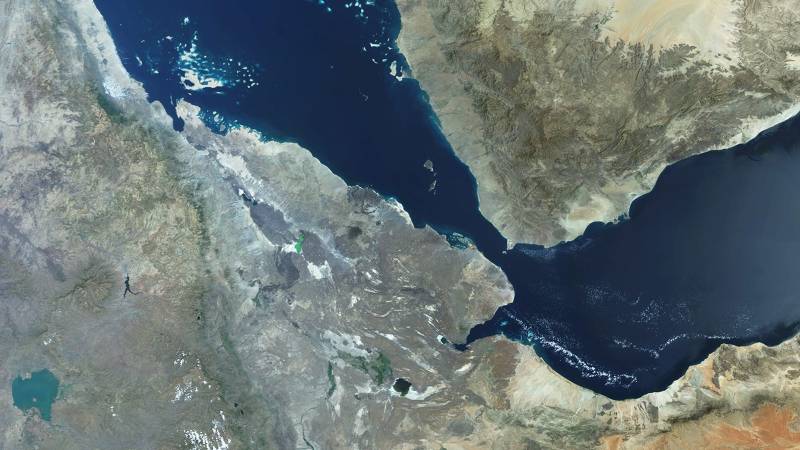
Global trade has always run on a quiet assumption: if one major sea route closes, another stays open. That assumption is no longer true. As of mid-September 2026, both the Strait of Hormuz and the Strait of Bab al-Mandab are contested at the same time. Together, these two straits carry most of the world's seaborne oil. This has not happened before.
The chain of events started in February 2026, when American and Israeli strikes on Iran opened a wider war. The Strait of Hormuz, through which the International Energy Agency puts roughly 20 to 25 per cent of global seaborne oil trade, came under sustained military pressure. Tanker traffic through the strait slowed. Insurers raised premiums. Gulf producers looked for another route to market.
Saudi Arabia found one through the Red Sea. Between March and mid-July, Saudi seaborne crude exports through Bab al-Mandeb rose to roughly eight times their volume from the same period a year earlier. A secondary export route became the kingdom's main lifeline. That made it a target.
Yemen's Houthi movement has fought Saudi-backed government forces since 2014. That war had gone quiet under a UN-brokered truce for roughly four years. It broke open again in July 2026. By September, the pace had turned fast. Within about a week, Houthi forces took the port city of Mocha, then Perim Island, which splits Bab al-Mandab into its two navigable channels. They followed this with the coastal town of Dhubab and a siege of government troops on the Hanish Islands.
If the restriction stays selective rather than becoming a general blockade, it changes how other states and shipping companies can respond
By mid-September, the Houthis held Yemen's entire Red Sea coastline along with Perim and the Hanish Islands. That gave them effective control of the strait itself. This is different from the missile and drone campaign they ran against Red Sea shipping in 2023 and 2024. This time they hold the ground. Alongside the advance, Houthi strikes hit the Saudi cities of Abha, Jazan, Khamis Mushait, and Najran, wounding at least seventy-three people and briefly halting operations at several energy facilities. Saudi Arabia said it would respond firmly and has carried out strikes inside Yemen.
Bab al-Mandab carries close to a tenth of global trade and an estimated five to seven per cent of global oil shipments. Losing free passage forces ships towards the long route around Africa's Cape of Good Hope, which adds weeks to a voyage and raises costs. Oil crossed $100 a barrel as markets priced in both straits under pressure at once. Hormuz alone typically carries around 20 million barrels of oil a day, most of it headed for Asia.
When both routes falter together, the supply picture changes in a way a single closed strait never forced it to. The two straits also play different roles, which is part of why losing both at once matters more than losing either on its own. Hormuz is the primary export channel for producers including Saudi Arabia, Iraq, the UAE, Kuwait, Qatar, and Iran, and it has few real alternatives. Bab al-Mandab was supposed to be one of those alternatives. Pipeline capacity exists to move some Gulf crude around Hormuz, but it is limited and cannot absorb the volumes that would need to shift if both sea routes stayed closed for long.
One detail has drawn less attention than it deserves. A senior Houthi political figure said general shipping through the Red Sea remains open, with an exception carved out for vessels linked to Saudi Arabia. A targeted, selective restriction is treated differently under the international law of the sea than a blanket closure would be. So far, this distinction has been mentioned in passing rather than examined as the legal question it is. If the restriction stays selective rather than becoming a general blockade, it changes how other states and shipping companies can respond, and it changes what kind of case, if any, could be built against it under existing maritime law.
Hormuz has been disrupted before, most memorably during the tanker war of the late 1980s, when Iran and Iraq targeted oil shipments to pressure each other and their allies. Bab al-Mandab went through its own extended crisis in 2023 and 2024. But in both cases, one strait stayed open while the other came under pressure. That backup no longer exists, and shipping companies are still working out what its absence costs them in practice.
For countries far from the Gulf and the Red Sea, the impact shows up indirectly, in freight rates, insurance premiums, and fuel prices rather than in headlines about naval movements. Economies with limited oil reserves and less room to absorb higher shipping costs typically feel this first, before the costs move down the chain to ordinary consumers. Governments that hold large strategic reserves, such as China, have some cushion. Countries without that buffer do not.
Whoever prevails in either conflict, the immediate lesson is a narrow one. Two of the world's most important shipping lanes can now be blocked at the same time, and neither the shipping industry nor the international legal framework governing these waters was built with that scenario in mind. Both were designed around the idea of one crisis at a time, with room to reroute, renegotiate, or wait it out. That room is gone for now, and nobody has a settled answer for what replaces it.