

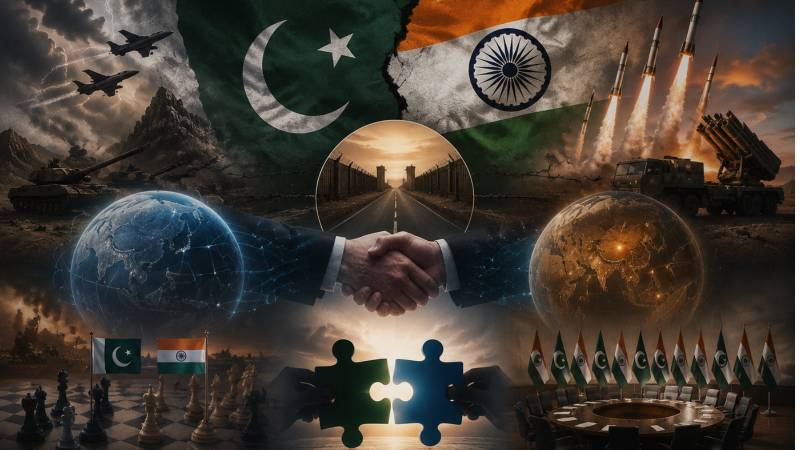
South Asia requires more bilateral summits, not security threats, to restore strategic stability and crisis diplomacy. After every interstate crisis between Delhi and Islamabad, the international world shifts its focus to the buzzwords of crisis management and diplomacy. Post-May 2025 crisis, the necessity of having active bilateral hotlines, crisis communication, and confidence-building measures (CBMs) popularly resurfaced. This episodic recurrence highlighted structural deficiencies in the political interactions of two nuclear-armed actors. First, a diplomatic inability to resolve political asymmetries; second, to develop proactive crisis diplomacy under the nuclear overhang; and third, remaining unable to prevent face-saving narratives from reinviting pretextual aggression. Despite several political deadlocks and military confrontations, South Asia’s history of conflict resolution is not entirely bleak. From Tashkent to Shimla, and Islamabad to Lahore, these bilateral crisis-driven arrangements provided declarations and agreements on shared irritants. Such rapport acted as strategic ‘pauses’ to prevent mutual capitulation and isolationist behavior.
Likewise, twenty-five years ago, the Agra Summit showed one more possibility for two nuclear actors to proactively reengage. Post-Kargil, the Musharraf-Vajpayee dynamics were seen as strained and sceptical, as the Lahore Declaration was placed in a predicament. However, the Agra Summit provided South Asia with another unconventional political space to reframe interstate conflicts. Despite having ended without a mutual consensus, the summit encouraged both sides to foresee the prospects of continued engagement through bilateral or multilateral channels, while keeping their Kashmir narratives on the front page. Two decades down the line, without addressing the spoilers and abiding by the bilateral cautions, is creating more obstructions in the way of summit diplomacy through episodic military interactions and clashing Kashmir views a move worth repeating?
For the world in its contemporary setting, maintaining old conflicts or producing new crises has become a pressing twofold geopolitical feature. These dynamics not only redirect a state’s foreign policy but also provide constructive reorientation to crisis planning, military strategy, and diplomatic statecraft. Post-1998, nuclear deterrence in South Asia was seen as a panacea for solving frequent conventional conflicts and escalatory crises. This nuclearization of South Asia came as a triggering corollary from the Second Nuclear Age. Hence, the international community started reapplying the Cold War antics of nuclear deterrence to South Asia, seeking to contextualize conventional warfighting and rationalize the actors’ crisis responses over stumbling flashpoints.
While the Third Nuclear Age focuses on procuring sophisticated technology to outsmart adversaries and reassessing crisis roles in escalation-intensive regions, it comes with different risks altogether: a systematic lack of global arms control incentives, multiplicity of escalation wormholes, intensification of conventional nuclear integration and entanglement, and an uncontrollable wave of vertical proliferation to counteract escalation asymmetry. This rapidity resulted in a systematic compression of crisis decision-making. Post-May 2025 crisis, this global environment made ground in South Asia. How Delhi and Islamabad manage proportional responses, contain immediate crises, produce bilateral channels, and address arms race instability has also been revolutionized. It encouraged New Delhi the space to maneuver under the stability-instability paradox, with frequent sub-conventional interactions in Herman Kahn’s escalation ladder. Post-Cold War, the rapidity of asymmetric actors and conventional postures in South Asia provided a geopolitical reorientation to the Indo-Pak nuclear dyad and the Kashmir knot.
Since 1998, South Asia has displayed concerning patterns. Frequent crisis instability emanates from Delhi’s political narratives and conventional arms asymmetry, adopting military mobilization as compellence tools, adding doctrinal variations in military postures for force maximization and crisis bargaining, and disabling preventive diplomacy for conflict resolution, while adopting coercive models for deterrence credibility. This resumption of maladaptive Cold War practices overshadows one proactive protocol: addressing deterrence vulnerabilities through crisis hotlines.
This is where bilateral meetings enter the equation; they mitigate trust deficits, reduce inflammatory narratives, and move beyond deterrence for bilateral crisis communication. In a nuclearized South Asia, searching for breathing spaces is difficult and comes with compressed timelines. Periodic crisis communication through bilateral engagement lowers the adventurous, yet normalized integration of nuclear brinkmanship to deter an adversary. Fearing a ‘chickened out’ label, both sides display such aggression that compels third parties to act as immediate kill switches. Using military signaling to produce political settlements is otherwise a gamble carrying the potential to create uncontrollable crisis triggers.
Therefore, in the absence of crisis-driven Indo-Pak engagements, terminating a crisis has outdistanced managing one. Also, India’s strategic thinking continues to equate such breaches of deterrence thresholds through ‘surgical strikes’ with a new normal, causing a mischaracterization of deterrence signaling and crisis responses. Where frequent summits identify clear red lines and threat perceptions for corrective measures, South Asia is reluctant to operationalize hotlines and bilateral channels. Since 2014, this practice has become more widespread than acknowledged. This exclusion has fragmented actionable steps towards creating bridges to address non-traditional security threats as well, such as maritime smuggling, air pollution, food insecurity, and water conflicts.
This exclusion has fragmented actionable steps towards creating bridges to address non-traditional security threats as well, such as maritime smuggling, air pollution, food insecurity, and water conflicts.
As bilateral summitries are seen as an all-directional, trust-restoring factor between habitual adversaries for conflict prevention, they also act as structured breathing spaces to neutralize burning issues through leadership rapport. Musharraf was widely recognized as a military strongman, while Vajpayee appeared as a democratic statesman. This clear difference in domestic political realities and leadership psychology impacted how conflict resolution was contextualized, while both leaders had a risk-seeking appetite for politically unconventional moves in bilateral affairs.
Amid the geopolitical juggling in the early 2000s, the Agra Summit displayed a continuation of historic disagreements on potential crisis catalysts. With no progress on the Kashmir question and spoilers’ management, the scorecards differed. Musharraf got his strongman image restored through media diplomacy and Kashmir-centric discussions, while Vajpayee presented cross-border counterterrorism as a precondition for the Kashmir resolution and viewed Musharraf’s stances as irreconcilable. Vajpayee viewed Musharraf’s historical recollection of Kashmir as a historiographical distortion. Islamabad viewed the Kashmir conflict as the core of Indo-Pak divergence; thus, Musharraf focused on resolving it first, whereas Delhi wanted a step-by-step process, starting with ‘cross-border terrorism’, which Islamabad viewed as a ‘freedom struggle’ not state-sponsored terrorism. This culminated in a Rashomon effect, where both sides had reconstructive interpretations of the Kashmir cause. Post-Agra Summit, this divergence was highlighted by the press conferences and interviews of both leaders. As alternative interpretations of the historic conflict continued, the discussions failed to produce the desired outcome; hence, the blame game persisted.
From Parakram to Pahalgam, perennial crises outpaced bilateral summits. Despite having the Agra summit, the Indian Parliament Attack and India’s unsupported censure of Pakistan disrupted peace negotiations on sticking points. This highlights how spoilers oversee interstate dialogues between traditional adversaries to sabotage through kinetic options and escalatory narratives.
The necessity of having another bilateral summit between Delhi and Islamabad is a strategic non-negotiable. Surprisingly, the Musharraf-Vajpayee dynamics emanated from the Bharatiya Janata Party (BJP), just like Narendra Modi’s strongman posture. The drastic shift in the party’s regional and national posture underlines the role of leadership in applying different foreign policy models to the same adversaries. The parallels and contrasts in the Vajpayee-Modi dynamics offer significant disproportionalities in crisis management, bilateral diplomacy, and nuclear deterrence. For Pakistan, after consistent efforts to reinvite diplomatic reconciliations, India answered with defense rearmament as a strategic necessity to refine political prestige and military strategy. Whereas Pakistan also adopted a twofold approach: increasing defense spending to rebalance strategic equilibrium and actively mediating conflicts to restore geopolitical relevance. However, in regional spaces, as South Asia prioritizes defense spending over bilateral diplomacy and weaponized victimhood narratives over resolved spoilers’ management, the chart for the next crisis is already drawn.
South Asia’s predisposition to seek breathing spaces through ceasefires, instead of bilateral summits, has created a recurrent crisis pattern. The prospect of another bilateral summit to not immediately resolve, but lay the groundwork for gradual reconciliation, appears out of the question. Under the recovery and learning stages of crisis management, South Asia’s prioritization remains confined to increasing defense budgets over refining crisis diplomacy. Years have passed since the nuclearization of South Asia, and the conflicts since 1998 have been outnumbered by those after India’s 2014 elections. Twenty-Eight years is a sufficient time to understand the risks of military interactions under the nuclear overhang, but is it enough to undo the crisis psychology of a region? The next event in South Asia could blow out of proportion, as proactive bilateral summits and crisis diplomacy have exited the region.