

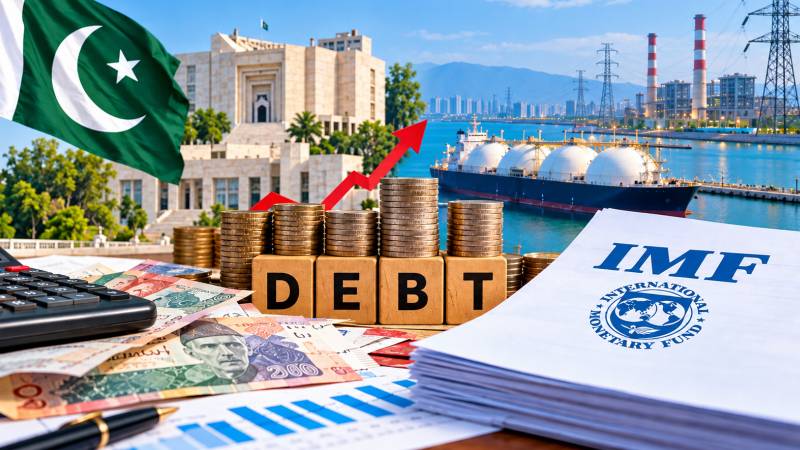
Pakistan has stabilized its accounts, not its economy. Last week FBR beat its quarterly target, reserves stayed above $21bn, the debt ratio fell and the IMF review opened without drama. That same week public debt touched Rs86.7tr, gross financing needs neared a fifth of GDP, inflation stayed above 10pc and investment held back. A Gulf oil and LNG shock set the outlook, and cabinet committees decided who could import LNG, export sugar or get fuel relief. The state has learned, after a fashion, to manage its cash, not how the economy produces, prices or allocates. The press covered the short-term fiscal scramble and missed the long-term decline underneath it, which has not changed. Nobody reached for the local research that explains why.
The news
Debt: Hardly anyone mentioned that the IMF's own projections show a financing gap of more than $20bn a year persisting through 2030. At home the state must raise Rs28.65tr this year to cover the deficit and roll over maturing debt. That is a fifth of GDP, nearly twice FBR's take, much of it short-dated paper that reprices every few months. This is where the real vulnerability lies. Banks lend to the government instead of to firms. Every rise in the policy rate comes straight back as a bigger deficit. And externally we remain dependent on rolled-over Chinese and Gulf deposits and on Fund money.
Then there are the contingent liabilities. Profit's number for guarantees, Rs4.28tr with more than half in power, may have been the most important figure of the week, and it ran as a line item. Circular debt, the losses of PIA, the railways, the gas utilities and the distribution companies, and an unfunded pension bill all sit outside the Rs86.7tr. Nobody asked how much of the power sector's debt is already sovereign debt in all but name, or what Rs37tr of new borrowing over four years actually bought. We discuss public debt only as the government announces it, with little memory of what is kept off the books. That debt will come back to haunt us.
The IMF and the fuel subsidy: This is Pakistan's 25th IMF program. Shahbaz Rana of the Tribune covered it best. In “IMF pushes targeted subsidies” and “Petrol subsidy puts govt, IMF at odds” he reported the Fund's objection to fuel relief targeted by vehicle size rather than income, its push to route support through BISP, and an Rs853bn discrepancy in the fiscal accounts. By October 2 the prime minister's Rs75bn scheme, Rs100 a liter for small cars plus weekly tokens for motorcycles and rickshaws, was being shelved because oil had eased. The petroleum levy, meanwhile, over-collected by about Rs99bn.
Look at what the two sides were arguing over: the price of a liter of petrol and who qualifies for a fuel token. Twenty-five programs in, this is micromanagement, with no reform program on either side. The government taxes fuel when revenue falls short, subsidizes it when prices rise and withdraws the subsidy when the Fund objects or oil falls. The Fund's quarterly benchmarks measure stabilization and little else. They are silent on energy pricing, hidden debts, the permission economy, the cost of the colonial state, and why every growth spurt ends in a balance-of-payments crisis. On both sides, expediency dressed up as conditionality has replaced strategy. The press reported each move as a separate event and never asked what the previous 24 programs changed. The Rs853bn discrepancy says decades of Fund supervision have not even produced reliable public accounts, and it was treated as a technical query.
Revenue: No one broke down the roughly Rs3.08tr collected to show how much came from withholding on existing payers, how much from petroleum and imports, and how much from deferred refunds, inflation or new taxpayers. A target is an accounting number; a tax system is an institution. The real tax story was FBR using PRAL data to uncover Rs9.41bn in falsified wealth statements: digitization enforcing laws we already have.
Prices and energy: The better reports looked under September's 10.3pc CPI and found food easing while transport rose 27.4pc. None tied energy inflation to administered tariffs loaded with circular debt and capacity payments. Then came the report that private firms may be allowed to import LNG directly. This was the week's most important structural story, because it is about who gets to enter a market. But the door is opening only because the single-supplier model collapsed under Qatar's force majeure, and nobody asked about terminal access, take-or-pay risk or PLL's privileges.
Sugar and water: The government capped sugar exports at 200,000 tons and formed a committee to watch prices. Why should a cabinet committee ration a private commodity? This is the permission economy in miniature, and the 2020 Sugar Inquiry Commission and the Competition Commission's 2021 order documented the cycle long ago. Coverage of the 25pc Rabi water shortage stuck to reservoir levels and the Punjab–Sindh quarrel. Nobody mentioned near-zero water prices or unregulated groundwater.
The pattern: Across outlets, the sources were the Finance Ministry, FBR, the IMF, the World Bank and business associations. No news story quoted a Pakistani economist or cited a Pakistani study, so the questions asked were the officials' questions. Stenographic journalism, in short.
Across taxation, energy, sugar, water and trade, the same pattern emerges: a state built around permissions sets prices by decree and relies on a bank-dominated financial system to finance its gaps, leaving firms small and exports weak.
The op-eds and editorials
Business Recorder's editorials were sharper than the news pages. “A tax scheme in trouble” laid out the damning arithmetic of the Fixed Tax Asaan Scheme: two previously unregistered traders signed up, and about Rs26m was collected against a Rs50bn target. Its remedy, enforcement built on electricity, property, banking and import records, beats another amnesty. But it ignores the Haque Reforms Commission's finding that complexity and discretion are what keep entrants out. “State of the economy” was the best fiscal commentary of the week. It took on the Finance Division directly. Interest swallows 46pc of current spending, revenue grew on enforcement and indirect taxes rather than a genuine primary surplus, and manufacturing growth fell from 8.9pc to 3pc as utility costs climbed and credit dried up.
Business Recorder's signed op-eds: The week's one real economic debate took place on BR's opinion page. In “The sovereign-bank nexus and its pitfalls”, Nadeem ul Haque argued that cash is a rational choice when banks hold about 60pc of their assets in government paper and 73pc of adults have no account. Two days later Zafar Masud of the Bank of Punjab answered in “Cartel charge, fiscal fact—I”. His case was that the culprit is fiscal dominance, not bank conduct: the government has borrowed four times what the private sector got, and margins have narrowed as rates fell. They agree on the facts and differ on the cause. Yet nobody linked it to the Rs28.65tr financing need reported the same week, which is fiscal dominance expressed in rupees.
Shahid Sattar's piece on transmission congestion put NEPRA's Rs60bn of out-of-merit dispatch losses on the table and called for a public congestion ledger. It belongs next to circular debt and power guarantees. Mamoon Bilal of PILDAT praised the fuel scheme's responsiveness but judged it at the pump, on delivery. He did not ask about fiscal cost or targeting, which were exactly the questions the IMF was raising.
Shahid Mehmood's “‘China model’ fallacies” in Dawn was the week's most research-based column. Drawing on Fengming Lu and Xiao Ma's work on EV firms such as BYD and NIO, which flourished in cities Beijing never picked, he argues that China is not centrally run. More than 80pc of public spending is local, the state facilitates rather than dominates, and failing SOEs are allowed to lose to private rivals. Pakistan, sugar mafia and all, does the reverse. What he leaves out is that the same decentralization brought land-financed growth, hidden local debt and financial repression, and he never says who Pakistan's equivalent of those entrepreneurial mayors would be. On the same day, Omer Javed's tenth installment in BR drew the opposite lesson and told Pakistan to copy China's state-guided banking. He misses the obvious point that Pakistan already directs credit, straight to the government. That is the crowding out Haque and Masud were arguing about. The two never engaged. Readers got two China models and no argument.
The commentary engaged them more than the news did, but in fragments. BR's civil-service editorial rightly said Pakistan lacks implementation, not reform reports, but never named the mechanism: a generalist, rotational, colonial-era cadre that controls permissions everywhere. Name it, and the trader-tax failure, the sugar quota and the LNG permission become one story. Nobody wrote about contingent liabilities as a whole, the sugar quota, or the IMF program's lack of a growth strategy. Cities, once again, did not exist.
Research? The signed op-eds used data far better than the news pages, from IMF and Findex figures to NEPRA determinations and PIDE's household panel. Pakistani research was still rare. The Haque Reforms Commission's 2024 tax report could have informed the trader-tax editorial, PIDE's sludge audits the permission debates, and the Framework for Economic Growth (2011) the growth commentary. The rest was siloed opinion, intelligent columns that each start from zero.
One system: The debt, energy, water and governance writers are all describing the same structure. A state built on permissions sets prices by decree and borrows from a bank-dominated financial system to cover the gap. Firms stay small and exports stay weak. The IMF stabilizes the result, and the cycle starts again.
What the press needs
Memory and theory. A revenue figure should come with its sources. A debt story should carry the financing gap, the rollover profile and the contingent liabilities, and should ask what the borrowing bought. An energy or trade decision should be judged by whether it opens a market. Each IMF review should be set against the 24 programs before it. Newsrooms should call Pakistani economists as readily as the Finance Ministry. The press is getting better at describing the symptoms. It has yet to attempt the diagnosis.