

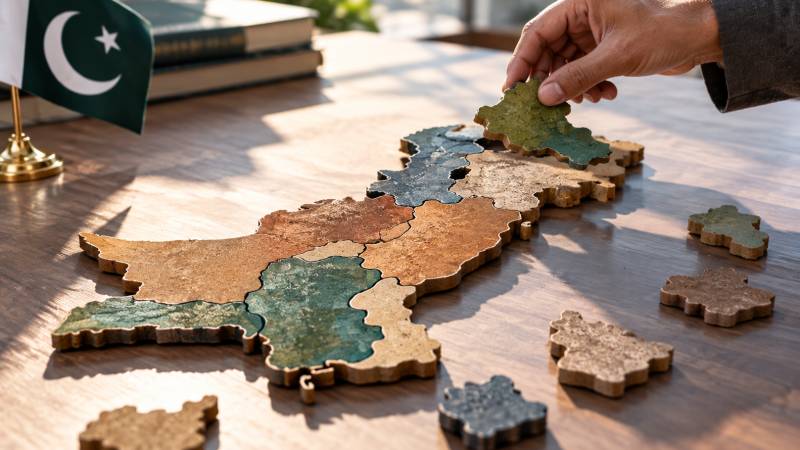
The new “administrative units” proposal is struggling for justification; is it really the most pressing issue? What is the actual proposal and its intended objectives? Arguably, the more compelling issue is the widening dissonance between constitutional commitments and power politics, and the resultant political and governance crises. There is no doubt that since independence, citizens’ needs and expectations have changed significantly but state machinery, ruling and governance attitudes have all remained much the same; a colonial executive state with a constitutional liberal democracy facade. In view of the changed demographics and related changes, the system of governance has become anachronistic and incapable of meeting the needs and aspirations of a young society of nearly 260 million. This article highlights key issues for redesigning Pakistan’s governance.
The constitution mandates both decentralisation (art. 37(i)) and local government (art. 32, 140A). The proposed reforms point towards creating smaller and increased number of “provinces” rather than strengthening local government. Although both exercises involve some devolution of power and reducing the state-citizen gap, the two processes are distinguishable. Increasing provinces is (hopefully, a more equitable) re-distribution of national power and authority with possible administrative, economic and efficiency gains. Local government is essentially about further reducing the state-citizen gap, taking service delivery to the doorstep and enhancing efficiencies. The resources follow accordingly.
The background, the grand disingenuity: Despite their claims, in practice, our governments have never been keen on devolving power and operationalising local government meaningfully. Devolution and decentralisation have been conceded only to the extent that the ruling elites could consolidate the political and resource gains rather than prioritising public welfare. Constitutionally, the failure to decentralise (art. 37(i)) and establish effective local government (arts. 32, 140A) is a breach of constitutional duty (art. 5(2)).
The 18th Amendment was a major reconfiguring of the state. It promised significant devolution of power but proved to be a mere power -and resource- grab for the provincial elites. The result is a missed opportunity that has left state integration, capacity and coherence fractured and state effectiveness compromised. Conceptually, it is still difficult to clearly discern how the administrative structure is aligned with constitutional objectives and governance realities for improved performance. How the federal government complements and reinforces other parts of the state including the peripheral regions equitably and efficiently. The 18th Amendment has proven to be riddled with duplication and clash of functions; breakdown of uniform policing laws; incomplete political and fiscal devolution from the provinces to the district, and weak local economies. Sub-provincial governments continue to be in the doldrums both in Islamabad and the provinces.
Despite the longstanding discussion for a south Punjab province, we still have a single province dominating the federal system that presents a major equity challenge for the federation. The same disingenuity affects the proposed ICT local government, which excludes core areas including security, policing and master-planning -making a mockery of the commonly understood idea of local government. Nor is it clear how this design will promote development and economic growth. Clearly, there are equity and efficiency issues giving rise to significant governance challenges that must form the basis for reimagining Pakistan as a strong federation with improved implementation and local service delivery.
There is no doubt that since independence, citizens’ needs and expectations have changed significantly but state machinery, ruling and governance attitudes have all remained much the same -a colonial executive state with a constitutional liberal democracy facade.
Re-imagining the state: The first issue is to constitutionally include all the constituent parts in the definition of Pakistan (art. 1). Whatever their final status will be, whilst Azad & Jammu Kashmir (AJK) and Gilgit-Baltistan (GB) are a part of Pakistan, it is politically appropriate and fair that they are treated as equal partners and citizens with a real say in federal policy and planning that affects their everyday lives and future. Adequate representation must therefore be ensured for AJK and GB in the National Assembly and Senate so that they can directly argue their concerns in the chambers of power. GB’s recent resolution must therefore be prioritised to grant it the status equal to a province.
The concentration of political, administrative and economic influence in Punjab creates persistent perceptions of unequal citizenship among peripheral regions. Balochistan is also an equity issue in terms of its actual share in national power. Whilst being a province covering over 44pc of Pakistan’s territory, its real share in the National Assembly (NA) is only 20 seats -16 general, 4 women- out of a total 334 seats. Hence, Balochistan has a mere 6pc of NA seats. This is less than the Lahore Division that has 24 seats. The population formula for the distribution of the NA seats structurally and permanently disadvantages Balochistan contributing to low human development and unresolved grievances including CPEC that have conflated into a sense of historic injustice. Balochistan’s representation needs to be enhanced so that it has a real share in power.
The population formula is also an intra-province issue. Chitral, for example, is territorially about 20pc of Khyber Pakhtunkhwa but has only one NA seat (out of 55 seats). This electoral disparity is reflected in the infrastructure and development deficits. The formula for electoral seats therefore needs to be revised to better balance population, territory and under-development to ensure a more even distribution of resources and development.
With provinces being unicameral, legislative cooperation and coherence between the national and provincial levels is a definite weak point. An option is to strengthen the deliberative function by making the Senate -the House of the Federation- the Upper or Revising chamber for the provincial assemblies. As well as ensuring wider deliberations that will both enrich and aggregate parliamentary thinking to inform a healthy and rigorous consensus on vital issues, it will strengthen the federal structure overall.
Whilst the case for additional “administrative units” still needs to be established, there is a compelling case for strengthening art. 140A to make local government an independent third tier with constitutionally defined areas of competence rather than being an extension of and at the behest of the provincial government for its election, resources and operationalisation. Arguably, in view of their population density, resource and other challenges, megacities -Karachi, Lahore- and other large cities, need to be provided with an empowered model of local governance that enables them to develop as engines of growth.
The messy politics: Technically, it may be, as Farrukh Saleem insists, strictly about who delivers that mandated constitutionally -but that is only so if the messy politics can be managed appropriately. The technical case is complicated by the trade-offs, the underlying and inter-connected conflicts of interest that have proven fatal for reforms. Despite recognising the benefits of local government, provincial governments sabotaged 18th Amendment reforms to protect their elite interests and have continued to frustrate both the constitutional decentralisation and local government mandates. And as noted by Nadeem F. Paracha (A separate province?) in Karachi’s ethnic political context, the provincial government acts as a safeguard against ethnic dominance in the city, demanding an inclusive and representative electoral systems as an essential precondition for a separate province.
To avoid it being another costly experiment to nowhere, lessons need to be learned from Musharraf’s and other reform initiatives. That without genuine public ownership, reforms are likely to be reversed or implemented selectively as in the case of the 18th Amendment. Hence, an official white paper for public consultation would be appropriate, which critically assesses risks, examines budgets and other wider questions (some discussed above) that are liable to impact the reforms, governance and performance. This would provide a more compelling case to secure public support and consensus to move from a colonial-style executive state towards an inclusive and effective democratic state.