

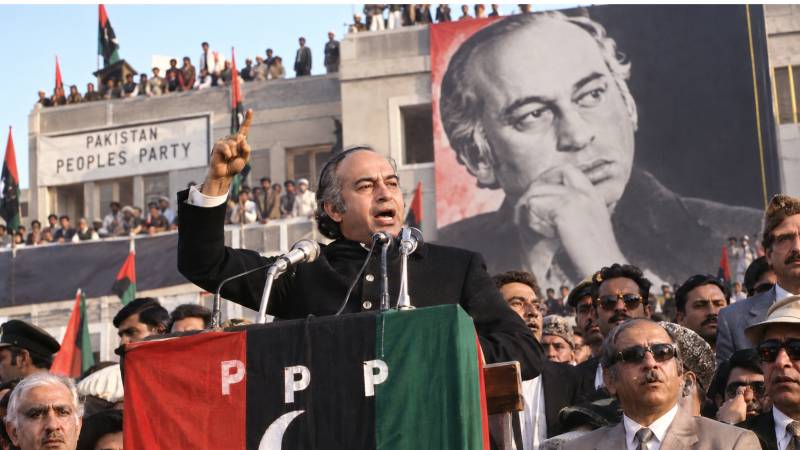
Pakistan emerged from the turmoil and trauma at the turn of the 1970s, as major political forces including nationalists such as Wali Khan and Ajmal Khattak from NWFP, Ghaus Bux Bizenjo, Atta Ullah Mengal and Khair Bux Marri from Balochistan, and Z. A. Bhutto from Sindh, prudently mustered their forces to strengthen democracy in the country. However, the newly founded Pakistan Peoples Party (PPP), under Z. A. Bhutto, emerged as the principal beneficiary of this political conjuncture. His anti-feudal and anti-capitalist rhetoric, combined with socialist and anti-establishment discourse, resonated with the rising rural middle classes while attracting students, workers, and peasants. In Sindh, it contained the nationalist tide while consolidating a broader support base in Punjab. Consequently, both the right and the left found themselves politically constrained, as Bhutto had emerged from the 1968 movement as its first major popular leader, drawing on the progressive mobilization of students, workers, and peasants and subsequently attracting radical liberals and sections of the left.
At the same time, the Green Revolution transformed the social and economic structure of the countryside, particularly in irrigated Punjab, disproportionately benefiting middle and larger farmers and strengthening a politically significant rural middle and upper peasantry. As sections of the feudal classes lost economic and political power, these farmers became increasingly economically independent and politically organized, weakening their traditional relationship with the peasantry and reducing their need to mobilize or protect the rural poor. At the same time, the Green Revolution initiated pauperization among sections of the rural population, prompting migration that fueled urban industrial growth in the big cities much like the phenomenon observed by Karl Marx in England during the Enclosure movement, a process that would intensify in the later decades.
The PPP was therefore able to consolidate its political influence and form governments at the center and in Punjab and Sindh, while nationalist forces, in alliance with the Jamiat Ulema-i-Islam (JUI), formed governments in NWFP and Balochistan. Thus, the political realignment of the early 1970s brought class, regional, and nationalist forces into a new relationship within the framework of the reconstructed Pakistani republic. It was this situation that helped create a new social contract between the rulers and the ruled, and between the federation and the provinces through both reforms and the Constitution, as the ruling elites and the establishment were still under pressure from the turmoil of the revolutionary uprising of 1968 and in shock from the trauma of the separation of Bangladesh. Therefore, drastic changes were made: reforms were introduced in the interests of students and workers, while land reforms were announced and industries were nationalized.
As the ruling elites and the establishment recovered from the turmoil and trauma of the turn of the 1970s, Bhutto increasingly adopted authoritarian tendencies and turned against the very forces that had brought him to power—the left, workers, and peasantry.
The new political configuration also produced different trajectories for the provincial nationalist movements. While Baloch nationalists, by and large, tied their fate to the NAP, and Sindhi nationalism was marginalized by the rise of the PPP, Pashtun nationalists gained considerably in political influence and representation. Pashtun nationalism soon recovered from the initial trauma of Partition and its aftermath, forged alliances with Baloch, Sindhi, and progressive forces in Punjab, and began to play a greater role in national politics. At the same time, Pashtun middle classes, particularly from mainland Peshawar and the Sama valleys, increasingly began to replace the Muhajir educated elites in the bureaucracy, while Pashtuns already occupied considerable numbers of positions in the armed forces. Against this background, Wali Khan emerged as a leading opposition figure in the 1960s, while supporting Pakistan during the 1965 war with India and later meeting Mujib to press him to abandon the separation plan while supporting his democratic demands. The contest for a greater share in the national pie thus became an important part of the political demands of the local middle classes and the emerging Pashtun bureaucracy. These competing forces nevertheless reached a pragmatic compromise over the 1973 Constitution. Although nationalist forces joined in its creation as a ‘pragmatic quid-pro-quo agreement’, despite Wali Khan’s reservations, Z. A. Bhutto was able to ‘smash him into becoming a Pakistani’, as Akbar Zaidi observed:
‘Although 125 of the 135 members of the National Assembly voted for Pakistan’s Constitution on April 10, 1973, Zulfikar Ali Bhutto is given, and deservedly so, credit for getting a large, discordant group of nationalists and Islamists to agree to the draft. To get leaders like Wali Khan, who was the parliamentary leader of the opposition, Mir Ghaus Baksh Bizenjo, the sardars of Balochistan, Mufti Mahmud, and Mian Tufail…to build a consensus on a document that would determine Pakistan’s democratic trajectory was a major feat.’
However, the nationalist provincial elites and middle-class Islamist leadership were alike bitterly opposed to economic reforms largely initiated by the central government. The demand for provincial autonomy by nationalist forces led by Wali Khan was cautiously received by Z. A. Bhutto, who was concerned that Punjab’s relative strength could make it difficult for a leader from a smaller province, such as himself, to manage the federal government. Punjab accounted for around 52 percent of the population, 62 percent of the gross national product, and 52 percent of the manpower, giving it a dominant position within the federation. As Shahid Javed Burki argues, Bhutto had ‘genuine if not necessarily legitimate concerns’ about the demands of nationalist forces regarding provincial autonomy and the weakening of the central government, particularly because Punjab’s relative size—demographically and economically could undermine the federal balance (It is against this demographic hegemony of Punjab that Pashtun, Sindhi, and Baloch forces have broadly supported the creation of a Saraiki Waseb province carved out of Punjab). The liberals and the left put their weight behind Bhutto in an attempt to strengthen the central government vis-à-vis the provinces, as many of the democratic rights and economic reforms were initiatives of the central government.
However, as the ruling elites and the establishment recovered from the turmoil and trauma of the turn of the 1970s, Bhutto increasingly adopted authoritarian tendencies and turned against the very forces that had brought him to power—the left, workers, and peasantry. As Tariq Ali pointed out the contradictions of the Bhutto-led PPP government: ‘Bhutto had unleashed the masses, but having awoken the sleeping tiger, he spent the rest of his years trying to cage it again.’ Bhutto first moved against the radical left within his own party, while the PPP government turned against the working-class movement in Karachi and elsewhere; the mass labor uprising of 1972 was eventually suppressed by the state. The conflict with the provincial nationalists deepened when Bhutto dismissed the NAP-JUI government in Balochistan on 14 February 1973, while the NAP-JUI government in NWFP resigned the following day in protest. On 23 March 1973, the anniversary of the passage of the Pakistan Resolution of 1940, the United Front, a coalition of eight opposition parties, organized a protest gathering at Liaquat Bagh, Rawalpindi, pressing the government to adopt a democratic approach. The gathering was attacked by goons and the state machinery, resulting in the deaths of 12 people and injuries to 75 others.
The confrontation continued, and the National Awami Party was eventually banned on 9 February 1975, with its leadership and workers subsequently facing arrest and prosecution. The NAP leadership was prosecuted in the infamous Hyderabad Conspiracy Case, with proceedings before a special tribunal in Hyderabad beginning in 1976. While the principal NAP leadership remained imprisoned, some Baloch nationalist leaders and activists went into exile in Afghanistan, where they found sanctuary, from where an armed Baloch struggle developed against the Pakistani state.