

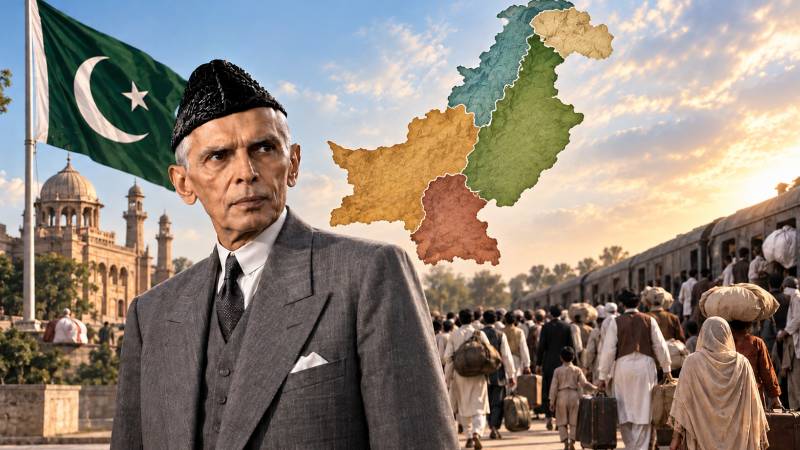
The Pakistan Movement emerged within the colonial framework to safeguard the interests of Muslim elites, middle and professional classes in the Muslim-minority regions of India, with the salariat providing its leadership. It gained momentum after the introduction of electoral politics under the Indian Councils Act of 1909 (Morley–Minto Reforms). By the 1940s, its focus shifted towards the Muslim-majority provinces and agriculturalist classes as communalism intensified and partition became increasingly foreseeable, while Britain, weakened by mass movements, militant struggles, and the revolt of the Indian Navy and Air Force, prepared to withdraw from India—the “Jewel in the Crown” as the sun was about to set on British imperialism in the aftermath of the Second World War.
In the face of strong progressive nationalist movements and mounting economic and political pressures, the vulnerable Muslim League leadership in the newly established country in 1947 turned to suppress them, seeking shelter in the ideological invocation of Pakistani nationalism and Islam. The challenge from the Bengali middle classes was formidable, along with the Pashtun, Baloch, and Sindhi middle-class nationalist movements. Under the direction of Governor-General M.A. Jinnah, the Chief Minister of NWFP, Dr Khan Sahib, was dismissed on August 22, 1947, while the Chief Minister of Sindh, Muhammad Ayub Khuhro, who had assumed office on August 23, 1947, was dismissed on April 26, 1948. The dismissal of the Khan Sahib ministry, despite its majority in the provincial assembly, and the subsequent dismissal of Khuhro reflected the early centralization of political power at the expense of provincial autonomy.
However, earth-shaking moments occurred in NWFP and Bengal in the coming years. Following the arrest of Bacha Khan and other leaders of the Khudai Khidmatgar Movement and the dismissal of the majority-elected provincial government of Dr Khan Sahib, thousands of unarmed Khudai Khidmatgar supporters organized a peaceful protest march at Babrra Ground, Charsadda, on August 12, 1948. The police and Frontier Constabulary opened fire on the unarmed protesters. Contemporary and later accounts have reported hundreds killed and many more wounded, with some accounts putting the death toll at around 600 and the number of wounded at around 1,000 or more. Since December 1947, the language movement in Bengal had become a formidable challenge to the central government, culminating in the massacre of February 21, 1952, when several students were killed during protests demanding recognition of Bengali as one of Pakistan’s state languages. Very soon, the Bengali middle classes realized that political and economic power was concentrated some one thousand miles away, in the hands of the ruling establishment in West Pakistan.
The outcome of the first provincial elections in East Pakistan, held on the basis of universal adult franchise, was entirely unexpected and profoundly unsettling for the ruling elite. The incumbent Muslim League secured only nine seats, whereas the opposition United Front achieved a resounding victory, winning 223 out of the 309-member provincial assembly. The United Front campaigned on a radical 21-point political agenda that centered heavily on economic and political autonomy, recognition of Bengali as a state language, and the preservation of provincial rights.
In the face of strong progressive nationalist movements and mounting economic and political pressures, the vulnerable Muslim League leadership in the newly established country in 1947 turned to suppress them, seeking shelter in the ideological invocation of Pakistani nationalism and Islam.
To politically counterbalance East Bengal whose population constituted around 56 percent of the country and thus outnumbered West Pakistan, the ruling elites introduced the One Unit scheme in 1955. Under the scheme, the provinces and princely states of the western wing were amalgamated into a single province known as West Pakistan, while East Bengal was renamed East Pakistan. Its strategic objective was to establish ‘parity’ between the two wings of the state. The second Constituent Assembly itself explicitly associated the establishment of West Pakistan with the aim of creating parity between East and West Pakistan.
Failing to deliver economically and politically, and increasingly fearful of mass movements, the insecure ruling elites remained divided over a way out of the crisis, creating persistent political instability. Consequently, they were unable to formulate a constitution for the country for nine years after independence, while repeatedly replacing one political leadership with another and suppressing dissent, including through the banning of the Communist Party in 1954. At the same time, Pakistan was drawn into the Western-led anti-communist alliance system through SEATO and CENTO (the Baghdad Pact), aligning the country with the capitalist-imperialist bloc of the Cold War. Finally, seeking stability, the ruling elites took shelter under martial law in 1958, suppressing democratic rights and paving the way for the dominance of the bureaucratic-military establishment.
With the help of the bureaucracy, a parasitic form of capitalist class developed through the Pakistan Industrial Development Corporation (PIDC), established in 1951. As a state enterprise, PIDC established factories and mills and, once profitable, transferred them to private capital, helping transform sections of the mercantile and trading classes into an industrial capitalist class. This process was consolidated during the so-called ‘Decade of Progress’ (1958–1969), resulting in the emergence of the notorious ‘22 families’. In 1968, Mahbub ul Haq reported that these families controlled about 66 per cent of Pakistan’s industrial assets, around 80 per cent of its banking assets and 79 per cent of its insurance business.
Alongside this industrial transformation, the ‘Green Revolution’, the introduction of modern capitalist farming through high-yielding variety (HYV) seeds, chemical fertilizers, pesticides, mechanization and irrigation also transformed agriculture. While it increased agricultural productivity, its benefits were unevenly distributed, with larger and wealthier farmers better positioned to adopt new technologies and obtain credit and other inputs. The decade of economic development and growth and the Green Revolution, however, created drastic changes in Pakistani society and increased disparities both at the class and regional levels. Capital and economic power became increasingly concentrated in the hands of a small number of capitalist families, while sections of the urban middle classes experienced some prosperity. At the same time, high inflation eroded the purchasing power of industrial workers; over the 15-year period ending in 1967, real wages in manufacturing fell by approximately 25 per cent, or about one-quarter. Thus, the benefits of economic growth were unevenly distributed, with capital accumulation advancing alongside growing pressure on sections of the working class.
At the regional level, the disparity between the two wings of Pakistan increased sharply. The per-capita income of West Pakistan rose from about 1.32 times that of East Pakistan in 1959–60 to 1.67 times by 1969–70, while per-capita income increased by approximately 42 per cent in West Pakistan compared with only 17 per cent in East Pakistan. Within West Pakistan itself, the concentration of industry, investment and infrastructure in Punjab and Karachi further widened the gap with NWFP, Balochistan and the rural areas of Sindh. Thus, the rapid growth of the 1960s did not merely produce economic expansion; it also intensified class differentiation and regional disparities, laying the material foundations for growing political and regional discontent.
The One Unit scheme and undemocratic dictatorship did not go unchallenged. Meanwhile, progressive and democratic forces from the two wings of the country united and formed the National Awami Party (NAP) in July 1957 in Dhaka to confront dictatorship and provide a political front for the working and peasant classes. NAP advocated parliamentary democracy, human rights and autonomy for the constituent units. NAP became an important force of opposition to the Ayub regime and, along with other opposition parties, aligned with Fatima Jinnah in the 1965 presidential election, which was conducted through the votes of the Basic Democrats rather than by direct popular franchise.
During the same period, the Pashtunistan movement gained some currency, while Baloch armed resistance also emerged. The Pakistan military arrested the Khan of Kalat, Mir Ahmad Yar Khan, on charges of sedition in October 1958, amid his opposition to the One Unit scheme. Nawab Nauroz Khan subsequently led an armed resistance against the state and the One Unit system, with a force reported to number several hundred men. After nearly a year of fighting, Nauroz Khan and his followers surrendered in 1959 following negotiations and assurances of amnesty, but were subsequently arrested and tried by a military court.
The economic transformation of the 1960s deepened disparities along both vertical class and horizontal regional dimensions, giving impetus to class and ethnic movements. The rising student, workers’ and peasants’ movements eventually forced Ayub Khan to step down on 25 March 1969, the authoritarian system built around his years of influence and power disappeared with him. Under the pressure of the mass movements of 1968–69, Yahya Khan subsequently abolished the One Unit scheme through the Legal Framework Order of 1970, restoring the four provinces of the western wing—Punjab, Sindh, NWFP and Balochistan—and announced the first general elections on the basis of adult franchise. The elections were held on 7 December 1970, and the Awami League secured a clear majority in the National Assembly. However, the results were not translated into the transfer of power; Yahya Khan postponed the convening of the National Assembly, deepening the political crisis. The confrontation eventually culminated in civil war and the military crackdown in East Pakistan, followed by the emergence of Bangladesh in December 1971.