

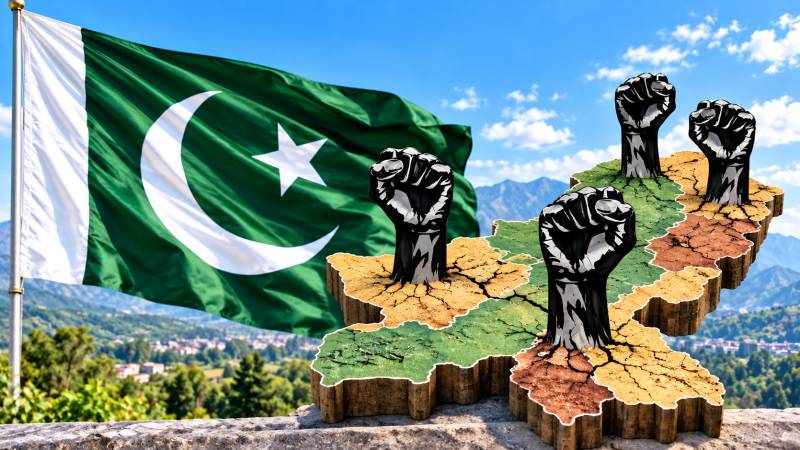
Following the controversial proposal to create new provinces, debate over a new local government system has now emerged in an increasingly contentious manner. Planning Minister Ahsan Iqbal has reportedly argued that if politicians are unwilling to create new provinces—an apparent indirect reference to the Sindh Assembly’s resolution—then Pakistan should establish 160 district governments. He has also proposed increasing the number of provinces to 15. It is particularly unfortunate that the honourable minister has linked the genuine and long-standing need for an effective third tier of local government with the highly controversial, one-size-fits-all proposal for creating new provinces advanced by Interior Minister Mohsin Naqvi. Similarly, MQM leaders have repeatedly conflated the demand for an empowered local government system with the creation of new provinces and administrative units.
Moreover, several journalists have begun speculating that the powerful establishment has now decided to introduce a centrally controlled local government system to weaken the provinces. However, in the absence of official confirmation or publicly available policy details, such claims should be treated as speculation rather than the government policy at this stage. In my view, these are two distinct issues that require separate, serious, and constitutionally informed consideration. The debate over new provinces must not be allowed to cast doubts on the need to establish effective, empowered, and accountable local governments as a genuine third tier of governance within the existing provincial framework.
The real issue is that, during the sixteen years since the passage of the 18th Amendment in 2010, provincial governments have largely failed to implement Article 140-A of the Constitution in its true letter and spirit. The Article requires each province to establish a local government system and properly devolve political, administrative, and financial responsibility and authority to elected local-government representatives. But in Punjab, Pakistan’s largest province, and in Islamabad Capital Territory, there has been no local-government system for last several years because the ruling party fears they might lose badly in local bodies election. On the other hand, in Sindh, Khyber Pakhtunkhwa, and Balochistan, local-government systems have been introduced at different times, but the devolution of powers, administrative authority, and financial resources to elected local representatives has remained very limited and uneven.
Pakistan could strengthen Article 140-A through a binding constitutional framework that protects elected local governments while leaving provincial assemblies responsible for their detailed structure, functions and fiscal arrangements.
The central problem, therefore, is not simply the number or size of provinces, but the persistent reluctance of the provincial governments to devolve meaningful authority to the local level. Creating more provinces or new administrative units will not, by itself, resolve this problem. What Pakistan needs is a constitutionally grounded, democratically accountable, and adequately resourced local-government system that functions as a genuine third tier of governance within the existing provincial framework.
India faced a similar problem for several decades. Although Article 40 of the Indian Constitution directed the Indian states to organise village panchayats and endow them with the powers and authority necessary to function as units of self-government, state governments were often reluctant to establish genuinely empowered local governments or to devolve meaningful political, administrative, and financial authority to them.
This situation began to change with the 73rd and 74th Constitutional Amendments, enacted in 1992, which gave constitutional recognition and greater institutional protection to local self-government in India. The 73rd Amendment established a constitutional framework for rural Panchayati Raj Institutions, while the 74th Amendment did the same for urban local bodies. Among other provisions, the amendments provided for regular elections, defined institutional structures, representation, and a framework for the mdevolution of powers and financial resources.
Pakistan also needs similar detailed arrangement in its constitution and the 73rd and 74th amendments provide a very useful case to have a serious look. At the time of 18th amendment, it was argued that as local governments fall under the residuary powers which are the exclusive domain of the provincial legislatures therefore parliament can not make laws for them and it should be left to the provincial parliaments to make laws regarding local government for themselves.
The persistent failure of provincial governments to implement Article 140-A of the 1973 Constitution and devolve meaningful powers to local governments makes it necessary to consider a constitutional reform similar to the one introduced in India. The objective should be to establish a stronger and more binding constitutional framework for local self-government while preserving provincial autonomy. Same like Pakistan’s 1973 Constitution, local government in India falls within the domain of the federating units—the states—under the State List. Nevertheless, the Indian Parliament, exercising its constituent power under Article 368, enacted the 73rd and 74th Constitutional Amendments in 1992, establishing a constitutional framework for rural Panchayati Raj institutions and urban municipalities and making their institutionalisation a constitutional obligation.
The amendments did not, however, transfer the entire domain of local government to the Union government. State legislatures retained the authority to legislate on the detailed structure, functions, powers, and taxation of local bodies. They are required, nevertheless, to exercise these powers within the constitutional framework established by the amendments.
Hence, the Indian Parliament exercised its constituent power to amend the Constitution to establish a more effective and constitutionally protected local government system, without usurping the legislative powers of state legislatures. The amendments created a binding constitutional framework for local self-government, while leaving state legislatures responsible for determining the detailed structure, functions, powers, and fiscal arrangements of local bodies within that framework. Because the amendments affected the federal structure, they also required ratification by the legislatures of at least half of India’s states before receiving the President’s assent.
The Indian experience demonstrates that constitutional protection for local government need not undermine provincial or state autonomy. Pakistan could similarly consider strengthening Article 140-A by establishing a more specific and enforceable constitutional framework for elected local governments, while leaving provincial assemblies responsible for determining their detailed structure, functions, and fiscal arrangements within that framework. To address the concerns that such constitutional reform might undermine provincial autonomy, the proposed amendment could be made subject to a more rigorous, step-by-step process requiring explicit provincial consent.
At the first stage, the provincial assemblies of all four provinces could pass resolutions under Article 144 of the 1973 Constitution, authorising Parliament to legislate on their behalf regarding the local government system. This would establish a formal expression of provincial consent to federal legislation in this domain.
At the second stage, Parliament could use this mandate to introduce a constitutional amendment establishing a binding framework for local government. To provide an additional safeguard for provincial autonomy, the provincial assemblies could stipulate in their initial resolutions that the proposed amendment must subsequently be ratified by a two-thirds majority in each of the four provincial assemblies before it is submitted to the President for assent. Such a procedure would make local-government reform a product of intergovernmental consensus rather than unilateral federal intervention. It would also preserve the authority of provincial legislatures to determine the detailed structure, functions, and fiscal arrangements of local bodies, while ensuring that the establishment and empowerment of elected local governments become a meaningful constitutional obligation.