

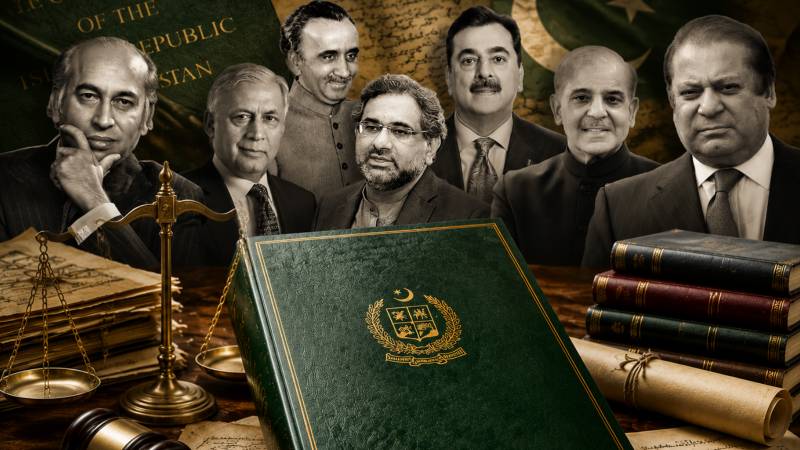
Pakistan has had three constitutions and mislaid every one of them at least once. The first arrived in 1956 and was gone inside two years. The second, in 1962, was cut to a single man's measurements. The third, agreed in 1973, is technically still with us. However, it has been amended so often that it now resembles a coat handed down through a large and quarrelsome family, each heir taking in a seam or letting out a pocket until the original garment is a matter of speculation. Other countries treat a constitution as a foundation. We have treated ours as soft furnishing, rearranged whenever the light changes, the guests change, or the man of the house wants a different view from the window. To understand how a country picks up this habit, you have to meet a judge named Munir.
In 1954, the Governor-General dismissed the Constituent Assembly, the body then engaged in writing the constitution, because it was taking too long. The Assembly's president, Maulvi Tamizuddin Khan, went to court. The Sindh Chief Court sided with him. Then the case climbed to the Federal Court, whose Chief Justice, Muhammad Munir, reached for a phrase that would outlive him by seventy years: the doctrine of necessity. That which is otherwise unlawful, he reasoned, necessity makes it lawful. The dismissal stood. A country three years into its life had just learned that its highest court would, when pressed hard enough, find the words to say yes.
Munir was not finished. In 1958, when Ayub Khan tore up the constitution altogether and declared martial law, the same court took a modest smuggling case called State versus Dosso and used it to bless the entire enterprise. A successful coup, the reasoning ran, is its own source of law. Break the constitution cleanly enough, and the break becomes legal. It was an elegant argument. It was also, if you sat with it for a moment, the legal equivalent of informing a burglar that the house becomes his the instant he gets both feet through the window.
This became the pattern, and patterns in this country are stubborn things. In 1977, when Ziaul Haq removed the elected government of Zulfikar Ali Bhutto, the very man who had steered the 1973 constitution into being, the Supreme Court heard Begum Nusrat Bhutto's challenge and produced the doctrine of necessity once again, this time with the added generosity of letting the general amend the constitution however he pleased. In 2000, after another general had sent another elected government home, a case called Zafar Ali Shah gave Musharraf three years in power and, for good measure, that same authority to rewrite the very document he had just suspended. Three seizures of power, three robed blessings. The court had grown very good at saying yes, and very quick about it.
I should be fair, because the record is not one unbroken surrender. In 1972 that same Supreme Court, hearing Asma Jilani's case, turned around and called Yahya Khan a usurper, conceding that Dosso had been wrongly decided all along. The judges could see the matter with perfect clarity, it turned out, once the general in question had already lost his grip on power. Hindsight has always been the bravest chamber in our judiciary.
The most inventive tinkering came under Zia, who grasped that a constitution is most useful when it can be made to hand you things. His Eighth Amendment, passed in 1985, quietly slipped in a clause, Article 58(2)(b), that let the President dissolve an elected National Assembly at will. Over the following eleven years that single clause was used to dismiss four governments, not one of which had done anything so vulgar as lose a vote on the floor. Zia had a gift for the referendum, too. In 1984 he put a question to the nation so beautifully engineered that a vote for Islam and the Sharia was, by its own fine print, a vote to keep him in office for another five years. He carried it with something like ninety-eight percent. The turnout figure was, let us say, an act of imagination.
Then, briefly, the coat was let out instead of taken in. In 2010 the Eighteenth Amendment struck 58(2)(b) from the text, returned a raft of powers to the provinces, and restored the parliament to roughly the shape the 1973 document had first intended. It was the rare amendment that gave power away rather than hoarding it. For a while it was possible to believe the old habit had been broken, that the constitution might finally be allowed to sit still and mean what it said.
It was not always lawyers alone who cared about any of this. In 2007, when a general tried to sack a sitting chief justice, the country did something it had not managed in a very long time. It took to the streets for a judge. Men in black coats marched through the heat, ordinary people marched alongside them, and the chief justice was put back on his bench. Whatever one privately thought of the man, the spectacle meant something real: a nation insisting, out loud, that the bench was worth defending. I find myself wondering where that crowd has gone, and I suspect the honest answer is that it is tired, or abroad, or has simply concluded that the marching changes nothing. I recite all of this because it is the water we are swimming in now, and because public memory in this country has roughly the shelf life of a cut mango.
Last November an amendment, the twenty-seventh, moved through both houses of parliament in under a week. Our legislature, which can require a full session to decide whether to hold a session, discovered sudden and uncharacteristic focus. The amendment did several things at once, but its heart was the judiciary. It conjured an entirely new court, a Federal Constitutional Court, and handed it the power to interpret the constitution, which is another way of saying it removed that power from the Supreme Court that had held it since the beginning. The old court still stands. It has simply been relieved of the questions that matter most.
Other countries treat a constitution as a foundation. We have treated ours as soft furnishing, rearranged whenever the light changes, the guests change, or the man of the house wants a different view from the window.
Three senior judges declined to take their places in the new arrangement and resigned, among them men widely counted the most independent on the bench. Lawyers in Lahore set down their files and walked out. The International Commission of Jurists described the amendment, in the flat and careful language such bodies reserve for the moments they are genuinely alarmed, as a direct assault on judicial independence and the rule of law. The International Bar Association's human rights arm went further, warning that the whole design was built to lift certain offices above the law and to turn accountability into a museum exhibit. One of its senior figures, herself a Pakistani lawyer who has spent a lifetime in exactly these fights, observed that an amendment granting lifelong immunity from prosecution makes a quiet joke of the notion that all citizens stand equal before the law.
Here is what stays with me, sitting with the whole sequence from Munir to now. For seventy years, power in this country still had to ask. It had to stage its coup and then dispatch its lawyers to court, hat in hand, to have the thing pronounced necessary after the fact. The judges obliged, over and over, but the asking itself mattered. It meant there was still, at least in theory, someone whose job was to say no, even if the no almost never came.
What the twenty-seventh amendment does is retire the asking. It writes the blessing into the architecture in advance. There is no longer any need for some future Justice Munir to improvise a doctrine of necessity in the heat of a crisis, because the necessity has already been pre-approved, notarised, and stitched into the constitution itself. A court that once had to be talked into saying yes has been quietly replaced by one designed to have no other word available to it.
We used to console ourselves, grimly, that at least the forms were observed. The general had to knock. The judge had to reason his way to it. The fiction had to be kept up, and a maintained fiction is at least a backhanded admission that the truth would be unacceptable if stated plainly. We have now dispensed with the fiction. The house has been signed over while the burglar is still politely wiping his feet on the mat, and the court has been good enough to hold the door for him. I keep returning to that coat, altered season after season by a family that can no longer quite remember what it was for. Somewhere beneath all the seams and re-stitched pockets is the original garment of 1973, the one thing those quarrelsome heirs once managed to agree on. You would only need a court willing to go, looking for it.