

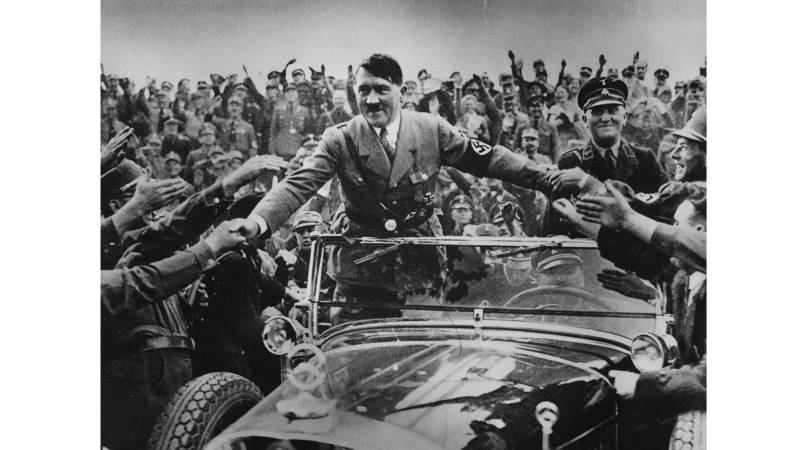
Hitler became the Fuhrer of Germany through a democratic process on the 30th of January 1933. In the next six years, he turned Germany’s first democracy into a tyranny. Then, on the 1st of September 1939, he attacked Poland seeking to fulfil what he considered was Germany’s destiny. In his view, the Third Reich would encompass all of Europe and last forever.
In response to his invasion of Poland, Great Britain and France declared war on Germany two days later. Knowingly or unknowingly, Hitler had lit the spark that would ignite the Second World War. Unlike the First World War, it would extend far beyond the borders of Europe.
His rule ended on the 30th of April 1945, when he shot himself in the head after swallowing a cyanide capsule. The Soviet army was standing on the gates of Berlin. He knew the game was over.
How did Hitler turn a well-educated country into an authoritarian dictatorship seething with revenge and Aryan supremacy, where most of the citizens were denied their basic civil and human rights?
Myriads of books have been written on Hitler. But a key question still remains: how did he end up governing Germany? Historian Volker Ullrich explores it in his latest book, Fateful Hours: The Collapse of the Weimar Republic. Germany’s first democracy was established on the 9th of November 1918, following the abdication of Kaiser Wilhelm II, Germany’s last Emperor and King of Prussia. Overconfident and arrogant to a fault, the Kaiser plunged Germany into the Great War, which would later be called the First World War.
On the 11th of November 1918, Germany signed the Armistice in the Compiègne Forest within the Rethondes Clearing in France. The signatories were the Allies (represented by France and Great Britain) and the German plenipotentiaries. Comprising 18 articles, the agreement imposed harsh conditions on Germany, notably the disarmament of its military.
It was followed on 28 June 1919 by the Treaty of Versailles, which officially declared peace between all the European nations. The Weimar Republic’s formal democratic system was finalised when the new constitution took effect on 11 August 1919. It was named after Weimar, the city in which the constitution was signed. It is located roughly three hours southwest of Berlin and three hours northeast of Frankfurt.
The Republic included a democratic system with a president, a chancellor, and a parliament, the Reichstag. It gave all adults aged twenty and over the right to vote. It also included Article 48, which let the president rule by emergency law without parliament during a state of emergency.
This signalled an official end to the First World War. Germany’s surrender came as a horrible shock to all Germans who had thought all along that they were winning the war. They woke up to realise that the Kaiser and his entourage of generals had been feeding them lies and propaganda for four years.
Three hours after Hindenburg's death, Hitler was both Germany's head of state and head of government, eliminating the last remedy by which he could be legally dismissed
The Treaty of Versailles held Germany responsible for initiating the war and required it to pay a massive sum of money in reparations for the damage caused by the war. The magnitude of the reparations stunned all Germans, and they began to lose confidence in the institutions of the state and in their leadership.
Then came the hyperinflation of 1923 which led to an unimaginable reduction in the purchasing power of the German currency, the mark. At one point, one US dollar equalled 2.52 trillion marks. Bank accounts and retirement accounts became worthless. Even a loaf of bread became unaffordable.
The currency was renominated and reissued. An economic recovery began to set in. Cultural events resumed, progress took place in science, and social freedom was restored, bringing with it a sense of normalcy. But one problem remained. The Republic had too many small political parties that prevented stability from setting in.
The last straw came in December 1929, a shock wave from across the Atlantic, the USA known as the Great Depression. It had global ramifications and Germany was not spared. Massive job losses occurred.
Adolf Hitler exploited German emotions to rise to prominence on the political stage. He was born and raised in Austria and trained as an architect. In Vienna, where he had been living in relative poverty since 1907, Hitler received the final part of his father's estate in May 1913 and moved to Munich in the German Empire, where he earned money painting architectural scenes. He did not want to serve in the Austro-Hungarian army since there were too many non-Aryans in it.
When the First World War broke out, Hitler volunteered for the German army in August 1914 and joined the 16th Reserve Infantry Regiment as a Gefreiter (lance-corporal) in the Bavarian Army. While widely called a corporal, he never reached the actual German rank of corporal (Unteroffizier).
He worked as a regimental dispatch runner, carrying messages between headquarters and front-line units. From all accounts, he served with valour in the war and was awarded the Iron Cross Second Class in 1914 and the Iron Cross First Class in 1918—a rare honour for an enlisted soldier. He was wounded by shrapnel in 1916 and temporarily blinded by a British mustard gas attack in October 1918 just before the war ended.
In November 1923, Hitler attempted to carry out a coup in Germany, the Beer Hall Putsch, with General Ludendorff against Bavaria. He was arrested and sentenced to five years in jail. He wrote his book, Mein Kampf (“My Struggle”), in 1924 while imprisoned at Landsberg Fortress in Bavaria, Germany.
The book outlines many of Hitler's political beliefs, and his plans for Germany and the world. He announced that he wanted to destroy the parliamentary system completely, believing it to be corrupt in principle, as those who reach power are inherent opportunists. Hitler betrayed his pro-Aryan sentiments by saying it was repugnant for him to see Czechs, Poles, Hungarians, Serbs and Croatians mixing with Austrians in Vienna.
In March 1940, the British writer George Orwell reviewed a then-recently published uncensored translation of Mein Kampf for The New English Weekly. Orwell suggested that the force of Hitler's personality shone through the often “clumsy” writing, capturing the magnetic allure of Hitler for many Germans. In essence, Orwell notes, Hitler offered visions of endless struggle and conflict in the creation of “a horrible brainless empire” that “stretch[es] to Afghanistan or thereabouts”. He wrote, “Whereas Socialism, and even capitalism in a more grudging way, have said to people ‘I offer you a good time,’ Hitler had said to them, ‘I offer you struggle, danger, and death,’ and as a result a whole nation flings itself at his feet.”
Hitler was released on probation prior to completing the five-year term and went on to establish a political party with a virulent anti-communist agenda that was pumped up with fiery rhetoric and intermixed with white supremacy. He brought populist demagoguery to German politics in a way that had not been seen before.
Ullrich argues that Hitler embodied the nation’s longing for a strong leader who would restore greatness to Germany. They thought he would lift them up from the humiliation suffered during the Great War. By then, Hitler had figured out how to present himself as a political messiah and exploit the public’s hopes for a salvation. He began to denounce the Weimer Republic and promised to create a united, prosperous and politically strong “German ethnic community.”
Hitler made no bones about what he intended to do once he gained power. “If our movement is victorious in its legal struggle, a state court will come, November 2018 will be atoned for, and heads will roll.” Even his opponents were impressed with his oratory. But they erred seriously in thinking they could restrain him, marginalise him and eventually force him out of politics.
He had joined the German Workers Party as an army informer. After the war he joined it and renamed it the National Socialist Party (Nazi). To give the fledgling party some visibility in the political sphere, Hitler adopted the black Swastika as its symbol. It would be worn on the shirtsleeve of ever Nazi on a red patch with a white centre and it would adorn the party flag. Additionally, to evoke a latent longing for victory, he adopted the war cry of “Seig Heil.” It was just a question of time before the “Heil Hitler” salute would become a staple of Nazi rallies.
Violence between the Nazis and those who stood in their way began to break out throughout Germany. Around the country, Nazi stormtroopers were running riot, attacking their political opponents. One of the first targets that the Nazis went after were school curriculums. They managed to ban the antiwar classic, “All Quiet on the Western Front,” three years before Hitler was installed as Chancellor. A state of political decay bordering on civil war had erupted in Germany.
Hitler kept on reassuring everyone that he would obediently follow the law, while taking every action that was against the law. In February 1932, he became a citizen and was now eligible to contest the election for Germany’s chancellor.
The German people, still recovering from the wounds of their defeat in the First World War, began to fall for his lies and half-truths, so desperate were they for a change in their political fortunes.
Hitler spoke from both sides of his mouth. From one side, he would praise Paul von Hindenburg to the hilt. After all, he was the President. From the other side of his mouth, Hitler would imply that he was old and effete, a former Field Marshal.
The gamble paid off. On 30 January 1933, Hitler was elected Chancellor. Hitler banned all other parties and suspended the Constitution. By now the SS, Schutzstaffel (“Protective Echelon”), which had been founded in 1925 to serve as Hitler’s bodyguards, had become the most powerful and feared organisation in all of Germany.
It outranked all other organisations. A major, dressed in the black uniform of the SS, outranked all generals in the Wehrmacht. Its head was Joseph Goebbels. Anyone who opposed Hitler or threatened to oppose him was rounded up and sent to Dachau by train. Trains were often packed to the point of suffocation. They did not have toilet facilities or food for the occupants who travelled for hours in miserable conditions. Those who survived were put in concentration camps, which eventually became Death Camps.
Hitler’s ascent to power was the product of a sinister game of behind-the-scenes intrigue in which a handful of players pulled the strings. Ulrich argues that Hitler’s triumph was by no means an “occupational hazard” of German history. Nor was it the consequence of a crisis in the Weimar Republic. Hindenburg could have postponed the elections. Or, worse, declared military rule, to preserve Germany’s political integrity.
Hitler's first act as chancellor was to ask Hindenburg to dissolve the Reichstag, so the Nazis and another party, the DNVP, could win a majority to pass the Enabling Act of 1933 that would give the government power to rule by decree, supposedly for the next four years. Unlike laws passed by Article 48, which could be cancelled by a majority in the Reichstag, under the Enabling Act, the chancellor was now empowered to pass laws by decree that could not be cancelled by a vote.
Hindenburg agreed. In early February 1933, Papen asked for and received an Article 48 bill signed into law that limited freedom of the press. After the Reichstag fire on 27 February, Hindenburg, at Hitler's urging, signed into law the Reichstag Fire Decree via Article 48, which suspended civil liberties. Göring, as Prussian Interior Minister, had enlisted thousands of Sturmabteilung (SA) men as auxiliary policemen, who attacked political opponents of the Nazis, with Communists and Social Democrats being singled out for particular abuse.
When Hindenburg died in August 1934, Hitler had the cabinet pass the “Law Concerning the Head of State of the German Reich,” which stipulated that upon Hindenburg's death, the office of president would be abolished and its powers merged with those of the chancellor under the title of Führer und Reichskanzler (Leader and Chancellor of the Reich).
Three hours after Hindenburg's death, it was announced that because of this law, Hitler was now both Germany's head of state and head of government, thereby eliminating the last remedy by which he could be legally dismissed and cementing his status as the absolute dictator of Germany. In a short span of time, Hitler had buried democracy and civil and human liberties in Germany.
However, he miscalculated badly when he invaded Poland in 1939. The Second World War did not end well for him. The tide had begun to turn once the US entered the war on the side of the Allies. Toward the end of 1944, the Allied forces had begun to close in on Berlin from the west and the Soviet forces from the east. Hitler spent the last six months of his life in a bunker in Berlin, which is portrayed very intensely in a movie, Downfall.
Before Hitler killed himself, he told his secretary, on whose diary the film is based: “Tomorrow, millions will hate me. That’s how it has always been in history.” He added, “History will remember us not for what we said but for what he did.” Hitler got it right in the end.
Other wannabe dictators should pay attention to Hitler’s words.