

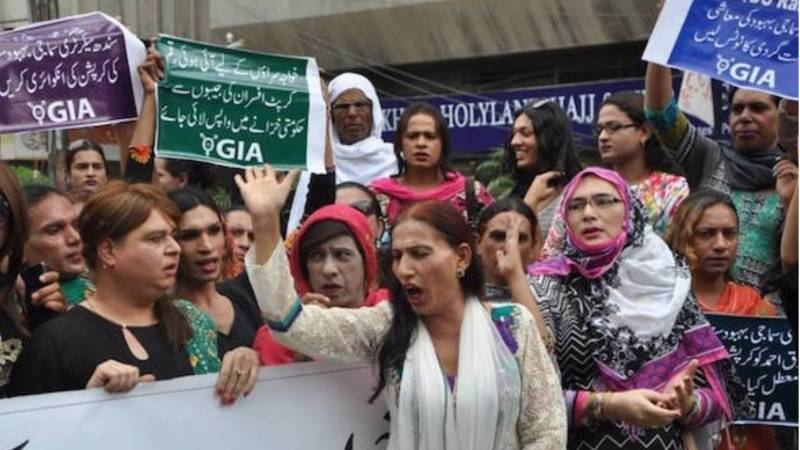
“If the third gender has existed in the Subcontinent for so many centuries, why are they still struggling for independence today?”
Before colonial influence shaped social norms in the subcontinent, gender-diverse communities held a different social position. Rather than being uniformly marginalised, they were in many contexts integrated into cultural, ritual and even political life, though this integration did not always mean equality in modern sense. Just as in pre-colonial South Asia, individuals of the third gender were often believed to possess special spiritual powers, granting them the unique authority to bestow blessings at birth and weddings, where their presence was considered essential for a prosperous future. Similarly, many rose to power under both Hindu and Muslim leaders. Many held influential positions within the Mughal court, particularly in managing royal households and private quarters. While pre-colonial South Asia integrated gender-diverse individuals into state and court structure, the British Raj soon had other plans.
British colonial administration destroyed the local social dynamics and replaced them with rigid binary codes like the Criminal Tribes Act of 1871. Rather than covering all of the sections targeting the transgender community, we would be focusing on two of the harshest provisions. To begin with, section 26. It allowed a registered “eunuch” to be arrested without a warrant for appearing in public dressed like or ornamented like a woman and also targeted public dancing, music and performances. The punishment could reach two years of imprisonment, a fine or both. What had once been a visible identity had then been restricted, demonstrating how colonial authorities attempted not only to regulate behavior but also the community's public visibility and expression as a whole.
Equally devastating was section 29, which extended these restrictions into private and legal lives of registered “eunuchs”. It prevented them from acting as guardians of minors, making gifts, creating wills or adopting a son. In doing so, the act placed limitations on the ability to exercise ordinary family and property rights, demonstrating that colonial regulation extended beyond public behavior into personal and legal life. Then came the period of 1947 to 1949, when the Madras Presidency attempted to repeal via the Criminal Tribes Act (Madras Repeal), which did not mainly focus on providing rights to the community, but it rather marks the first step towards ending systemic discrimination in the subcontinent.
Before colonial rule reshaped social norms, gender-diverse communities were often integrated into cultural, spiritual, and political structures across South Asia. Colonial laws transformed visibility into criminality.
From here, the focus shifts towards the gradual pursuit of equitable treatment for the transgender community in Pakistan. A significant change began to emerge through Pakistan's judiciary in Dr. Mohammad Aslam Khaki vs. SSP (Operations) Rawalpindi. During the timeline of 2009–2013, the Supreme Court affirmed that the transgender citizens were entitled to the same fundamental rights as the other citizens. This judicial recognition was further reflected in Mian Asia vs. Federation of Pakistan, where the High Court addressed the difficulties faced by transgender citizens in obtaining a CNIC and emphasized the importance of recognition and dignity before the law. These developments paved the way for a broader legislative recognition of transgender rights, culminating in the Transgender Persons (Protection of Rights) Act, 2018.
In September 2022, Karachi witnessed a case that highlighted the consequences of stigma surrounding the transgender community. A man was convicted of the murder of a transgender person, the reported motive being the "spread of vulgarity." This case illustrates how deeply rooted social prejudices can intersect with violence against transgender people, even within a society where their legal recognition has increasingly developed. This was not an isolated case. In November 2025, two transgender people were killed in Lakki Marwat by unidentified suspects, further demonstrating this vulnerability. However, violence is not limited to individual attacks; reports from Khyber Pakhtunkhwa in 2025 also highlighted protests and alleged attempts to drive transgender people from certain districts, pointing towards a broader form of social exclusion.
Pakistan has undoubtedly taken steps towards recognizing the rights of its transgender citizens, from judicial intervention to legislative protection. Yet recognition on paper does not always confirm acceptance. The persistence of violence, exclusion, and discrimination suggests that changing legislation is only one part of eliminating a system shaped by generations of social stigma. Legal rights can provide protection, but they cannot by themselves transform public attitudes or guarantee that those rights are attainable in practice. After all of this, we are once again brought back to the same question: “If the third gender has existed in the subcontinent for so many centuries, why are they still struggling for independence today?” Perhaps the answer lies not in their non-existence from our history, but in how that history has been written, distorted, and passed on from one generation to the next. Their existence was never the question—their equal place in society was.