

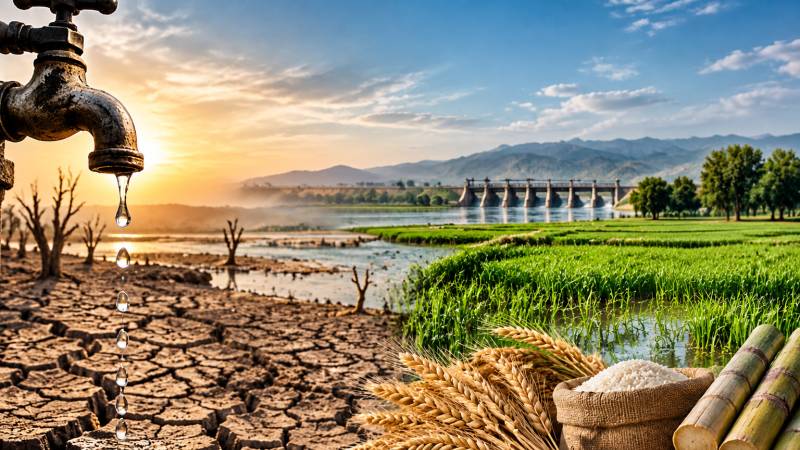
By 2050, the world will need to feed nearly 10 billion people. The World Bank’s “Nourish and Flourish” report warns that current agricultural water management can sustainably feed only 3.4 billion. The challenge is not only scarcity but imbalance. Some regions overuse water and damage ecosystems, while others underuse water and fail to unlock food and jobs. Pakistan is placed in the report’s global framework as water deficit and calorie surplus. This means the country produces more food calories than it consumes, but at the expense of its scarce water resources. The Indus Basin Irrigation System, once a symbol of abundance, now struggles with inefficiency, groundwater depletion, and climate stress. Pakistan’s apparent food security is concealing ecological insecurity.
Government policies often emphasize building new dams or expanding irrigation canals. But are these measures sustainable, or are they short-term injections? Should Pakistan continue to grow water-intensive crops like rice and sugarcane in water-scarce zones, or shift toward crops that match local water realities? Is trade being used strategically to balance food and water needs, or is it simply filling gaps created by poor planning? The report challenges policymakers to ask whether subsidies and outdated practices are locking Pakistan into inefficiency. Are investments being made in rain fed agriculture where water is abundant? Are ecosystems in the Indus Delta being protected, where sea water intrusion is destroying farmland and mangroves? Most importantly, are policies being designed to balance food security with sustainability?
Other countries show what is possible. In Sub-Saharan Africa, expanding irrigation within ecological limits could create 218 million jobs, unlocking both food production and livelihoods. Israel turned scarcity into resilience through drip irrigation, desalination, and strict water accounting. Australia’s water trading system demonstrates how markets can allocate water more efficiently. Pakistan’s classification as water deficit and calorie surplus highlights its paradox. The country produces more calories than it consumes, but this surplus is achieved by overusing scarce water. Heavy reliance on water-intensive crops has created a false sense of food security while groundwater tables fall and the Indus Delta suffers from reduced flows. Expanding irrigation without efficiency reforms risks worsening scarcity. Ignoring rain fed agriculture wastes opportunities. Neglecting trade strategy leaves Pakistan vulnerable to global shocks.
Pakistan’s apparent food security is concealing ecological insecurity; the country produces more calories than it consumes, but at the cost of draining its scarce water resources.
Pakistan faces serious barriers. More than 90 percent of freshwater is consumed by agriculture, yet irrigation efficiency remains below 40 percent. Groundwater is pumped without regulation, leading to falling tables in Punjab and Sindh. Sea water intrusion in the Indus Delta is destroying farmland and forcing lower riparian communities to migrate. Globally, freshwater reserves are shrinking by 324 billion cubic meters each year, enough to meet the needs of 280 million people. Pakistan reflects this crisis, with desertification spreading in Sindh and Balochistan. At the same time, food imports are rising, showing that water is not being used to secure national food needs.
The paradox is stark. Pakistan is producing a calorie surplus while living with a water deficit. This surplus is achieved by draining aquifers, reducing flows to the delta, and undermining ecosystems. What looks like food security is in fact ecological insecurity. Financing adds another layer of difficulty. Transforming agricultural water management requires investment, but Pakistan already spends heavily on subsidies that encourage wasteful practices. Redirecting these resources could fund efficiency, resilience, and ecosystem protection.
The way forward must be multi-pronged. Pakistan should reform crop subsidies to discourage water-intensive crops in dry zones and promote diversification. Rain fed agriculture should be strengthened in areas with abundant rainfall. Irrigation efficiency must be improved through drip systems, laser land leveling, and better canal management. Trade must be used strategically. Pakistan should import water-intensive crops where local production is unsustainable and focus on exporting crops that require less water. This aligns with the water-food nexus framework, which emphasizes balancing domestic production with trade to protect ecosystems.
Governance must be strengthened. Water allocation laws should be implemented which guarantee flows to the Indus Delta to push back sea water intrusion. Institutions must enforce groundwater regulation and ensure equitable distribution between provinces. Reliable water services, supported by clear rules, better information, and regular water audits, are essential to track usage, identify waste, and ensure accountability. Private sector investment and innovation can help scale solutions. Machine learning tools, remote sensing, and farmer-led irrigation can identify opportunities and improve productivity. Globally, the report estimates that aligning crop production with median efficiency could save 137 billion cubic meters of freshwater each year, equal to the needs of 118 million people. Pakistan could capture part of this saving by modernizing its practices.
Pakistan’s water-food crisis is no longer distant. It is visible in falling groundwater tables, rising food imports, and sea water intrusion in the Indus Delta. The Nourish and Flourish report shows that feeding 10 billion people globally is possible, but only if countries like Pakistan manage water wisely. The paradox of Pakistan’s position is striking. It is a country with a water deficit but a calorie surplus. Food production is being achieved by overusing scarce water, leaving ecosystems degraded and lower riparian communities exposed. This track is not sustainable. The choice is clear. Continue with wasteful practices and face ecological collapse, or embrace reform and resilience. With evidence-based policies, stronger institutions, and smarter investments, Pakistan can transform its agricultural water management to nourish its people and protect its ecosystems. The time to act is now, before the Indus Delta sinks deeper into the sea and Pakistan’s food security slips further out of reach.