

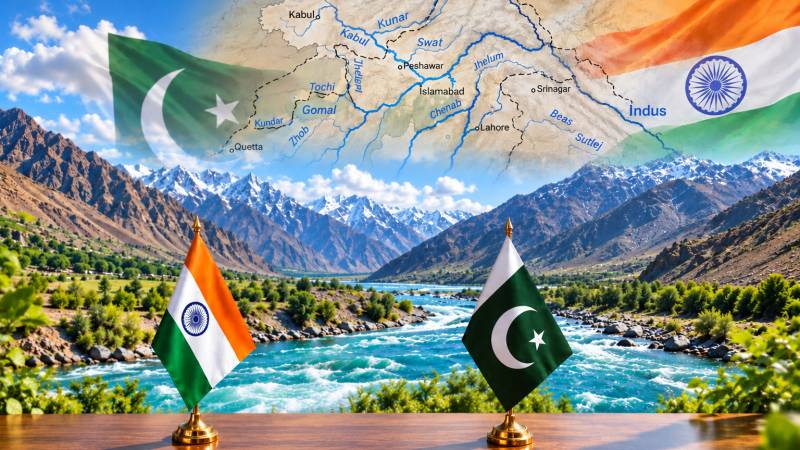
In the days after the attack in Kashmir in April 2025, and the short war between Pakistan and India that followed that May, I was in Pakistan on a project to improve water management in Sindh province. I found myself, first, in conversations among colleagues trying to make sense of what was happening, and later in a conversation with higher officials, laying out, as a hydrologist rather than as a diplomat, what it would actually take to keep the Indus Waters Treaty alive. Seventeen months later, on September 1, 2026, the Permanent Court of Arbitration in Den Haag ruled, unanimously, that the Indus Waters Treaty "remains fully in force" and that India must observe its obligations under it. The court rejected every justification India had offered for suspending the treaty, finding no basis in international law for unilateral suspension on grounds of sovereignty, terrorism, or changed circumstances. It was among the clearest rulings international arbitration produces: unanimous, procedurally unimpeachable, and unambiguous in its language.
Within days, India rejected the ruling and confirmed it would keep the treaty in abeyance. Nothing on the ground changed. River-flow data that has been withheld since 2023 continues to be withheld. Inspections that have been blocked continue to be blocked. The Permanent Indus Commission, the treaty's own mechanism for resolving exactly this kind of dispute, has not convened since May 2022, long before any of the events that followed. It is worth being precise about what kind of moment this is. Abeyance is not termination, and rejection of a ruling is not the end of a dispute; both are positions each government is actively choosing to hold, day by day, under the particular pressures of this moment, rather than settled facts about how this relationship must now remain. Positions held under pressure can be revised once the pressure changes. Nothing that follows should be read as a fixed endpoint. It is a point in an ongoing argument that is still, visibly, being had.
None of what follows is intended to assign blame to either government, and readers looking for a verdict on who is right in the underlying dispute over Kashmir and cross-border violence will not find one here. That question sits outside what a hydrologist has standing to answer, and moralizing it further is, if anything, part of the problem this piece is trying to describe. What follows is a narrower argument: about why a legally clean ruling failed to change anything on the ground, and about what that failure reveals regarding the treaty's design rather than either country's conduct.
This is worth pausing on, because it is not a small or technical failure. A body with real legal standing examined the facts, applied the relevant law, and reached a unanimous conclusion, and that conclusion changed nothing about how either country is actually behaving. If the purpose of a ruling is to settle a dispute, this one did not. If the purpose is to establish who is legally correct, it succeeded completely and still did not settle the dispute. Those two things are not supposed to come apart this cleanly, and the fact that they did tells us something important about what has actually broken in the treaty's management, and about what water diplomacy generally requires that a court ruling, on its own, cannot supply.
It helps to look at what actually broke, and when. The sequence is by now familiar, but worth restating plainly. In April 2025, an attack in Kashmir killed 26 civilians. India, linking the perpetrators to Pakistan, declared the treaty in abeyance and demanded that Pakistan "credibly and irrevocably" end support for cross-border terrorism before cooperation would resume. A brief but serious military confrontation followed in May. Since then, the treaty has existed in a strange administrative limbo: neither formally terminated, since the treaty contains no exit clause and international law offers India no basis for unilateral suspension, nor functioning in practice.
What is easy to miss in this sequence is that the treaty's procedural machinery had already stopped working well before the crisis that triggered its formal suspension. The Permanent Indus Commission, which is required to meet regularly to review operations, exchange data, and resolve technical disagreements before they escalate, had already gone quiet by 2022, a body that depends on both governments choosing to convene it, and that neither side worked to revive as relations cooled in the years before the attack. The abeyance declaration did not break a healthy institution. It formalized the collapse of one that had already been failing quietly, for reasons that had little to do with the attack that made the failure impossible to ignore.
Durable agreements over contested resources depend not only on strong legal texts, but on genuine consultation, continuous data-sharing, proportionate consequences and a shared approach to managing risk.
This distinction matters because it changes what kind of problem the Den Haag ruling was actually being asked to solve. A ruling can settle a legal question. It cannot, by itself, restart a data-sharing relationship, rebuild a commission's habit of meeting, or supply the kind of ongoing, low-stakes cooperation that made the earlier decades of the treaty's operation function without needing to invoke arbitration at all. The treaty survived wars for sixty years not because its legal text was unusually robust, but because both countries kept doing the unglamorous procedural work of running it. When that work stopped, no ruling was going to restart it from outside.
The Indus Waters Treaty, for all its historic achievement, was never built with much of this in mind, because it did not need to be for most of its life. It was designed in 1960, with World Bank mediation, to divide the six rivers of the basin geographically: the three western rivers to Pakistan, the three eastern rivers to India. That allocation held for decades not because the treaty anticipated a moment like this one, but because neither side had much reason to test it. The treaty's dispute-resolution provisions, including the option of arbitration in Den Haag, were built for technical disagreements between two parties who still, fundamentally, wanted the arrangement to continue. They were not built for a moment when one party had concluded the political cost of appearing to comply outweighed the cost of simply not complying, backed by nothing more than a demand the other side has no realistic way to satisfy on the timeline being asked.
Put differently: the ruling failed to change behavior not because international law is toothless in general, but because the treaty's own machinery for making compliance matter, the day-to-day habits of consultation and data-sharing that once gave both countries a reason to keep working through the relationship rather than around it, had already stopped functioning by the time the ruling arrived. That is a design gap, not a verdict on either country's intentions, and design gaps, unlike the underlying political relationship, can in principle be closed. Consequences for non-compliance need to be proportionate and agreed in advance rather than improvised after the fact, so that a state deciding whether to comply is weighing a known cost against a known benefit rather than guessing at an open-ended one. And perhaps most importantly, compliance needs to be treated as a matter of shared risk management rather than moral vindication, because once a technical obligation becomes a referendum on one side's righteousness, backing down from it costs far more than the underlying issue would otherwise warrant.
It is this last point that deserves the most attention, because it is the one most within either government's control right now, independent of any deeper resolution of the political relationship. Framing India's continued participation as something it must earn through proof of Pakistan's good conduct turns a water-sharing mechanism into a morality test, and morality tests are, by their nature, things a government cannot be seen to fail publicly and still retain domestic credibility. A risk-management framing does not ask either side to concede a moral point. It asks both to recognize that the failure of the treaty is a cost neither can fully contain, regardless of who is judged to be at fault, since both countries' agricultural and urban water security ultimately depend on the same river system continuing to be managed rather than abandoned.
It would also be a mistake to treat any of this as a peculiarly South Asian failure. A strikingly similar structural gap is currently playing out on the Colorado River in the western United States, among seven American states that have shared that river's water since 1922 under a compact of their own. There, too, the formal mechanisms for resolving disagreement have begun to strain under pressure the original agreement never anticipated. One state, Nevada, has already filed suit against the federal government rather than continue working through the states' own consensus process, and water engineers there have begun openly proposing new statutory authority, an empowered federal "referee" with real, legally bounded power, precisely because they recognize that a body without teeth, however fair its process, risks the same fate the Den Haag ruling has just met on the Indus.
The proposal now being discussed there is instructive precisely because it targets the same gap. It pairs an authority empowered to act when consensus fails with mandatory consultation for every affected party, review clauses that keep the arrangement from calcifying into something no one can adjust, and consequences for non-compliance that are set out in advance rather than invented after the fact once a state has already decided to defect. It is, in other words, an attempt to build in, ahead of time, what this piece has argued was missing from the Indus treaty: not more law, but more of the ordinary maintenance that makes law worth following. Whether it succeeds is not yet settled, and there is no guarantee it will. But the fact that it is being attempted at all, in a basin edging toward the same kind of impasse, is itself evidence that the gap behind Den Haag's toothless ruling is not some fixed feature of how these two particular countries happen to be arranged relative to each other. It is a gap that can be designed around, if the parties involved are willing to do the designing before the next crisis rather than during it.
It is worth remembering, too, that this is not a new instinct for the American West. In 1934, Arizona's governor declared martial law and sent the National Guard to physically halt construction of a dam on the Colorado River he believed violated his state's rights, backed by two commandeered ferries the press nicknamed, only half in jest, the "Arizona Navy." Arizona did not ratify the underlying compact for another decade after that standoff, a decade in which its refusal looked, to most outside observers, like a settled and permanent fact about the state's relationship to the river. It was not. The willingness of a party under enough pressure to simply step outside an agreed process, rather than work through it, is not unique to any one country or culture. It appears to be a recurring feature of what happens when the maintenance of an agreement is neglected long enough that only the crisis, and not the habit of resolving it together, remains. But it is worth holding onto what the Arizona case also shows: a position that looks immovable from outside is still, for the party holding it, a choice being renewed rather than a fact already fixed, and choices of that kind can change once the pressure that produced them does.
That comparison is not offered to suggest Colorado holds a lesson Indus has somehow failed to learn, or the reverse. The two situations differ enormously in stakes, history, and the underlying political relationship between the parties. What the comparison does suggest is that the specific failure now visible on the Indus, a fair ruling that changed nothing, is a structural pattern that shows up wherever an agreement's day-to-day maintenance has been allowed to lapse for long enough, and not a peculiarity of India and Pakistan's relationship alone. Nor, on the evidence of what Colorado is now attempting, is it a permanent condition of the basins where it appears. None of this, though, is a case for abandoning the treaty, and it is very much not a case for treating either government's current position as immovable. The Indus Waters Treaty has survived sixty-six years, two wars, and periods of hostility at least as severe as the present one, because enough of its underlying machinery kept functioning even when the political relationship above it did not. That machinery can, in principle, be restarted, though not by a single ruling, however clean, and not while compliance continues to be framed as something one side must prove it deserves rather than something both sides need regardless of what has already gone wrong.
The more realistic path back begins smaller than a grand renegotiation: resuming the routine, low-visibility work the Permanent Indus Commission was built to do, restoring the flow of data that gives both countries a shared picture of what is actually happening on the river, and finding language for compliance that both governments can accept without it reading as capitulation to the other's political demands. None of that resolves the underlying dispute over Kashmir, and none of it should be expected to. But the underlying dispute is not, in fact, what Den Haag was asked to rule on, and its resolution is not, in fact, a precondition for the river's management to resume functioning. Conflating the two is precisely the moral framing this piece has argued against, and untangling them may be the most practical step available to either government that does not first require the other to change its mind about anything larger. The ruling was never going to be enough on its own. The real work, as it was before the ruling and will be after it, is the unglamorous kind: the data exchanged, the commission convened, and the small commitments kept long enough for the larger ones to become possible again. That work does not make for a satisfying verdict. It is, nonetheless, the only kind that has ever actually kept this river governed. Which direction this goes from here is not yet decided. It rarely is until enough small choices have quietly determined it.