

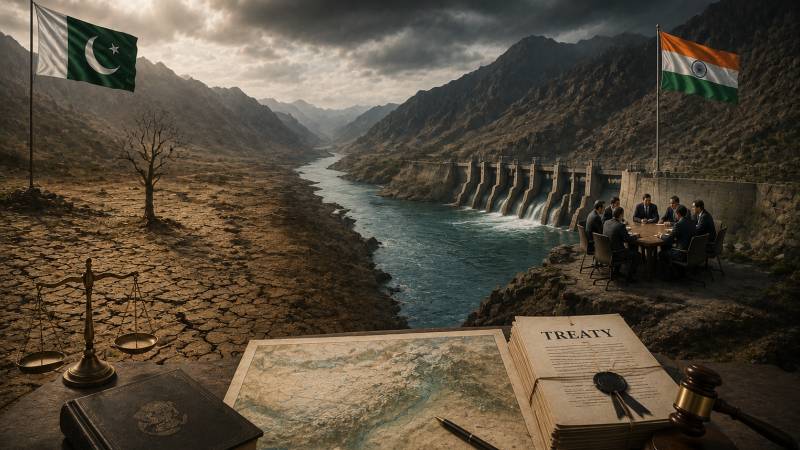
India’s suspension of the Indus Waters Treaty (IWT) in May 2025, following the baseless Pahalgam terror attack, has opened a dangerous new chapter in South Asia’s already fragile security landscape. The treaty, signed in 1960 with World Bank mediation, was long considered a rare success story of transboundary cooperation. It underwent wars, crises, and decades of hostility between India and Pakistan. Its abrupt suspension now threatens not only bilateral water resources management but also regional stability, raising the possibility of water being used as a weapon in one of the world’s most volatile regions.
The Indus Basin itself emphasizes the gravity of this decision. Originating in the glaciers of the Himalayas, Karakoram, and Hindu Kush, the basin covers about 1.1 million square kilometers and sustains approximately 300 million people across India and Pakistan. The Indus River inclines from elevations above 4,500 meters in Tibet and Kashmir to less than 10 meters at its delta in Sindh, creating steep gradients in its upper reaches and a flatter slope averaging 1:7,000 across the Sindh floodplains. This topographic transition explains both the massive hydropower potential upstream and the vulnerability of downstream floodplains. The Indus floodplain, stretching across Punjab and Sindh, is fertile but fragile; its flat terrain makes it highly dependent on controlled irrigation flows, and any disruption upstream converts rapidly into shortages downstream.
Average annual flows of the Indus River system are estimated at 207 billion cubic meters, yet variability is high. Monsoon rainfall contributes about 80% of annual discharge, while glacial melt provides critical base flow during dry months. Pakistan, as the downstream riparian, depends on this system for 93% of its total water use, irrigating 16 million hectares of farmland. With live storage capacity in its major reservoirs, Tarbela and Mangla, limited to just 14.4 million acre‑feet, hardly 10% of annual flows, any disruption in upstream releases can trigger immediate shortages. This structural imbalance between upstream control and downstream dependency lies at the crux of the issue.
India’s decision raises critical questions about intent and timing. Was this move a genuine response to terrorism, or a calculated strategy to exploit its upstream geography to punish Pakistan? The suspension coincides with New Delhi’s broader agenda of asserting control over Kashmir and curbing Islamabad’s alleged support for separatists. Indian Prime Minister Narendra Modi’s earlier declaration that ‘‘blood and water cannot flow together’’ has now been converted into policy. Yet the timing, amid sensitive nationalist rhetoric and regional insecurity, suggests political maneuvering rather than a purely security‑driven response.
From the perspective of international law, India’s suspension is indefensible. The IWT contains no exit clause, and under the Vienna Convention on the Law of Treaties (1969), the principle of ‘‘pacta sunt servanda’’ obliges states to honor treaties in good faith. By unilaterally suspending its obligations, India violates this keystone of treaty law. The Permanent Court of Arbitration (PCA) has already ruled that unilateral abeyance is impermissible, reinforcing Pakistan’s legal position. Moreover, the UN Convention on the Law of Non‑Navigational Uses of International Watercourses (1997) codifies the doctrine of “no significant harm,” prohibiting upstream states from actions that cause material damage downstream. India’s closure of sluice gates on the Chenab, reducing flows by up to 90%, is a textbook breach of this principle.
Comparative legal frameworks further highlight the illegitimacy of India’s move. The Nile Basin Cooperative Framework Agreement requires consensus among riparian states for any major alteration of water rights. Ethiopia’s unilateral filling of the Grand Renaissance Dam has been challenged by Egypt and Sudan precisely on grounds of “significant harm.” Similarly, the Mekong River Commission, though not as binding as the IWT, obliges member states to consult and negotiate before altering flows; unilateral withdrawal is not permitted. In contrast, India’s rejection of the PCA ruling and its claim that the Court of Arbitration is “illegal” undermines not only the IWT but also the principle of pacta sunt servanda, eroding trust in international law itself.
The geographical imbalance magnifies the conflict potential: India can delay or throttle releases with immediate downstream consequences.
The challenges for Pakistan are enormous. With average annual rainfall of just 240 millimeters, among the lowest in Asia, Pakistan is already one of the most water stressed countries in the world. Its per capita water availability has fallen from 5,000 cubic meters in 1950 to less than 1,000 cubic meters today, crossing the threshold of water scarcity. The Indus floodplain supports crops such as wheat, rice, sugarcane and cotton, contributing one‑fourth of Pakistan’s GDP. Any disruption in Indus flows threatens catastrophic agricultural losses, food shortages, and economic paralysis. The textile and fertilizer industries, which rely heavily on irrigation water, could collapse under scarcity. Social unrest, militant recruitment, and heightened insecurity are probable consequences.
The hydrological asymmetry is severe. India, as the upper riparian, controls the headwork’s and slopes that determine flow velocity and timing. Run‑of‑river projects such as Kishenganga and Ratle exploit steep gradients in Kashmir, where river slopes exceed 1:500, enabling rapid diversion and storage. Pakistan’s plains, in contrast, rely on flatter gradients and canal networks that require predictable flows. This geographic imbalance magnifies the political one: India can delay or throttle releases with immediate downstream consequences, while Pakistan has little capacity to safeguard such surprises due to inadequate reservoir storage and sedimentation.
The fallout extends beyond Pakistan’s borders. The suspension weakens international legal norms at a time when water insecurity is growing globally. If a major power like India can unilaterally walk away from a longstanding treaty without consequence, it undermines trust in multilateral frameworks essential for managing transboundary resources globally. China, meanwhile, has seized the opportunity to frame India’s move as coercive diplomacy, signaling support for Pakistan and hinting at its own ability to throttle water flows from the Brahmaputra. This adds another sheet of complexity to South Asia’s already fraught geopolitics.
Solutions lie not in abandonment but in reform. The IWT must be modernized to address contemporary challenges such as climate change, drought management, and upstream dam impacts. Glacial retreat in the Himalayas is projected to reduce Indus flows by up to 30% by 2050; extreme rainfall events and glacial lake outburst are already triggering flash floods that kill hundreds annually. Credible independent third‑party mediation is essential. The United States, with longstanding ties to both India and Pakistan, is well‑positioned to facilitate dialogue and reinforce mechanisms like the Permanent Indus Commission and arbitration processes. Reforming the treaty would not only safeguard water security but also prevent its weaponization from becoming a new front in South Asia’s conflicts. Without engagement, the suspension risks transforming a technical dispute into an ideological war, with consequences far beyond the Indus Basin.
India’s withdrawal from the IWT is a dangerous gamble. It threatens Pakistan’s survival, destabilizes the region, and undermines global norms of cooperative resource management. The prudent course is not to weaponize water but to strengthen frameworks that ensure its equitable sharing. South Asia cannot afford to let its lifeline become a fault line. The future of the Indus Basin must be secured through dialogue, reform, and renewed commitment to cooperation, not through unilateral actions that risk turning water into a weapon of war.