

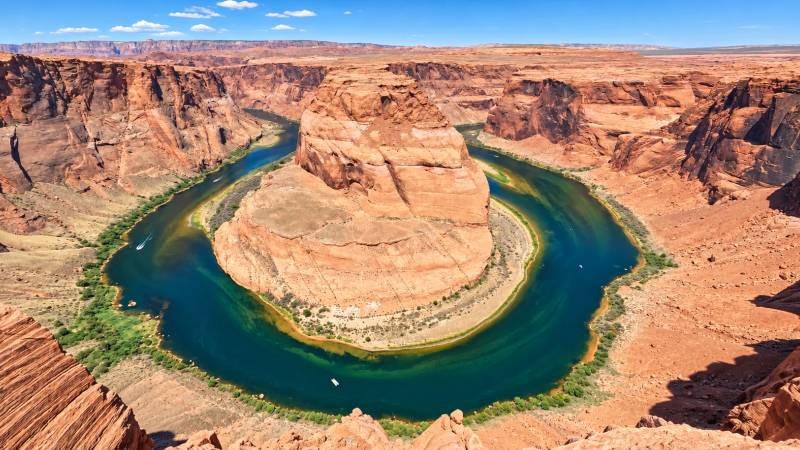
The Colorado River crisis carries a warning for Pakistan: allocating water is not the same as governing scarcity. The Colorado River is running short of the water around which the American Southwest built its farms, cities and political bargains. Lake Mead and Lake Powell have fallen sharply, and seven American states remain divided over who should bear the burden of adjustment. Pakistan should pay attention. Not because Colorado offers a success story. It does not. Its value lies in what it reveals about a river system whose legal expectations have become increasingly difficult to reconcile with physical supply.
The American response has been to build successive layers of operating rules around its foundational agreements: shortage triggers, reservoir guidelines, conservation arrangements and scenario modelling. Political disagreement remains, but scarcity can increasingly be managed without renegotiating the entire allocation bargain whenever the river falls short. That is the lesson Pakistan needs.
Our interprovincial water debate returns to familiar arguments whenever supplies tighten. Punjab and Sindh do not generally dispute the basic allocations written into the 1991 Water Apportionment Accord. The recurring disagreement concerns how shortages should be shared, how Paragraph 14 should be interpreted, which operational formula should apply, and whether forecasts and measurements are reliable. The Accord divided the river. What Pakistan never completed was the operating system beneath that bargain. The answer is not to reopen provincial shares. That would risk converting a difficult management problem into a fundamental federal dispute. The more practical course is to make the existing settlement work under increasingly unpredictable conditions.
The Council of Common Interests should approve an Indus Scarcity Operating Protocol beneath the Accord. It would establish agreed hydrological conditions, from normal availability through severe shortage and emergency, with predetermined operational consequences attached to each. The Indus cannot copy Lake Mead's reservoir-elevation triggers. Our system depends much more heavily on seasonal flows and their timing. An Indus framework would combine forecast and actual rim-station inflows, reservoir storage, remaining seasonal availability and other agreed indicators.
The principle is transferable: move the argument upstream in time. Negotiate the rule before the drought arrives.
The principle is transferable: move the argument upstream in time. Negotiate the rule before the drought arrives, not the drought after it has arrived. This requires resolving the contested three-tier formula, not avoiding it. CCI should examine the consequences of competing interpretations under identical historical hydrology before settling the applicable rule. What would each province have received under different formulas? Where are the differences material? How would those rules perform under consecutive droughts or lower storage?
Pakistan's water disputes contain too many competing narratives and too few agreed counterfactuals. Much of the technical capacity already exists. Work undertaken with IRSA and Pakistan's water institutions has formalised the complex Accord planning process into a sophisticated modelling tool. The next step is to make that capacity a foundation for shared decisions.
A Shared Indus Facts Platform should expose common forecasts, reservoir assumptions, authorised allocations and actual withdrawals. Independent verification should establish whether measurements and deliveries correspond with agreed rules. This must include Balochistan, whose supplies depend partly on conveyance through infrastructure upstream of its provincial boundary. Allocation and actual delivery are not the same thing. Yet even this federal debate risks missing a deeper danger.
While Pakistan argues over how to divide the visible river, Punjab is drawing down a second reservoir that barely enters our national water politics. Our Lake Mead is underground. Punjab's aquifer has become a strategic buffer for agriculture, cities and industry. When canal supplies are unreliable, farmers pump groundwater. When cities expand, another well is drilled. Groundwater is too often treated as available simply because it can still be reached.
Lake Mead has a visible elevation, measured storage and controlled outlets. Punjab's aquifer is accessed through a vast network of tubewells, with inadequate measurement and groundwater regulation that remains far behind the scale of abstraction. ,Solarisation makes this more urgent. Once equipment is installed, solar power substantially reduces the marginal cost of pumping. For farmers, this can be economically transformative. For a stressed aquifer, it can also remove one of the remaining restraints on additional abstraction. The answer is not to oppose solar energy. It is to govern the groundwater being pumped.
Punjab should establish a Groundwater Security Index, classifying major aquifer zones according to water-level trends, recharge, abstraction and water quality. Stressed zones would require stronger monitoring and registration. Severely depleted zones would face tighter controls on new high-capacity abstraction. Critical zones should not permit new groundwater-dependent development without a demonstrated sustainable supply. Arizona offers a useful precedent. In its Active Management Areas, new subdivisions must demonstrate an assured water supply extending 100 years. Punjab need not copy that horizon. It should copy the principle.
Large housing and industrial developments in groundwater-stressed areas should require a Water Security Certificate before approval. A 30-year assessment could examine aquifer trends, cumulative demand, water quality, wastewater reuse and drought resilience. Do not approve the housing scheme and then ask where its water will come from. Show us the water first. Agricultural policy requires an equally important change. Governments have subsidised drip irrigation, sprinklers, watercourse improvement and canal lining. Many of these investments are valuable, but reducing diversion is not necessarily the same as reducing consumption. A farmer who uses saved water to expand acreage may leave total consumption unchanged. Canal seepage can also recharge groundwater and be pumped again elsewhere. Lining may therefore be sensible in one location while producing little basin-scale saving in another. The relevant question is how much net depletion an intervention actually avoids.
Punjab should pilot voluntary conservation contracts in severely stressed groundwater areas. Farmer organisations could be compensated for verified reductions in aquifer depletion through crop switching, reduced pumping, deficit irrigation or temporary fallowing. Government would purchase a measurable outcome rather than prescribe the hardware. Pay for depletion avoided, not equipment installed.
Pakistan should not import American prior-appropriation doctrine, turn Accord allocations into tradable commodities or create permanent private groundwater rights that could entrench over-abstraction. Nor should Colorado persuade us that storage no longer matters. Pakistan needs to preserve existing capacity and develop additional storage where justified. But storage moves water through time; it does not create long-term river yield. The reform agenda is therefore clear. Federally, establish adaptive operating rules, common modelling and independent verification beneath the Accord. Provincially, bring groundwater into the same accounting and planning framework as canals and reservoirs, and link development and agricultural incentives to sustainable water use.
The Colorado River is not a model to copy. It is a warning from a basin further along the road we are travelling. Its deepest lesson is that when a river is fully allocated and its hydrology becomes less dependable, the most important infrastructure is not only concrete and steel. It is also institutional: the rules that determine beforehand what happens when there is not enough water. Pakistan's 1991 Accord divided the river. Now we must learn to govern scarcity. And while we do so, we must recognise that one of the largest reservoirs on which Punjab already depends is being depleted not behind a dam, but beneath our feet.