

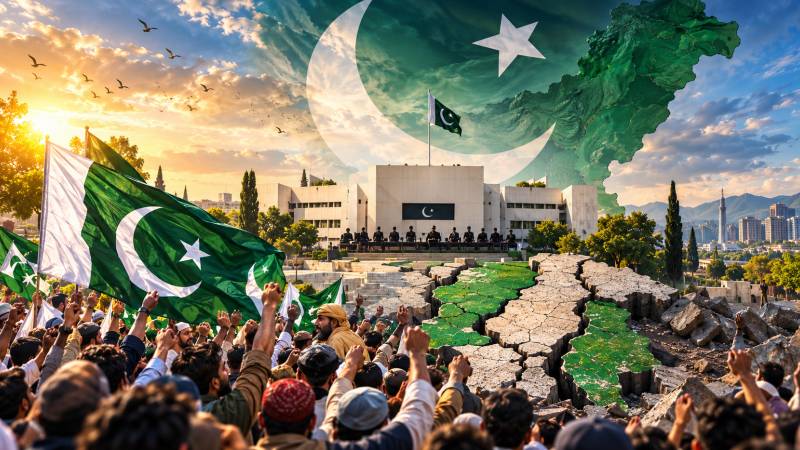
Pakistan’s polycrisis is a self-created source of political instability that is eroding state implementation capacity, risking economic development and social progress, and challenging the state to manage crises effectively. The widening dissonance between constitutional commitments and power politics, the resulting political polarisation, disenchantment and lockdowns are at a crisis point. Festering grievances are fast eroding legitimacy that provides the essential basis of voluntary compliance, public order and national security. It begs the questions: Why are legitimate grievances becoming intractable governance and security challenges? With the spread and intensity of violence, why are political and security assessments failing to appreciate structural and governance failures as risks? Who is responsible? How can stability and security be restored?
Pakistan has been here before and unfortunately lost half the country. In an interview with Voice of America and in a The Friday Times article, Prof. Akbar S. Ahmed, recounted his stint as assistant commissioner in the former East Pakistan, and made the poignant observation: “If 90% of Bengalis were for Pakistan before the military action, after the shooting began 90% were against it… Bengalis needed balm not bullets”. He noted how delusional and detached the Pakistan leadership in the West was from events and sentiments on the ground in East Pakistan. Crucially, it should have taught us that legitimacy is a matter of doing what is right, not might.
A genuinely representative political system mediates and aggregates society’s conflicting positions peacefully and constructively. But when governance becomes exclusionary by its narrow composition and/or criminalises anything outside of a narrow range of opinion, all other concerns stand penalised. Similarly, disenfranchising -the proposal to enhance the voting age from 18 to 25 years- will only exacerbate a bad situation. Using control and coercion to quell legitimate demands such as equality and justice have aggravated into complicated and intractable crises. The result is a structurally embedded crisis that strips the political system of its vitality to resolve political issues effectively.
Our electoral system systematically reproduces established political elites that are now grooming their next generation for power -promising a new iteration of the same rotten politics. For the state, it may be better the devil that you know -pliable ruling elites, tribal sardars and maliks- who can be managed through bribes, perks and privileges. But state institutions are playing on a losing wicket, these elites are no longer trusted locally, nor do they represent their constituencies meaningfully. The result is a structurally induced political leadership crisis characterised by mediocrity and a vicious culture of impunity.
The widening dissonance between constitutional commitments and power politics is pushing political polarisation, disenchantment and lockdowns towards a crisis point.
Albeit presently fragmented and lacking in organisation, the changing demographics, a growing population with a median age of about 21.8 years (World Population Review) is an emerging challenge for the status quo. Real power is transitioning to the younger generations. The Gen. Zs, those born between 1997 and 2012, make up 30pc of Pakistan’s population, numbering about 76 million persons. By failing to engage with demographically significant generations, we are excluding large and vibrant sections of society resulting in a fatal disconnect between state and society, and increasing social and political polarisation. As Maleeha Lodhi warned, the young will determine Pakistan’s future, “their needs and aspirations are ignored at great peril to the country’s stability”.
“This is not a generation that believes history will save it, or that time alone delivers justice” notes Aniqa Atiq Khan. “It is one that keeps asking: what is happening, who benefits, how does this connect to me, and what, exactly, am I going to do about it?” These are the real interlocutors for the public and the prevailing sentiments. Traditional patronage politics are being challenged by networked politics, information accessed and organised on social media, horizontal mobilisation and more diffused leadership. It highlights the increasing gulf between the ruling elite (aka Boomers) and the burgeoning youth in terms of narrative, organisation and tactics. Critically, this is not just Balochistan, Gilgit-Baltistan or Azad & Jammu Kashmir, this is Pakistan’s youth reaching out across provincial and other divides.
Being deeply conflicted politically, the state is also hampered by poor decision-making. A senior retired official, Dr. Syed Kaleem Imam complained: “I saw capable civil servants and police officers hesitate to offer honest professional advice, because agreement was rewarded while candour was treated as disloyalty.” It is a crisis when state thinking and decision-making cannot protect and appreciate independent advice that is vital for maintaining institutional integrity and state effectiveness.
A state and democracy that refuses to listen, that diminishes or excludes major sections of the population, is on a collision course with its own people. A political system out of sync with society not only blocks new leadership and fresh thinking, it is also unable to mediate grievances, pushing them to fester into anger and disaffection against both government and local parliamentarians. All demographics must be brought within the political system meaningfully to ensure durable stability and security.
Pakistan’s crises demand a focus on reducing the structural conditions that repeatedly allow insurgencies to regenerate rather than just defeating armed groups and curbing dissent. Legitimacy can only be restored by doing what is constitutionally right, which is vital for maintaining trust, institutional integrity, public order, security and state effectiveness. Only genuine consent, granted by genuine representation grounded in local demographics, can carry the community to ensure stability.
Leading with hard state responses against citizens including opposition parties- only betray new vulnerabilities, panic and security risks. It converts genuine grievances into homegrown crises “of choice” that undermine Pakistan’s credibility as a responsible state and a capable regional security anchor. Instead, the state must extend a benevolent touch to address the increasing frustrations. It must engage hearts and minds to heal and maintain a shared and broad-based consensus on national issues. Prioritising Balochistan, Azad Jammu & Kashmir and Gilgit-Baltistan’s concerns, and the political polarisation, the state must lead honest and determined efforts to mediate consensual political solutions to restore stability, security and enable development. We cannot afford to assume the luxury of not learning from the East Pakistan-Bangladesh and create another debacle.