

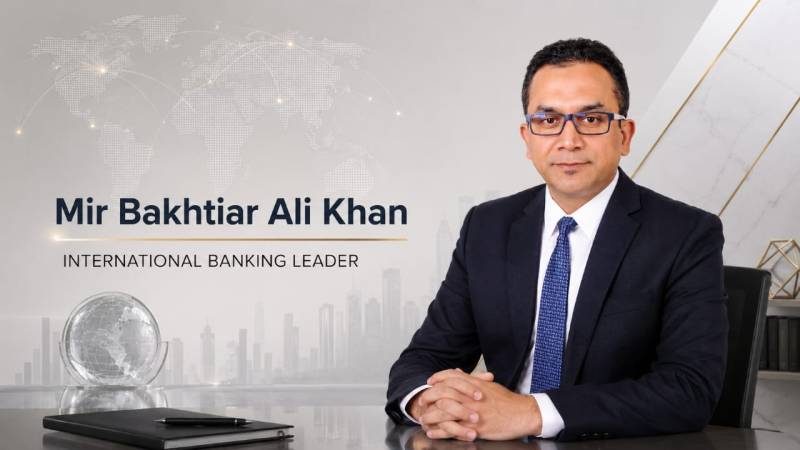
Banking customers are already aware of Artificial intelligence through mobile apps, automated support and digital transactions. But a technical industry analysis by international banking professional Mir Bakhtiar Ali Khan argues that its more consequential role may develop behind the scenes, particularly in credit assessment, portfolio monitoring, regulatory compliance and financial risk management.
Ali Khan, a Senior Vice President and Senior Manager Credit based in Manama, Bahrain, has more than 25 years of international banking experience across GCC and South Asian markets. His professional background covers credit risk, structured lending, portfolio management, trade finance and regulatory compliance. In his analysis on artificial intelligence in modern banking, he examines how the technology could support traditional banking judgment rather than replace it.
The central argument is relatively straightforward. Banks make lending decisions using large volumes of information, ranging from audited financial statements and tax records to cash-flow data, loan agreements, security documents and debt covenants. Much of this material still requires considerable manual processing before a credit professional can properly assess a borrower.
One example is financial statement spreading, the process through which information from a company’s financial statements is reorganised into a standard format so that a bank can analyse its financial position and compare performance over time. Ali Khan’s analysis suggests that AI can reduce this repetitive work by extracting and organising information from complex documents, allowing banking professionals to spend more time on risk assessment and decision-making.
But the analysis also highlights an important limitation. General-purpose artificial intelligence systems, particularly Large Language Models, are useful for understanding and organising large amounts of written information but should not necessarily be trusted to perform every financial calculation independently.
How a dual-engine model could work
Ali Khan proposes what the analysis describes as a “dual-engine architecture”, effectively separating the interpretation of information from the calculation of financial risk.
Under this approach:
• An AI-based extraction system could read balance sheets, tax documents, operating statements and other borrower records, identify the relevant information and place it into standard financial categories.
• A separate deterministic calculation engine would handle numerical work such as cash-flow ratios, stress-testing and Expected Credit Loss calculations. Unlike a general-purpose language model, these calculations would follow predefined financial formulas and rules.
• The system would also maintain source traceability, allowing an analyst or auditor to see where a particular number came from in the borrower’s original documentation.
For an ordinary banking customer, the technical distinction may appear small. For a regulated financial institution, however, it is significant. A mistake in a key ratio such as the Debt Service Coverage Ratio can affect how much a business is able to borrow and how a bank evaluates the risk associated with that lending.
The analysis therefore does not present AI as an autonomous credit officer. Instead, it describes the technology as a tool that can perform data-heavy work while keeping important calculations auditable and credit decisions under professional supervision.
Another major area identified in the analysis is portfolio monitoring.
Commercial and corporate borrowers are commonly reviewed at defined intervals, such as annually or quarterly. The problem with this approach is that a company’s financial condition can deteriorate between those reviews. Operating margins may decline, cash flows can come under pressure or liquidity available for cross-border obligations may weaken well before the next formal assessment.
Ali Khan’s analysis argues that AI-assisted monitoring could allow banks to identify such changes earlier by continuously analysing available financial and operating signals.
Rather than waiting for deteriorating performance to become visible after a reporting cycle, banks could potentially identify early-warning indicators and engage with borrowers sooner. Depending on the circumstances, that may lead to closer monitoring, adjustments to lending structures, debt restructuring or other risk-mitigation measures.
For banks, the significance is not simply faster technology. Earlier visibility can affect the quality of an entire lending portfolio by allowing institutions to respond before a credit problem becomes significantly more difficult to manage.
From IFRS 9 to trade finance
The analysis also identifies several areas where AI could have practical applications within regulated banking.
One is IFRS 9, the international accounting framework under which banks estimate Expected Credit Losses. Ali Khan argues that AI can support this process by analysing larger historical datasets, identifying relationships with changing economic conditions and highlighting emerging concentrations of risk. He stresses, however, that independent model validation and regulatory oversight would remain necessary.
Trade finance is another area highlighted in the analysis. International trade transactions generate extensive documentation, including letters of credit, bills of lading, invoices and other shipping and financial records. AI-assisted document checking and transaction monitoring could help institutions identify inconsistencies, suspicious patterns and potential trade-based money laundering while reducing some of the manual workload associated with reviewing large document sets.
Regulatory compliance sits alongside these applications. As banks handle increasingly complex datasets and cross-border transactions, the analysis argues that technology can improve the speed with which unusual patterns are identified, but accountability for the resulting decisions must remain with qualified professionals.
That distinction runs throughout Ali Khan’s analysis. AI may help a bank identify information, organise it faster, calculate risk through controlled systems and flag possible problems earlier. It cannot assume the ethical, regulatory or professional responsibility attached to a credit decision.
Final credit approvals, policy exceptions and decisions to downgrade a borrower’s risk rating, the analysis argues, should remain subject to human oversight.
For Ali Khan, this combination of automation and professional judgment is central to the future use of AI in banking. Rather than replacing experienced bankers, the technology could serve as a decision-support system that gives them better organised information and earlier risk signals.
The wider implication is that the value of artificial intelligence in banking may ultimately be measured less by how much work it eliminates and more by whether it improves the quality and timing of financial decisions.
Used responsibly, Ali Khan’s analysis suggests, AI could help financial institutions strengthen credit risk management, improve regulatory discipline, support financing for productive businesses and make their balance sheets more resilient. But the analysis places an equally strong emphasis on governance: technological capability, it argues, has to develop alongside professional judgment, ethical responsibility and clearly defined human accountability.
In that sense, the next phase of AI in banking may not be about handing decisions to machines. It may be about giving banking professionals better tools to make those decisions while ensuring that the principles of prudent lending remain intact.