

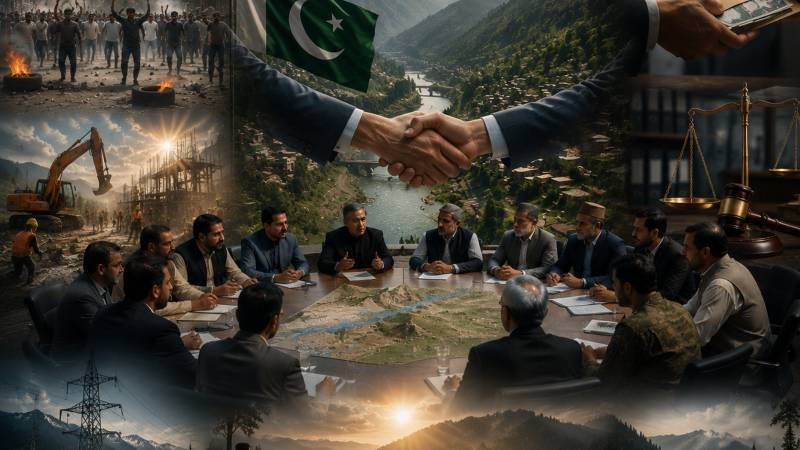
The situation in Azad Jammu and Kashmir has once again brought into focus the urgent need for responsible leadership, national coordination, and a sincere commitment to the welfare of the people. Economic hardship, political uncertainty, governance challenges, and growing public frustration have collectively created an environment that demands wisdom rather than confrontation. At this critical moment, Pakistan must rise above political divisions and recognize that the future of both Azad Kashmir and the country depends upon unity, stability, and visionary leadership. Azad Kashmir is not merely a geographical region; it is one of Pakistan's most significant national responsibilities. Its strategic, historical, political, and emotional importance makes its stability a matter of national interest.
The people of Azad Kashmir deserve more than promises during times of crisis—they deserve continuous investment in education, healthcare, infrastructure, employment, and transparent governance. Their voices should never become secondary to political rivalries taking place elsewhere in the country. Pakistan's political history has been marked by recurring instability. Governments have come and gone, institutions have repeatedly been tested, and political polarization has gradually weakened public confidence. Unfortunately, it is always the ordinary citizen who pays the highest price through inflation, unemployment, declining public services, and economic uncertainty.
The recent developments in Azad Kashmir serve as yet another reminder that governance failures eventually affect every corner of the nation. What makes today's situation particularly significant is that many of these challenges were highlighted years ago by Dr. Tahir-ul-Qadri. Long before Pakistan entered its current cycle of political instability, he repeatedly exposed what he described as a deeply entrenched system of corruption, political patronage, and institutional weakness. At a time when many dismissed these warnings as political rhetoric, he consistently argued that corruption had become systemic rather than individual—that unless meaningful reforms were introduced, Pakistan would continue moving from one crisis to another. Dr. Tahir-ul-Qadri did not merely criticize individual governments; he challenged the structure that, in his view, allowed corruption, poor governance, and weak accountability to flourish regardless of which political party held power.
Through public lectures, books, constitutional discussions, and political movements, he repeatedly called for electoral reforms, judicial independence, institutional accountability, merit-based governance, and genuine constitutional implementation. His central argument remained consistent: changing faces without changing the system would never solve Pakistan's underlying problems. He also warned that if political leadership continued placing personal and party interests above national interests, the country's institutions—including those responsible for safeguarding national security—would inevitably come under increasing public and political pressure. His concern was not directed against any institution itself but against a political culture that repeatedly failed to resolve national issues through constitutional dialogue.
True leadership is demonstrated by the ability to unite the nation during difficult times, make difficult decisions in the national interest, and build institutions that serve future generations.
Looking at Pakistan's political developments over recent years, many of his supporters believe those warnings proved remarkably relevant. Whether one agrees with all of his political views or not, it is difficult to ignore that many of the governance challenges he identified decades ago continue to dominate national debate today. The absence of meaningful political consensus remains one of Pakistan's greatest challenges. Political disagreement is a natural feature of every democracy, but when disagreement evolves into permanent confrontation, governance suffers and public confidence declines. Leadership should never be measured solely by electoral victories or political slogans. True leadership is demonstrated by the ability to unite the nation during difficult times, make difficult decisions in the national interest, and build institutions that serve future generations rather than short-term political objectives. The people of Azad Kashmir deserve particular attention. Their concerns must not become casualties of broader political disputes. Sustainable development requires long-term planning rather than temporary political compromises. Federal authorities, the Azad Kashmir government, opposition parties, civil society, economists, legal experts, and community representatives must work together to ensure that economic development, tourism, infrastructure, education, healthcare, and transparent governance remain national priorities.
Recent criticism directed at the government's handling of public protests and governance challenges has further demonstrated the importance of accountability. Whenever credible allegations arise regarding the misuse of authority or excessive force, they should be investigated independently and transparently. Accountability is not a threat to democracy; it is one of its greatest strengths. Likewise, political opposition must remain peaceful, responsible, and committed to constitutional principles. Pakistan cannot afford another decade of endless political confrontation. Economic recovery, investor confidence, institutional stability, judicial independence, and constitutional governance all require cooperation rather than continuous conflict. National coordination should not be viewed as political compromise but as an essential responsibility owed to every Pakistani citizen.
Ultimately, the responsibility does not rest solely with political leaders. Citizens also play a vital role in strengthening democracy by remaining informed, respecting differing opinions, rejecting violence, and holding every public office accountable through constitutional and democratic means. National unity does not require everyone to think alike; it requires everyone to place Pakistan above personal, political, and partisan interests. The future of Azad Kashmir and Pakistan will not be secured through slogans or political point-scoring. It will be secured through justice, accountability, transparent governance, and leadership that places national interest above personal ambition. For years, Dr. Tahir-ul-Qadri consistently argued that unless corruption was confronted at its roots, institutions strengthened, and genuine reforms introduced, Pakistan would continue experiencing recurring political and constitutional crises. Today, many of those concerns appear more relevant than ever. Whether one agrees with his politics or not, his long-standing call for national coordination, institutional reform, and principled leadership deserves serious reflection. Pakistan possesses immense potential; what it requires now is the collective wisdom and courage to build a future founded on unity, justice, stability, and the welfare of all its people.