

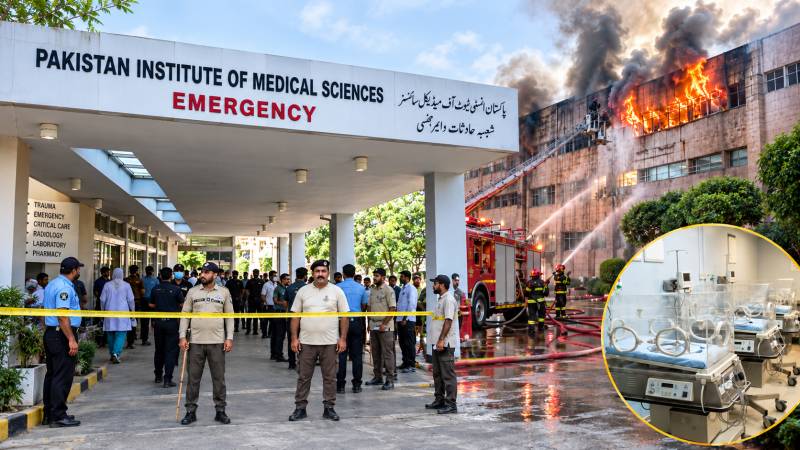
The deaths of 14 newborn babies in the recent fire at the Pakistan Institute of Medical Sciences (PIMS) in Islamabad have understandably generated questions about fire alarms, sprinklers, emergency exits, evacuation procedures and staff training. All of these questions need answers. But there is another question that deserves considerably more attention: How safe are the electrical systems inside Pakistan’s hospitals?
The precise source of the PIMS fire has not yet been conclusively established. The interim inquiry considered several possibilities, including an air-conditioner, incubator or warmer, an electrical short circuit, an overloaded plug or another component. Importantly, Islamabad Electric Supply Company records reportedly showed no external feeder fault or tripping at the time. The inquiry therefore said that if the cause proves electrical, attention would have to turn to the hospital’s internal electrical distribution system—its wiring, sockets, plugs and connected equipment. That distinction is important. It would be premature to blame an electrical fault for the tragedy. But it would be equally mistaken to wait for the forensic investigation before asking whether the electrical infrastructure of our hospitals is being designed, installed, inspected and maintained to the standard that such critical facilities require.
The inquiry itself makes essentially this point. It states that uncertainty about the first spark should not prevent examination of the protective systems that should have kept an initial fire from becoming a mass-fatality event. In engineering terms, the cause of the initiating event and the failure of the protection system are two different questions. An engineering system is not designed on the assumption that equipment will never fail. An aircraft is not certified on the assumption that pilots and components will never make mistakes. Nuclear plants use multiple independent layers of protection because failures are expected to occur eventually. Hospitals deserve the same philosophy. What is important is to design, build and operate engineering systems so that when equipment does fail, safety mechanisms and processes prevent that failure from becoming a disaster.
To ensure public safety, electrical installations whether commercial, residential, industrial or utility must meet certain safety standards. And it is the role of competent government authorities to ensure such standards are established and enforced. The issue is not that Pakistan has no safety standards. The Pakistan Engineering Council has developed the Pakistan Electric and Telecommunication Safety Code, or PETSAC-2014, as well as the Building Code of Pakistan— Fire Safety Provisions 2016.
There is, however, an important limitation to PETSAC. Its focus is primarily electric-supply and telecommunications infrastructure and does not apply to end user facilities such as hospitals or other commercial facilities. PETSAC excludes customer-premises wiring beyond the service point from its principal scope and states that utilization equipment and premises wiring on the load side are intended to be performed under the National Electrical Code. What is less clear is through which Pakistani law, building regulation or enforcement mechanism compliance with the NEC is made mandatory for individual buildings.
To ensure that facilities are designed and built according to these codes, several processes must be in place. Engineers and electricians responsible for safety-critical installations should be required to demonstrate competency in the electrical code formally adopted for such installations. Where NFPA 70 is the applicable reference, that should include demonstrated NEC competency. Pakistan has access to NEC training, but it is unclear whether electricians, electrical supervisors and engineers responsible for safety-critical hospital installations are required to demonstrate competency in a defined modern electrical code. Pakistan does not need to invent the knowledge needed to make electrical systems safer. The standards exist, and training on them is already available inside Pakistan. The question is why demonstrated competency in those standards is not clearly required of everyone designing, installing, maintaining and inspecting safety-critical hospital electrical systems? A code has little value unless compliance is verified. Electrical plans should be reviewed by technically competent authorities before construction; installations should be inspected during construction; and occupancy should not be permitted until electrical systems have passed inspection. That in turn requires local authorities to maintain inspectors who understand the codes they are expected to enforce.
What is far less clear is which authority is responsible for ensuring that a hospital's electrical system complies throughout its operating life with a comprehensive hospital-specific electrical safety standard.
Pakistan appears to lack a consolidated national database identifying how many fires are caused by electrical faults but a quick review of data from Punjab shows in 2020, Punjab Rescue 1122 recorded 15,590 fires in which 79 people died, of which 7,348—47.1% were attributed to electrical short circuits. In 2024, this number increased by 80% to 28,018 fire incidents in Punjab alone. If the 47.1% electrical-short-circuit share recorded in 2020 had remained unchanged, the 2024 total would imply roughly 13,200 electrical fires. That is an extrapolation rather than a reported 2024 cause count, but it illustrates the potential scale of the problem. These are examples of systemic failure which do not need to wait for creation of additional provinces to be fixed. The question, therefore, is not whether Pakistan has established safety rules or administrative overburden. It is whether those rules form a complete safety assurance system.
If the problem is not the establishment of standards, then where does the problem lie? Safety assurance means more than having a code. It means knowing who must comply, who verifies compliance, how often inspections occur, how deficiencies are prioritized, who must correct them, and who confirms that corrective actions have actually been completed. Pakistan has a highly fragmented regulatory authority and enforcement regime. Pakistan Engineering Council develops and adopts engineering and building codes and regulates engineers. Local authorities enforce building codes. Under the Electricity Act 1910 framework, provincial governments appoint qualified persons to serve as Electric Inspectors within specified jurisdictions.
Pakistan has electrical, building and healthcare safety requirements, but responsibility for enforcing them is divided among PEC-established codes, local building authorities, Electric Inspectors, electricity distribution companies and healthcare regulators. What is far less clear is which authority is responsible for ensuring that a hospital's electrical system complies throughout its operating life with a comprehensive hospital-specific electrical safety standard.
Provincial healthcare regulators provide another layer. The Punjab Healthcare Commission, for example, requires hospitals to comply with Minimum Service Delivery Standards and includes "Facility Management and Safety" among the areas subject to regulation and inspection. Khyber Pakhtunkhwa has similar Minimum Service Delivery Standards for hospitals. In Islamabad, responsibility lies with Islamabad Health Regulatory Authority. So, Pakistan does not suffer from a complete absence of rules. The problem is that the regulatory structure appears fragmented. For a hospital administrator, consulting engineer or electrical contractor, a basic question should have an unambiguous answer: What electrical-safety standards must a Pakistani hospital comply with, who verifies that compliance, and how frequently must the hospital demonstrate that it remains compliant? That answer is much less obvious than it should be.
In the United States, for example, Article 517 of the National Electrical Code is specifically devoted to healthcare facilities. It works alongside NFPA 99, the Health Care Facilities Code. NFPA 99 contains an entire chapter dealing with electrical systems, while Article 517 establishes requirements for essential electrical systems serving healthcare facilities. In hospitals, critical electrical loads are identified. Emergency systems are divided according to their function. Alternate power supplies, distribution systems and protective equipment are engineered so that failure in one part of the system does not unnecessarily disable another. Grounding, receptacles, patient-care areas, transfer arrangements and maintenance requirements receive special treatment. The underlying philosophy is simple: No single foreseeable electrical failure should be allowed to become a catastrophe.
Pakistan should establish a mandatory electrical-safety framework for both public and private hospitals. In the case of PIMS, there are Islamabad Healthcare Regulatory Authority regulations that mention inspections but do not establish a mandatory periodic inspection regime. The closest statutory language establishing recurring inspections appears in Islamabad Healthcare Regulation Act, 2018 Section 4(1)(i) which states “ensure compliance and implementation of provisions of this Act, rules and regulations made there-under and notified standards, by arranging periodical inspections and surprise visits by inspection committee”. This language is vague and it does not establish a mandatory periodic inspection regime within a reasonable timeframe. IHRA’s licensing framework establishes inspection every three years unless otherwise decided by the Authority. The three-year provision appears to establish a benchmark, but it does not itself establish an absolute maximum interval. The regulations should make clear that IHRA may inspect more frequently when warranted, but that no hospital may go more than three years without an inspection.
Additionally, such inspections should include electrical-safety audits performed by qualified engineers independent of the hospital's routine maintenance organization. Such an audit should go much further than checking whether the lights work. It should examine load growth and circuit loading; protective-device ratings and coordination; earthing and bonding; condition of distribution panels, cables, sockets and plugs; emergency generators and automatic transfer systems; electrical supplies to intensive-care and neonatal units; fire stopping around cable penetrations; maintenance records; thermal hotspots; elevator safety; unauthorized modifications; and whether critical equipment is supplied from appropriately designed essential electrical systems. Deficiencies should be risk-ranked, given mandatory deadlines for correction and reported to the healthcare regulator. And if such deficiencies are not fixed within stipulated timeframe, then appropriate penalties must be levied up to and including closure of unsafe facilities.
Hospitals should also be required to document electrical and other safety near misses—overheated sockets, recurring breaker trips, burnt plugs, small electrical fires and equipment insulation failures. These events should not disappear into maintenance logs. They are warning signals. A mature safety system learns from incidents in which nobody dies or gets hurt. Every regulatory requirement should have one clearly designated enforcement authority. The agency responsible for approving the design, the agency responsible for construction inspection, the agency responsible for periodic electrical audits, and the agency responsible for verifying corrective actions should all be explicitly identified. Where responsibilities overlap, the law should designate a lead authority accountable for ensuring that deficiencies do not fall between institutional cracks.
Perhaps the most disturbing finding surrounding the PIMS tragedy is that it was not the institution's first recent fire. According to the subsequent PIMS inquiry, a fire had occurred at the PIMS nursing hostel on July 6, only weeks before the neonatal nursery tragedy. The inquiry reportedly identified deficiencies involving fire detection, alarms, evacuation preparedness, electrical inspections, security response and record keeping and recommended corrective measures. The later inquiry found that the required measures had apparently not been adequately implemented before the August 26 fire.
That suggests Pakistan's problem may go beyond inadequate safety standards. It may be a safety-assurance problem. A safety system must ensure that deficiencies are identified, assigned to someone, corrected by a deadline and independently verified as closed. And if corrections are not made, people are held accountable. The electrical power industry calls this corrective-action management. Aviation, nuclear power and other high-reliability industries use similar concepts. Hospitals should too.
Pakistan should use the PIMS tragedy to conduct more than another round of fire drills and extinguisher inspections. The country should create a national framework setting mandatory requirements for the design, installation and periodic inspection of hospital electrical systems, along with competency requirements for the personnel who design, install, maintain and inspect them. The objective should not merely be to determine who was responsible for the last tragedy. It should be to establish robust systems and processes so that the next electrical fault, overheated socket or failed piece of equipment remains what it should have been in the first place: a manageable equipment failure not a national tragedy.