

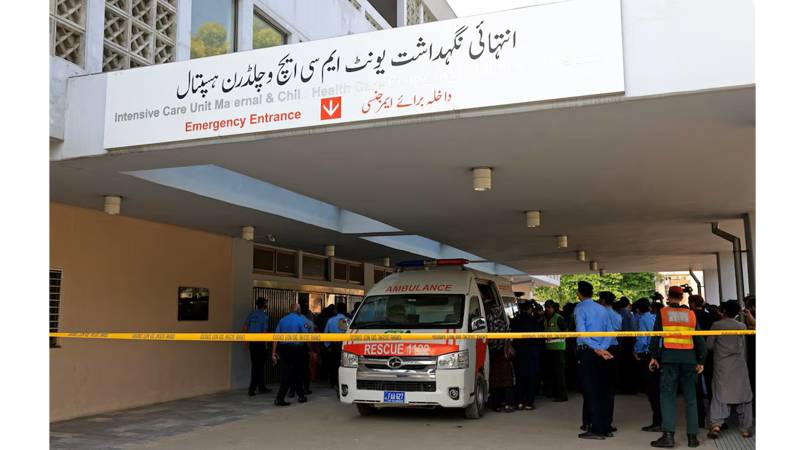
When we moved to Islamabad in 2001 as privileged yet salaried civil citizens, I made it a point to avail myself of the healthcare benefits afforded to state servants. For medical advice and treatment, my absolute preference was always the Pakistan Institute of Medical Sciences (PIMS). It was the premier public sector facility, where some of the region’s most accomplished specialists and professors, backed by competent staff and round-the-clock emergency care, work. It was our instinctual, first-thought facility.
I recall an evening around 8:00 PM when a severe splinter embedded beneath my thumbnail developed an agonising, pus-filled abscess. PIMS Emergency took me in without hesitation, removed the splinter, and applied a soothing poultice to drain the infection.
On another occasion, while pregnant with our youngest son, I accidentally broke my little toe while chasing after his elder brother. In utter agony and with a rapidly swelling foot, we rushed to PIMS Emergency once more. Within a short time, the X-ray was taken, the plaster was bound, and we headed home in quiet contentment.
Yet, public facilities are places where institutional competence sits uncomfortably alongside systemic neglect. At Fajr, soon after the toe injury, my water broke, a distress signal I later learned was meconium-stained fluid—a critical situation where a foetus in distress risks fatal toxicity if the fluid is aspirated. Gathering my hospital bags, I was rushed to the Mother and Child Health Centre (MCH) at PIMS. My attending gynaecologist, a PIMS employee whom I had visited in her private clinic, paying her private fee faithfully throughout nine months of prenatal care, failed to appear despite repeated calls and the urgent intervention of the administrator, Dr Rubina Kamran. Nevertheless, the emergency surgical team stepped in seamlessly. My emergency C-section was executed flawlessly, saving both my child and me.
The institutional paradoxes continued over the years. During a subsequent laparoscopy, a gynaecological head of department accidentally nicked a fresh blood vein. As I bled, the nursing staff insisted on administering a blood transfusion through a collapsed vein in my arm, yielding only after an excruciating debate and my persistent demand that they pierce the other arm.
The system is operating exactly as it was designed to, absorbing tragedy, deflecting blame, and insulating power while the vulnerable bear the total cost of its apathy
On another visit to address a painful scalp cyst, the treating specialist clearly harboured a deep-seated grievance against civil servants and their entitlement perks; it was a bitterness perhaps born of the disparity between medical and civil service remunerations or perks. Rather than treating the lesion professionally, he dismissively instructed his house staff to perform a raw biopsy on me instead.
And yet, whenever our youngest son suffered from recurrent joint dislocations, I would race to the Children’s Hospital Emergency at PIMS, where the duty orthopaedic surgeons expertly reset his joints every single time. I was never disappointed by their swiftness or raw clinical competence.
PIMS remains an old structure marked by dilapidated washrooms, chronic staffing shortages, overburdened resources, and corridors overflowing with human suffering. Yet, as a bloody civilian who has navigated the depth of its halls, I remain deeply bound to its vital mission.
Even our brief foray into Polyclinic Hospital carried its own absurdities. I once developed a painful, inward-growing plantar callus on the sole of my foot. While listening to the senior physician’s conservative prescription, I naively ventured to ask, "What if we simply operate on it?" Offended that a layperson had questioned his diagnostic authority, the doctor formally complained to my husband's superior (who promptly delivered a firm reprimand to his physician friend for such petulance). Days later, a different doctor casually recommended the exact same procedure, scooping out the corn without fuss.
Systemic Neglect and the Recent Tragedy
The recent tragedy at the Mother and Child Health (MCH) Centre at PIMS, where a catastrophic fire in the neonatal nursery claimed the lives of fourteen premature infants, is the agonising culmination of systemic neglect, structural decay, and a profound failure of regulatory oversight—and not an isolated event.
I, as a civilian with bittersweet experiences, have but a few inquiries, in the hope that they will be looked into by the authorities, as they are answerable as public servants. Foremost: how does an emergency ward housing the most fragile human lives—the premature babies dependent on incubators and oxygen—operate in a building constructed decades ago without modern fire suppression systems, functional emergency exits, or redundant electrical safety circuits?
Where were the mandatory, regular safety audits for high-risk zones where concentrated oxygen lines dramatically increase the speed of flame ignition?
If initial reports point to a routine electrical short-circuit or air conditioning malfunction, why was there no instantaneous auto-suppression or immediate, trained staff protocol to evacuate infants before smoke density rendered the room un-enterable? Is human oversight at night so dangerously depleted that infants are left effectively unattended until an explosion occurs?
To the Media and Journalist Fraternity:
Why does the national press restrict its investigative capacity to reactive, sensationalised coverage after a disaster occurs, abandoning these facilities the moment the initial horror fades?
Why is mainstream journalism so consumed by the endless, shallow theatre of political rivalries, executive musical chairs, and elite power struggles, while the crumbling infrastructure supporting millions of ordinary citizens receives zero sustained investigative scrutiny?
Why do reporters not conduct regular, unannounced audits of public sector emergency rooms, paediatric wards, and intensive care units during quiet, normal hours to expose equipment shortages, broken fire exits, and toxic administrative attitudes before they cost human lives?
The fire vanishes from the headlines within forty-eight hours, replaced by the relentless noise of political theatre and press releases. The ash settles over the broken tiles of the Mother and Child Health Centre, but nothing fundamentally shifts. No senior administrator resigns. No minister accepts culpability. The inquiry committees, formed with great fanfare in the immediate wake of the burnings, quietly dissolve into the administrative bureaucracy, their findings filed away in locked cabinets to gather dust alongside decades of forgotten mandates. Be it Civil Hospital, JPMC Karachi, Lahore General Hospital, or Services Hospital, the situation is the same, if not worse. These public healthcare centres are located in the big cities of Pakistan; one can easily imagine the plight of small and out-of-sight cities and the public health situations in other parts of the country.
Outside, the corridors of PIMS remain as choked and desperate as ever. Families still drag sick children down hallways, stepping over pooling water and navigating past cracked, non-functional fire extinguishers that exist only as ornaments of compliance. The specialists still hold their grudges, the staff remains overworked and indifferent, and the systemic decay continues its daily, quiet erosion of human dignity.
There is no redemptive turn in this narrative, no grand reckoning that restores order or grants solace to the grieving. The mothers who left the MCH Centre with empty arms return to homes filled with silent nurseries, left to carry an unbearable, permanent grief in a world that has already moved on. The realisation that takes root is a bitter one; the system is operating exactly as it was designed to, absorbing tragedy, deflecting blame, and insulating power while the vulnerable bear the total cost of its apathy. Disappointment turns into a dull, heavy exhaustion, leaving behind only the cold certainty that when the next catastrophe strikes, the response will be identical, and the consequences will fall, once again, upon those with nowhere else to turn.