

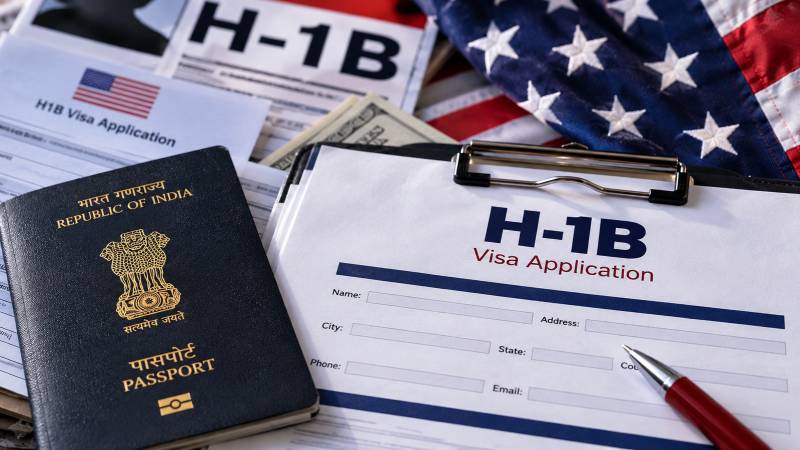
On October 8, 2026, the United States did more than suspend eight technology firms from its Permanent Labor Certification program. It publicly dismantled one of the most successful national marketing campaigns of the early twenty-first century. By freezing Cognizant, Infosys, Tata Consultancy Services, Wipro, HCL Technologies, Capgemini, Microsoft, and Adobe from the process that converts temporary H-1B workers into green-card candidates, Washington applied the letter of its own immigration statutes to a business model long treated as inevitable. The language used by Vice President JD Vance “foreign indentured servants,” wage gaps of twenty to forty-eight thousand dollars, concurrent American layoffs and foreign visa filings was deliberately harsh. It was also rooted in the statutory requirements of the programs themselves.
For more than twenty years India sold a story of seamless ascent. Its engineers were the world’s most gifted. The H-1B system merely recognized that gift. Remittances, diaspora success, and the branding of “Shining India” proved the point. The narrative was elegant, emotionally satisfying, and useful. It turned demographic scale and English-language technical education into soft power. It allowed New Delhi and its corporate champions to treat dominance in the U.S. visa lottery as national validation rather than a particular commercial arrangement. That arrangement is now under formal investigation for systematic abuse of the rules designed to protect American workers.
U.S. law is unambiguous on the point. The H-1B is a temporary specialty-occupation visa. The subsequent PERM process requires an employer to certify that no qualified, willing, and available American worker can fill the position and that the foreign hire will not depress domestic wages or conditions. These are legal attestations, not optional formalities. When the same firms file for hundreds of thousands of such certifications over a decade while staffing client sites at lower wage bands and, in some documented cases, laying off Americans for roles later filled through the same pipeline, the government is entitled to examine whether the certifications were genuine. Officials cited collective figures since 2009: nearly three million foreign-worker requests, more than 230,000 H-1B approvals, and over 100,000 permanent labor certifications from the companies now suspended. The claim is that these numbers represent jobs diverted from the domestic labor market through practices the law was written to prevent.
The economic engine beneath the story was never pure merit. It was cost arbitrage reinforced by visa dependency. Indian outsourcing firms could recruit at Indian salary levels, place workers on American client projects, and retain them through the threat of status loss. The worker’s legal presence depended on the employer. Defenders call this opportunity. Critics call it leverage. Both descriptions contain truth. Historical data showing outsourcing firms clustering at lower prevailing-wage levels while direct employers paid substantially more for comparable roles cannot be wished away. Nor can the long record of smaller staffing operations prosecuted for fabricated jobs, wage kickbacks, and document fraud. The large firms always insisted they operated on a higher plane. The current probes, launched in July 2026 after whistleblower complaints and expanded through field checks and subpoenas, are testing that distinction at scale.
The economic engine beneath the story was never pure merit. It was cost arbitrage reinforced by visa dependency. Indian outsourcing firms could recruit at Indian salary levels, place workers on American client projects, and retain them through the threat of status loss.
Microsoft’s inclusion supplied the sharpest political edge. Vance stated that the company laid off roughly six thousand American workers in 2025 after certifying it could not find qualified domestic talent, then secured approval for more than six thousand H-1Bs and filed thousands of PERM applications, nearly a thousand of which matched the eliminated roles. Microsoft replied that eighty percent of its recent H-1B filings were extensions or status changes for existing employees, that remaining new filings largely concerned people already legally present in the United States, that its H-1B wages rank among the highest and that the vast majority of its American workforce remains American. The exchange is unresolved. The investigations continue. No major criminal charges against the named giants have been publicly detailed. Administrative suspension of new and pending PERM processing is not a conviction. Those facts matter.
What has already changed is the narrative monopoly. India’s Ministry of External Affairs called the “indentured servants” phrasing deeply offensive and insisted talent mobility benefits both countries. The diplomatic response is predictable. It does not restore the previous framing. When a country’s signature global industry is collectively barred from a key pathway by the host government on grounds of systemic abuse, the claim of effortless excellence becomes harder to sustain. “Shining India” was always a selective construction: growth rates, unicorn counts, diaspora headlines, less candid about structural dependence on a U.S. immigration system never designed as a permanent mid-cost labor pipeline.
Rivals are watching with interest rather than surprise. In Beijing, the episode is read as confirmation that Western markets will eventually enforce their own rules when domestic political pressure rises. Chinese technology and services firms have long competed against Indian outsourcing on cost and scale; any erosion of Indian credibility in the American market creates openings for alternative suppliers who can present themselves as less entangled in visa controversies. In Islamabad, the reaction is quieter but pointed. Pakistani policymakers and technology entrepreneurs have spent years arguing that their own IT sector was unfairly overshadowed by India’s larger marketing machine. The public unraveling of that machine’s most prized claim unquestioned superiority in the U.S. talent pipeline offers space to position Pakistani firms as lower-profile, more compliant alternatives for clients suddenly sensitive to compliance risk. Other South Asian and Southeast Asian providers will make the same calculation. The global services market is not sentimental. Once the assumption of Indian invincibility is punctured, buyers re-price risk.
The opportunity is not automatic. China faces its own political headwinds in Western markets. Pakistan’s technology sector still lacks the depth and brand recognition of its neighbor. Yet the psychological shift is real. For two decades, India treated the volume of H-1B approvals as proof of national quality. That metric is now reframed by the host country as evidence of over-reliance on a contested model. The difference is consequential. Countries that once accepted the Indian story at face value are free to demand higher standards of transparency and wage parity. Clients who once defaulted to the largest Indian vendors will weigh reputational and legal exposure more carefully.
None of this means Indian engineers lack talent. Many are exceptional, and many have contributed genuine value to American companies. The issue is the business architecture built around temporary visas, labor-cost differentials, and green-card dependency, and the national narrative that treated that architecture as pure merit. That narrative is no longer self-evident. The investigations will produce more facts. The legal challenges will test the administration’s authority. The commercial adjustments will take years. What has already occurred is the loss of narrative control. The great Indian bluff was never that Indians cannot code. It was the insistence that the particular system of visa-enabled arbitrage was itself an expression of superiority, and that questioning it was prejudice rather than enforcement of statute. The world has begun to examine the fine print.