

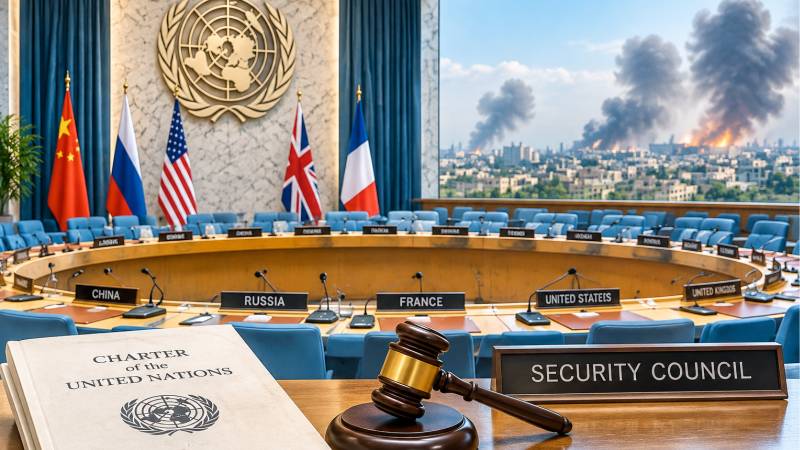
On 28 February 2026, the United States and Israel opened their war on Iran with hundreds of strikes in a single day, killing its Supreme Leader and dozens of senior officials. The Security Council had not authorised the war. It could not stop the war. Within two weeks, the one collective action the Council could agree upon was a resolution condemning Iran. That sequence holds the problem this war has exposed, and it is larger than the conflict itself. What happens to the international system when the states with the greatest power to use force are also the states whose agreement is needed for the United Nations to act?
For six months the answer has been uncomfortable. The United Nations has stayed present throughout the crisis. The Council has met, resolutions have been adopted, the Secretary General has called for restraint, and the IAEA has remained central to the nuclear question. Yet the organisation has not been able to shape the course of the war. The power to start military action has stayed with states, while the United Nations has been left to deal with the legal and political consequences. It is too easy to call this a UN failure. The problem is not that the United Nations has no authority. It is that its authority, and the power to enforce that authority, increasingly sit in different places.
The split goes back to the design of the Charter. Article 24 gives the Security Council primary responsibility for maintaining international peace and security, and member states agreed it would act on their behalf. This was the collective security system built after the Second World War: aggression would become a matter for the international community, not something individual states settled by force. But the founders knew that community was not equal. The United States, Soviet Union, Britain, France and China were given permanent seats and the veto because the organisation could not function against the interests of the major powers. The veto was part of the bargain from the start: special authority in return for staying inside the institution.
The difficulty is that the same arrangement that keeps the great powers inside the United Nations can also stop it from acting when one of them is a party to a conflict. That problem has existed since 1945. What is different today is the size of the gap between the UN's authority and the military power that sits outside it. The United States does not need UN permission to launch a military operation. Nor does Russia. Nor does China. Their armies exist independently of the UN system. The Council can debate their actions and question their legality, but it cannot physically stop a powerful state that has decided its interests justify force.
Iran has brought this into sharp focus. When the United States and Israel began their operations on 28 February, Washington described its actions as self-defence and notified the Security Council. Iran called them aggression and invoked sovereignty and the ban on the use of force. The Council became a place where two readings of the Charter were argued, rather than a body that could impose an agreed response. It can provide the legal frame within which states argue about their conduct. It cannot decide the conduct itself.
The Council has not been silent. On 11 March it adopted Resolution 2817, condemning Iran's missile and drone attacks on the Gulf states and Jordan. But the way that vote went is more telling than the fact of it. The resolution passed thirteen to nil, with China and Russia abstaining, and a rival Russian draft was rejected the same day. The text named neither the United States nor Israel, the two states that had opened the war. The Council could bring itself to condemn the country that was struck first. It could not bring itself to name the powers that struck.
That is the pattern, not the exception. The Council can act with real authority when the target is a state outside its permanent membership. Its effectiveness depends on agreement among the five states that control its most important decisions, and when one of them is a party, that agreement vanishes. Where the agreement exists, Article 24 has force. Where it does not, the same article becomes a reminder of what the system was meant to do but could not. Ukraine had already shown this. Russia's permanent seat meant the Council could take no real action against it, and the matter moved to the General Assembly, where the wider membership stated its position. My earlier analysis of Article 24 argued the lesson: the Assembly holds real residual authority, but that authority is political and recommendatory, not coercive.
If powerful states come to believe they can act outside the UN system and then return to it to explain or negotiate the consequences, the organisation's job changes: from preventing the use of force to managing what force leaves behind.
Iran goes further. Here the problem is not only that a permanent member is a party. It is that the major powers hold competing interests in the war itself, in Iran's nuclear programme, and in the future shape of the Middle East. Their members are no longer only debating how to end a conflict. They are debating whether the actions that produced it were legitimate at all. This is why calling the crisis another case of Council paralysis misses the point. The United Nations is becoming a place where great-power actions are justified, challenged and negotiated after the force has already been used. That is a departure from what collective security was meant to be.
The nuclear dimension makes it more serious still. The strikes disrupted the IAEA's inspections, and the Agency now says it can no longer account for Iran's stock of enriched uranium. The question is moving back towards the Security Council: the United States, Britain, France and Germany are pressing the IAEA Board of Governors to refer Iran's nuclear file to the Council for breaking its safeguards obligations. The dispute did not disappear because force was used. After the force, the system is simply returning to the institutions that were meant to handle the underlying problem in the first place. Even this return is uncertain, since Russia and China have signalled opposition to further Council action. The Council remains both necessary and blocked. This is the central contradiction. The states with the greatest power to change the situation do not depend on the United Nations for that power, yet the United Nations remains the main body through which the world can give their actions legal and political meaning.
There is a danger here that should worry more than the diplomats in New York. If powerful states come to believe they can act outside the UN system and then return to it to explain or negotiate the consequences, the organisation's job changes: from preventing the use of force to managing what force leaves behind. Much of the Charter still stands. The ban on the use of force remains a central rule of international law, the Council keeps its authority to name acts of aggression, and the Court and the Assembly offer further avenues. What has weakened is the link between authority and enforcement.
So the debate about reform should not shrink to whether the General Assembly should have more power. Its resolutions carry weight and shape legitimacy, but they cannot force a powerful state to stop a war. The real question is how to close the gap between authority and power. The veto sits at the centre of it, but veto reform alone will not fix everything.
I have argued before that the honest answer is to reform the veto, and that leaning on the General Assembly is not enough. I still think veto reform is the harder and more important goal. But this war has changed my mind about where to begin. Veto reform depends on the agreement of the very states whose power it would limit, which is why it has stalled for decades. The realistic first move is smaller and within reach: make the Assembly's role automatic rather than optional when a permanent member blocks the Council. The 1950 Uniting for Peace resolution already provides the base, but calling an emergency session still depends on a vote and on political will. That trigger could be made automatic, so that a veto on a question of aggression sends the matter to the Assembly within a fixed period, together with fact-finding, monitoring, investigation and mediation as a matter of course. This would not give the Assembly the power to wage war, and it should not. It would give the wider membership a standing way to respond together when the Council cannot act.
The pattern runs from Kosovo to Ukraine and now Iran. In Kosovo, with the Council divided, the dispute moved to the courts and ended at the ICJ. In Ukraine, with a permanent member as the party, it moved to the Assembly and became a matter of condemnation rather than enforcement. Iran shows the next stage. The dispute no longer moves to a single venue. It spreads at once across the Council, the Assembly, the IAEA, bilateral talks and regional arrangements, while the fighting goes on outside all of them.
The United Nations remains necessary, because no other body combines universal membership, legal standing and political legitimacy. But it is not all-powerful. It cannot create agreement among states whose interests pull in opposite directions, and it cannot easily restrain a great power that has decided to act. The next generation of reform is not about more resolutions or declarations. It is about building the link between what the international community says and what it can actually do together.
For seventy years, much of the system rested on a quiet assumption that great powers would, in the end, prefer to work through the United Nations. That assumption is under strain, and the Iran war has made the strain visible. The United Nations still holds authority. The great powers still hold power. What is missing is the reliable connection between the two. If that gap keeps widening, the danger is not that the United Nations will disappear. The greater danger is that it will stay exactly where it is, widely recognised, legally important and politically necessary, while the most consequential decisions about war and peace are made somewhere else.