

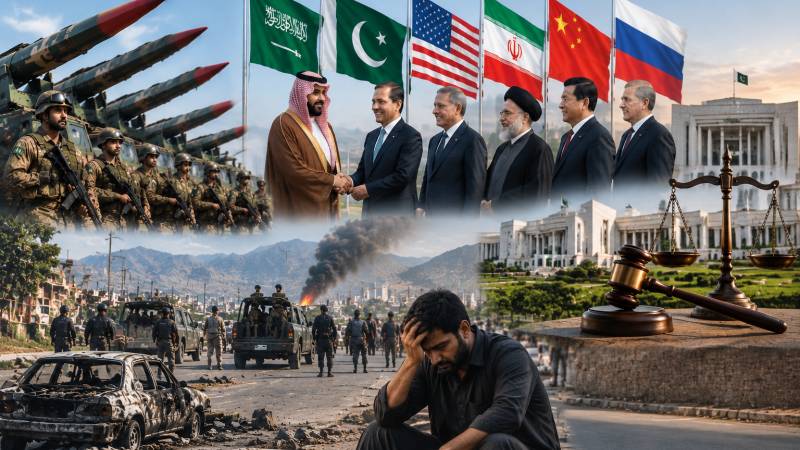
Fact 1: Pakistan continues to invest heavily in conventional and strategic defense (The 2026-27 defense allocation is Rs. 3 trillion, up by 17.65%)
Fact 2: Pakistan has expanded its external security partnerships (Strategic Mutual Defence Agreement in Riyadh on September 17, 2025; Mecca Joint Defence Agreement on August 7, 2026)
Fact 3: Pakistan has exhibited remarkable diplomatic finesse during the Iran-USA war. (Pakistan enjoys very strong diplomatic relations with all world powers)
Fact 4: Pakistan’s internal violence is highest in a decade (CRSS recorded 3417 violence-linked deaths in 2025, the highest death toll since 2015. Violence is rising steadily)
Fact 5: Pakistan is suffering from a devastating rule of law deficit (The World Justice project’s 2025 index ranks Pakistan 130th out of 143 Countries, signifying decaying governance)
Fact 6: For the common man, insecurity coupled with economic hardship is an overwhelmingly everyday experience (Whether it is crime, rotten governance or terrorism, the citizen is encountering these threats far more directly than external threats)
The above six facts, highlight the security paradox, which we face. Obviously, the challenges posed by India and Afghanistan and the dangerous scenario which may develop if the war between Iran and USA deteriorates, need our maximum attention. The question is not whether should Pakistan remain vigilant against external threats. It has to. The real question is whether we have given internal security the same strategic importance that we have traditionally given to external security.
Let’s, study the rule of law paradigm. Hasn’t it become the norm to break the law and laugh about it? The type of scandals which are springing out each day, whether about the pithy state of governance exhibited during the PIMS Tragedy or the mega corruption cases, in which billions are mentioned as if they are millions, have very adversely affected the psyche of Pakistanis. Their trust on Government and the State has been deeply shaken.
If State and the Government can defend borders but cannot guarantee justice, opportunity, meritocracy, inclusiveness, rule of law and economic emancipation, the notion of security remains flawed.
According to Pakistan's 7th Population and Housing Census (2023), approximately 70% of the total population is under the age of 35, which equates to roughly 169 million Pakistanis. Although contested, according to official data, Youth in Pakistan face an unemployment rate that is higher than the national average, with specific brackets showing rates around 11% to 12.5% for ages 15–24 and roughly 7.3% for the 25–34 age bracket.
Similarly, approximately 30 to 32 million people below the age of 35 reside in Khyber Pakhtunkhwa (KP), while 11.76 million people reside in Balochistan. Disaggregated figures specifically for under-35 bracket in KP show disproportionate joblessness, particularly among educated degree-holders. Similarly in Baluchistan, 22% young people are unemployed, driven by a weak industrial base and limited formal job creation.
There exists a large body of research on linkages between unemployment and crime/terrorism. Unemployment usually fuels terrorism when it combines with other issues, such as government corruption, political repression, lack of rule of law, and social or religious divisions. International inimical forces act as a major add-on. So, the natural question which arises is this: If Interior Minister of Pakistan, the man responsible for ensuring internal security of the Country is himself agitating against the present governance structures, how can Pakistan escape the vicious cycle it finds itself in?
Will entering into major security pacts solve the most serious internal challenges, especially the problems of the youth of Pakistan? If major upheavals have taken place, in Bangladesh, Nepal, Sri-Lanka, India and other countries, are we insulated? Till when can we rely on our self-created delusional belief, that no revolution can take place in Pakistan, while forgetting that the creation of this Country, was one of the biggest revolutions of the 20th century? Perhaps, the real question is not whether Pakistanis are secure but rather what is meant by security? We possess a powerful professional triad of forces, which is battle hardened. We are the only Muslim Country who has declared nuclear weapons. These are indispensable for our national security. But it cannot end at the borders.
For an ordinary Pakistani, security simply means, him being able to travel with-out fear at any time, send children to school without anxiety, find employment through crystal clear meritocracy, approach a police station without influence, obtain justice without delay and conduct his business without being shaken by corruption. He has to believe that the Law will protect him as firmly as it shall restrain the powerful. This is why Pakistan’s security debate needs a fundamental overhaul.
The Sate cannot permanently compensate the woes of its people through stronger external alliances. Nor can diplomatic successes substitute for public confidence. International partnerships are most needed but they cannot create social cohesion. Weapons can deter an enemy but they cannot create jobs. Intelligence agencies can disrupt terrorist networks but they cannot restore a young person’s faith in the State and his/her future. And this creates an urgency given our demographics. The youth are our biggest asset but can also be our greatest source of instability. They can become the engine of a prosperous Pakistan or a reservoir of anger and frustration.
Pakistan today, more than ever before, needs a Whole-of-State concept of security. It means strong defense but equally strong institutions operating within the Constitution; strategic diplomacy but also economic opportunity; inclusive political stability but more importantly public trust. The danger is that we have become so accustomed to the narrative of the threats from our neighbors, that we have been overlooking the erosion taking place within the body politic of Pakistan. With two provinces facing severe terrorism and violent crime on the rise in rest of the Country, we appear to be in a quagmire.
No country has the luxury of choosing between external and internal security. A strong military, credible deterrence and powerful diplomacy remain indispensable. But the citizen is the only client, who can decide. If State and the Government can defend borders but cannot guarantee justice, opportunity, meritocracy, inclusiveness, rule of law and economic emancipation, the notion of security remains flawed. A secure Pakistan must become a Pakistan in which the common man feels secure. And the process had to start yesterday. Tomorrow is already too late.