

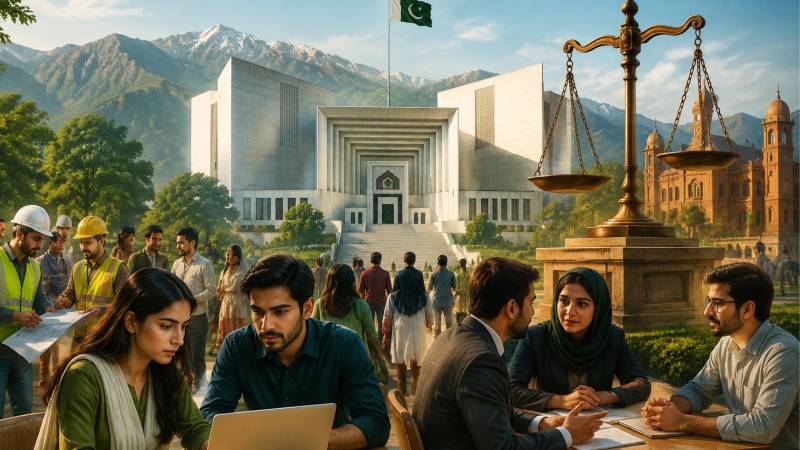
Every generation inherits a defining national challenge. For Pakistan, that challenge is not merely economic growth, political competition or national security. It is the restoration of public trust in state institutions. No democracy can achieve long-term stability unless its citizens believe that institutions operate according to law rather than personalities. Courts derive their legitimacy from public confidence in impartial justice. Electoral bodies earn credibility when election outcomes are widely accepted. Civil services function effectively when appointments and decisions are guided by merit. Legislatures fulfil their constitutional purpose when public policy takes precedence over political confrontation. Pakistan has made important achievements since independence. It possesses one of the world's largest youth populations, a strategically significant geographic location, a resilient society, a capable entrepreneurial class and a global diaspora that contributes substantially to the national economy. These are enduring national strengths.
Yet these strengths coexist with persistent institutional challenges. Concerns about governance, corruption, administrative efficiency, fiscal capacity, political instability, policy inconsistency and the implementation of the rule of law continue to shape public debate. Citizens from different political backgrounds often disagree on the causes of these problems, but there is broad recognition that institutional performance must improve if Pakistan is to realise its potential. The debate, therefore, should move beyond the question of which political party governs. Democracies are strengthened not when governments simply change, but when institutions become more transparent, more accountable and more resilient regardless of who holds office. The rule of law must remain the foundation of any meaningful reform agenda. Laws should be applied consistently, accountability should be impartial, and public offices should be exercised within constitutional limits. Strong institutions protect both the state and the citizen. Weak institutions ultimately weaken both.
No democracy can achieve long-term stability unless its citizens believe that institutions operate according to law rather than personalities.
Pakistan also faces an urgent governance challenge. Sustainable economic development requires predictable public policy, efficient tax administration, investment in education, a professional civil service and effective local government. Equally important is creating opportunities that encourage talented young Pakistanis to build their futures at home rather than seeking opportunities abroad. Youth participation deserves particular attention. Pakistan's demographic profile offers a historic opportunity. Young citizens should not merely be voters; they should become policymakers, entrepreneurs, researchers, lawyers, judges, civil servants and parliamentarians. Their participation must be based on competence, integrity and commitment to public service rather than patronage or political inheritance.
Institutional reform, however, cannot succeed without national consensus. Constitutional democracy depends upon respect for legal processes, dialogue between political stakeholders and the willingness to place national interests above partisan advantage. Durable reform is rarely achieved through confrontation alone; it requires cooperation among elected representatives, public institutions and civil society. Constructive criticism should never be mistaken for hostility towards the state. On the contrary,
democracies become stronger when citizens participate thoughtfully in national debates and propose practical solutions. Patriotism is demonstrated not only through pride in one's country but also through a commitment to improving its institutions.
Pakistan's future will not be determined solely by elections, economic indicators or political personalities. It will be determined by whether the country succeeds in building institutions that are trusted, accountable and governed by the Constitution and the rule of law. Nations that achieve this transformation create stability, attract investment, retain talent and inspire confidence among their own citizens. Pakistan has overcome immense challenges throughout its history. There is every reason to believe that it can overcome its institutional challenges as well—provided reform is guided by constitutionalism, accountability, national unity and a shared commitment to the public good.