

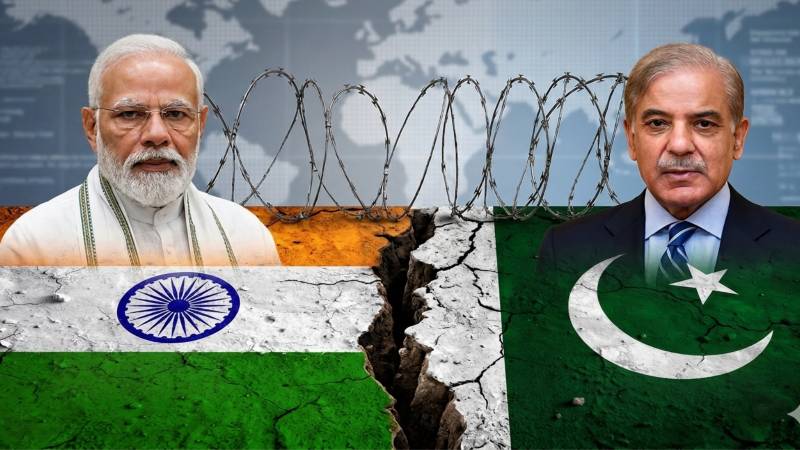
When India and Pakistan emerged from Partition in 1947, they shared the same administrative DNA. Pakistan inherited strong agricultural regions, a capable bureaucracy, and a promising industrial base. India inherited size, diversity, and complexity. In the early years, Pakistan's economy was arguably at least as strong as India's, and by some measures a bit better. Today, India is a rising global power with an economy more than ten times the size of Pakistan's, by the IMF's April 2026 estimate, close to $4.15 trillion against roughly $400 billion, while Pakistan remains dependent on IMF support, its more than twenty-fifth arrangement with the Fund since 1958.
This divergence is not mainly cultural or geographic. It is architectural. It is the story of two nations that began together but built two different systems of power, and a recent, sharp reminder of exactly how different: the India-Pakistan military clash of May 2025. India entrenched democratic institutions under Nehru. Pakistan drifted toward military dominance, culminating in its first coup in 1958, just eleven years after independence. This single divergence created two different political civilizations.
India's military remained under strict civilian control. Pakistan's military became the most powerful institution in the country, shaping foreign policy, security, intelligence, and political outcomes at critical moments. Elected civilian governments in Pakistan hold formal authority; the military establishment holds practical authority. That duality is the core of what analysts often call Pakistan's hybrid regime: civilian governments govern, but only within boundaries set by an institution nobody elected.
India's democracy is noisy, contentious, and imperfect, but structurally coherent. Power flows through a single chain: people, to Parliament, to government, to institutions. The Supreme Court of India is independent and widely respected. The military stays out of politics. Elections are competitive and broadly legitimate. Governments change through ballots, not coups. That clarity has produced real stability: uninterrupted civilian rule since independence, reasonably predictable policy continuity, and long-term economic planning. The results are visible in a nearly $4.15 trillion economy, a globally respected judiciary, a world-class technology sector, and a rising global profile. India's system is messy, but it works.
Pakistan's system runs on two centers of power at once: an elected civilian government and a military establishment that answers, in practice, mostly to itself. The Supreme Court of Pakistan, though constitutionally independent, has at points validated coups, disqualified prime ministers, and issued rulings widely read as reflecting the military's preferences rather than the law alone. Intelligence agencies operate with real political influence. Elections are competitive but often shaped by forces outside the ballot box. This duality creates a system that is confusing even to Pakistanis themselves, by their own frequent description. It is not chaos exactly. It is a stable imbalance. But it has repeatedly prevented the emergence of a fully democratic, fully accountable state.
The real lesson of the India-Pakistan comparison is that nations do not merely inherit institutions at independence; they either strengthen them, politicise them, or allow competing centers of power to hollow them out.
None of this is a case of one side doing everything right and the other doing everything wrong, and a serious essay has to say so. Pakistan's early Cold War alignment with Washington, its role as a frontline state absorbing the fallout of the Soviet war in Afghanistan, and four decades of refugee flows and militant spillover across its western border placed strains on Pakistani institutions that India, sheltered by geography from most of that particular history, never had to absorb in the same way.
India, for its part, is not a finished democratic project either. Recent years have brought genuine, well-documented friction over judicial independence, press freedom, and the treatment of religious minorities, criticism that comes from within India's own civil society as much as from outside it. A fair comparison holds both of these things at once: India's institutions have proven more resilient than Pakistan's, and India's institutions still face real internal pressure of their own.
At independence, Pakistan's economy was competitive with India's. Today, by IMF figures for 2026, India's nominal GDP stands at roughly $4.15 trillion against Pakistan's roughly $400 billion, a gap of more than tenfold. India's GDP per capita, while still modest by global standards at under $3,000, is around 65 percent higher than Pakistan's. India attracts sustained global investment; Pakistan has cycled through repeated balance-of-payments crises and currency interventions. India's technology and IT-services sector is globally competitive; Pakistan's, though real and growing, particularly in freelance digital work, remains a fraction of the size. Political architecture, more than natural endowment, explains this divergence. Stable, predictable civilian institutions tend to produce stable, predictable economies. Hybrid regimes, where investors can never be entirely sure whether the elected government or the military establishment will make the decisions that matter, tend to produce volatility instead.
India faces serious security challenges of its own, particularly in Kashmir and along its northeastern frontier. But Pakistan has absorbed a far higher frequency of terrorism and extremist violence over the past two decades, much of it tied to militant networks that have, at various points, operated with a degree of tolerance or even sponsorship from parts of the Pakistani security establishment before turning on the state itself. Weak civilian oversight of security policy and inconsistent judicial enforcement have made that problem harder to contain than it might otherwise have been.
The clash triggered by the April 2025 terror attack in Pahalgam offers an unusually clean, recent test of this whole argument. Within days, India's response moved through its elected government and its conventional military chain of command. Pakistan's response was led, from the outset, by its military establishment, with its civilian government largely ratifying decisions made elsewhere. The fighting itself, days of strikes involving combat aircraft, drones, and missile systems along the Line of Control, ended in a ceasefire, but both countries emerged determined to spend more on defense. India's military budget rose almost 9 percent in 2025 to $92.1 billion, the world's fifth-largest; Pakistan's rose 11 percent to $11.9 billion, according to SIPRI's 2026 data, an eightfold gap in absolute spending even before accounting for the size difference between the two economies.
India’s institutional resilience has given governments the continuity to pursue long-term economic transformation, while Pakistan’s recurring political uncertainty has repeatedly interrupted policy, weakened civilian institutions and unsettled investors.
The crisis didn't create the institutional pattern each country followed. It revealed a pattern that had been built over the preceding seven decades. India's population growth has slowed and is moving into what demographers call a demographic dividend, a large working-age population with rising average education levels. Pakistan, with a median age around 22, faces something closer to a youth bulge without matching economic absorption, a gap that has historically fed both instability and outward migration.
India invested early in elite technical and medical institutions, the IITs, IISc, and AIIMS among them, which became genuine engines of global talent and, eventually, of the diaspora success discussed below. Pakistan's education system suffered from chronic underfunding, periodic politicization, and uneven quality, producing a smaller skilled workforce and slower technological advancement, notwithstanding real pockets of strength in its universities and tech sector.
India's Indian Administrative Service remains, by most independent assessments, one of the more competitive and meritocratic civil services in the developing world. Pakistan's bureaucracy, once comparably strong at independence, became increasingly politicized and, at points, subordinated to military priorities, weakening long-term policy continuity across changes of government. India's federal structure gives its states real fiscal and policy authority, and they compete with each other for investment in ways that generate genuine policy experimentation. Pakistan's federalism is comparatively center-heavy; provinces depend more on federal transfers and, in practice, on the military's tacit approval for major decisions, which narrows the space for local innovation.
India's soft power, Bollywood, yoga, cuisine, a large and increasingly influential diaspora, and a growing footprint in global technology leadership, is genuinely global in reach. Pakistan's soft power is real but more constrained, shaped heavily by international media narratives around security. India's diaspora includes a disproportionate number of Fortune 500 chief executives, scientists, and entrepreneurs; Pakistan's diaspora is hardworking and economically vital to the home country, but contributes primarily through remittances rather than global corporate or scientific leadership at the same scale.
Survey and anecdotal evidence both point the same direction. Most Indians describe their political system as democratic and broadly predictable, whatever their complaints about specific governments. Most Pakistanis, in my own conversations with the Pakistani-American community and in Pakistani commentary itself, describe their system as confusing, shaped by the military behind the scenes, and inconsistent in its judicial independence. And yet, tellingly, admiration for India's stability does not translate into any real appetite for merging with India. National identity, historical memory, and sovereignty remain deeply rooted on both sides of the border, a point any serious policy discussion of the region has to respect rather than wish away.
This stark comparison invites an obvious objection: is India's advantage really institutional, or is it simply a matter of scale and starting resources that would have produced a similar gap under almost any political system? The honest answer is probably both. Size and early industrial endowment mattered. But scale alone doesn't explain why Bangladesh, similarly resource-constrained and no larger than Pakistan at independence, has in recent years posted stronger growth and social indicators than Pakistan despite its own history of military intervention, or why Sri Lanka's institutional collapse in 2022 happened despite a civilian government nominally in charge throughout. Institutions interact with resources; neither one alone tells the whole story, and a fair reader should hold both.
India and Pakistan represent two distinct political trajectories from a single starting point. India's consolidated, civilian-led democracy has produced stability, economic growth, technological advancement, and rising global confidence, alongside real and current strains on some of its own institutions. Pakistan's hybrid system, split between elected authority and military dominance, has produced political ambiguity, economic fragility, and recurring security challenges, for reasons that are only partly self-inflicted.
The lesson of eighty years, and of one clash in May 2025, is not a verdict on either people. It is that political architecture shapes national destiny more than almost any other factor a country controls in its first decade, and Pakistan's next serious reform conversation would do well to start there.