


This paper argues that the Deputy Commissioner is best understood not as a neutral administrator but as the institutional heir of a commercial-extractive state. Pakistan’s contemporary administrative weakness cannot be separated from this genealogy: the same upward, generalist, command-oriented structure that once extracted revenue from districts now shapes ministries, policy sectors and public service delivery. Decolonisation therefore requires more than historical recognition. It requires redesigning district and secretariat power around local accountability, specialised competence and citizen service.
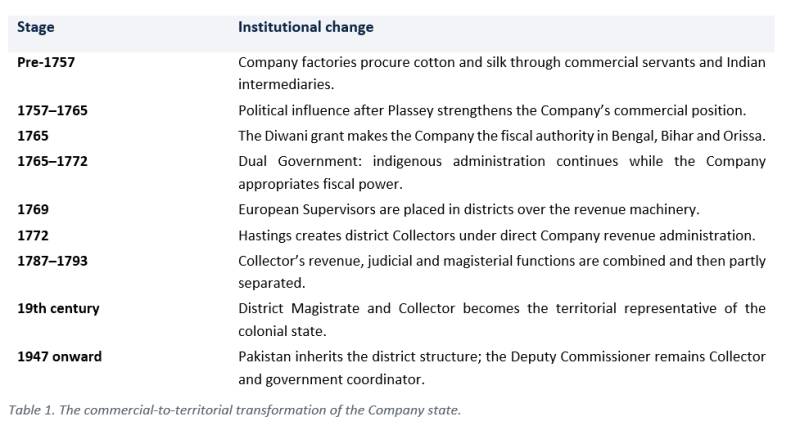
This paper investigates the claim that the modern South Asian Deputy Commissioner descends from East India Company officials who first purchased Bengal’s cotton cloth and later became revenue Collectors. The claim is useful only if stated precisely. Read literally, as a simple renaming of textile purchasers, it goes beyond the evidence. Read institutionally, it captures a deeper transformation: the Company converted a commercial procurement apparatus into a territorial revenue-and-command state. Before conquest, Bengal operations depended on factors, chiefs, Commercial Residents, brokers and gomastas who advanced money, contracted with weavers, inspected cloth and assembled the annual ‘Investment’ for export. After the Diwani grant of 1765, the Company acquired fiscal sovereignty over Bengal, Bihar and Orissa. European Supervisors entered the districts in 1769, and Warren Hastings created district Collectors in 1772. Over time, the Collector accumulated fiscal, magisterial, executive and coordinating authority, becoming the District Magistrate and Collector under colonial rule and the Deputy Commissioner in Pakistan after 1947. This genealogy matters because it explains not only an administrative title but an extractive institutional logic: revenue, information and coercive authority flowed upward from district society to a distant centre.
The argument in one sentence
The Deputy Commissioner is the direct etymological descendant of a cloth buyer called a ‘collector’; he is the institutional descendant of a commercial corporation whose procurement bureaucracy, personnel, finances and coercive habits were converted into a territorial revenue-and-command state. The paper proceeds in five steps. First, it locates the Company within Bengal’s pre-existing commercial and fiscal order. Second, it explains how political power turned the Company from a buyer into a coercive purchaser. Third, it traces the institutional hinge from Diwani to Supervisor to Collector. Fourth, it distinguishes a defensible institutional genealogy from an over-simple etymological claim. Finally, it follows the office into the colonial district state, Pakistan’s DC system and the wider consequences of the extractive model: economic contraction, famine vulnerability, secretariat dominance, distrust of domestic expertise and the failure to build specialised public-service institutions.
Why the claim matters
Standard administrative histories usually begin with the British District Collector, move through the Indian Civil Service and end with the Pakistani Deputy Commissioner. That sequence is correct but incomplete because it begins after the decisive transformation had already occurred. The crucial institutional shift took place inside the East India Company, a joint-stock trading corporation whose Bengal business rested heavily on cotton and silk textiles and whose commercial organisation gradually acquired the powers of a state. A common version of the argument suggests a striking lineage: purchasers of Bengal cloth became Collectors and ultimately Deputy Commissioners. The proposition identifies something that conventional administrative histories often hide—the colonial district state grew out of a corporate buying and extraction machine. But a persuasive account must distinguish three claims: a linguistic claim about the title ‘Collector’; a personnel claim that textile purchasers became revenue Collectors; and an institutional claim that commercial administration evolved into territorial administration. The third is strongly supported. The second is plausible in the broader sense of career mobility within a unified Company service, though not as a universal or mechanical progression. The first, in its strongest form, is not established by the available evidence.
Bengal before the Company became a state
Long before the Company’s conquest, Bengal possessed a developed fiscal and commercial order. Mughal and Nawabi administration distinguished the Diwani—revenue and finance from the Nizamat—executive authority, policing and criminal justice. Revenue functions were distributed among diwans, amils or amalguzars, qanungos, zamindars and other officials. The Company did not invent revenue collection in Bengal. Its innovation was to appropriate this machinery, subordinate it to corporate command and gradually concentrate dispersed functions in a European district officer.
Nor did the Company create Bengal’s textile economy. Bengal was already a globally competitive manufacturing region whose fine muslins, calicoes, silk and mixed cloths reached markets across Asia, Europe and Africa. The Company entered this economy as one buyer among several. Its factories were commercial establishments, not manufacturing plants in the modern sense. European factors and chiefs worked through Indian brokers, dadni merchants and, increasingly, gomastas. Advances were made to weavers; cloth was ordered by type and quality; deliveries were inspected, graded, packed and sent to Calcutta for export. The annual export procurement was called the Company’s ‘Investment’—a revealing term. Administration existed to serve trade. The factory was an office of purchasing, warehousing, accounting and enforcement. This is the organisational soil from which the later district bureaucracy grew.
From buyer among many to coercive purchaser
Before Plassey in 1757, the Company’s bargaining power was limited by rival European companies, Indian merchants and the Nawab’s government. After Plassey, political leverage increasingly reinforced commercial procurement. Company agents could use official influence to restrict competitors, bind weavers to advances and enforce deliveries. Hameeda Hossain’s work on Bengal’s Company weavers shows that commercial and revenue interests were sometimes in conflict but were also parts of the same expanding corporate power. Kranton and Swamy similarly demonstrate how political authority changed the contractual relationship between exporters and producers, especially where the Company and its agents could evade or manipulate market discipline.
The point is not that every transaction became forcible or that Bengal’s textile decline has one simple cause. The scholarship debates the relative roles of coercive procurement, shifting world demand, British industrialisation, tariffs, technological change and internal disruptions. The narrower conclusion is firmer: Company political power altered the textile market, and commercial officials increasingly operated with powers unavailable to an ordinary purchaser.
The hinge: Diwani, Supervisors and Collectors
The Battle of Buxar in 1764 and the Mughal grant of the Diwani in 1765 transformed the Company’s constitutional and financial position. It became the revenue authority for Bengal, Bihar and Orissa while initially preserving the fiction that the Nawabi system continued. Under the so-called Dual Government of 1765–1772, Indian officials conducted much of the immediate administration, while the Company claimed the fiscal surplus without accepting full public responsibility.
In 1769 the Company inserted European Supervisors into districts to observe and control the indigenous revenue apparatus. In 1772 Warren Hastings ended the Dual Government, brought revenue administration under direct Company management and redesignated the district officers as Collectors. Banglapedia dates the district Collector’s inception to these Hastings reforms. The office was briefly withdrawn and repeatedly reorganised; in 1787 revenue, judicial and magisterial powers were combined in the Collector, while Cornwallis again separated important functions in 1793. The nineteenth century eventually produced the durable District Magistrate and Collector.
Were purchasers literally renamed Collectors?
This is where precision matters. The principal officer responsible for the Company’s textile procurement in a manufacturing centre was normally styled a Chief, Resident or Commercial Resident. He worked through gomastas, appraisers, brokers and warehouse staff. The revenue Collector was a distinct office responsible for assessment, collection and district fiscal administration. Contemporary material can therefore show a Commercial Resident and a Collector operating simultaneously in the same district. Regulations and correspondence also show them coordinating—and sometimes quarrelling—over weavers, advances, taxes and access to treasury funds.
Accordingly, the clean formula ‘purchasers were renamed Collectors’ is too strong. No reliable evidence located for this paper establishes a general pre-1765 Company job title of ‘cloth Collector’ that was simply transferred to land-revenue administration in 1772. Indeed, Calcutta had an official concerned with revenue or rents who was described as a Receiver of Revenue or Collector as early as the Company’s municipal establishment, which further weakens a purely textile etymology.
But rejecting a literal renaming does not sever the connection. The commercial and revenue officers belonged to the same Bengal civil establishment. Career records show movement between commercial, political and revenue work. The British Library catalogue, for example, describes George Vansittart as a Company servant who progressed from factor and junior merchant to Resident at Midnapore, then to the Revenue Council at Patna and later the Bengal Board of Trade. Such careers demonstrate that the Company did not recruit a wholly new public service when it became a territorial power; it reassigned and promoted commercial servants into governing functions. Thus the personnel proposition should be framed probabilistically, not mechanically: some men trained and employed in a commercial corporation moved into revenue and administrative posts; the entire service was gradually repurposed; and commercial habits of accounting, hierarchy, patronage and remittance became embedded in the territorial state.
The fiscal circuit: Bengal financed the purchase of Bengal
The most powerful bridge between purchaser and Collector was financial. Before the Diwani, the Company generally had to remit bullion or other resources to buy Asian goods. After 1765, Bengal’s revenue could finance the Company’s export Investment. Tax receipts entered Company treasuries; Commercial Residents drew funds for textile procurement; finished cloth was exported and sold abroad. The Company increasingly purchased Bengal’s goods with resources extracted from Bengal itself.
This created a circular mechanism of extraction: fiscal authority funded commercial procurement, and political authority protected the procurement system. The revenue branch and commercial branch could conflict over immediate priorities—whether to collect a weaver’s dues or preserve his capacity to complete Company cloth—but both ultimately served the same corporate balance sheet. Hossain aptly analysed the alienation of weavers through the conflict between the Company’s revenue and commercial interests. The conflict itself is proof that the branches were distinct; their resolution within one Company is proof that they belonged to a single system of power.
Economic contraction and the extractive district state
The institutional genealogy also had a macroeconomic consequence. India did not merely lose political sovereignty under the Company and the Raj; it suffered a severe relative contraction in the world economy. Angus Maddison’s historical GDP reconstructions estimate India’s share of world output at about 24.4 per cent in 1700 and around 4.2 per cent by 1950. Exact figures remain debatable, and absolute output did not fall continuously, but the broad movement is unmistakable: one of the world’s major manufacturing and trading regions was progressively repositioned as a low-income colonial supplier of revenue, raw materials and soldiers.
A central mechanism of this contraction was deindustrialisation. Indian textiles had competed successfully in world markets before conquest, but British policy increasingly redirected the structure of production in Britain’s favour. Indian cloth faced prohibitions, punitive duties and restricted access in British markets, while machine-made British textiles later entered India under far more favourable conditions. At the same time, Company procurement in Bengal used advances, gomastas, monopoly pressure and coercive contracts to weaken the bargaining power of weavers and bind them to low-price production. The result was not a natural migration of manufacturing to Britain but a politically engineered transfer of advantage: India was pushed from exporting finished textiles toward supplying raw cotton and revenue, while Lancashire and other British industrial centres captured the higher value added from mechanised manufacturing.
The district Collector, and later the District Magistrate and Collector or Deputy Commissioner, was central to this extractive order. Through land-revenue demand, settlement records, coercive collection, policing authority and control over local intermediaries, the district officer helped convert agrarian production into fiscal surplus. That surplus did not primarily circulate back into local industrialisation or welfare. Under the Company, Bengal’s revenue financed the Company’s own ‘Investment’ in export goods; under the Raj, India’s export surplus and tax revenues helped meet imperial administrative, military and financial obligations. Dadabhai Naoroji’s ‘drain of wealth’ argument and later economic histories describe this as an unrequited transfer: India generated surplus, but a substantial portion was appropriated abroad or spent to sustain the colonial state itself.
Famines show the human cost of this extractive architecture most starkly. The Bengal famine of 1770 followed soon after the Company acquired the Diwani, when revenue farming, uncertainty over public responsibility, grain purchases for military and commercial purposes, and limited relief magnified the effects of drought and crop failure. Later Raj famines repeated the pattern in a more bureaucratised form. During the Great Famine of 1876–1878, drought was the immediate trigger, but colonial priorities—continued revenue demand, fiscal restraint, confidence in market grain circulation, export orientation and reluctance to intervene in prices—helped turn scarcity into mass mortality. The district officer stood where imperial policy met village distress: assessing conditions, enforcing or remitting revenue, supervising relief works, regulating movement and reporting upward. Where policy valued revenue discipline and market order over subsistence security, the district state could become not a shield against famine but a mechanism through which famine was administered.
This does not mean that the DC alone caused India’s economic decline. Global industrialisation, technological change, shifting demand, internal politics and British tariff policy all mattered. But the district state supplied the administrative mechanism that made extraction routine. It made land, labour, crops, commercial flows and people legible to a distant power; it enforced revenue even when local conditions were fragile; and it subordinated local economic life to imperial fiscal needs. The contraction of India’s world-economic position was therefore not an accidental backdrop to the rise of the Collector. It was part of the same historical process: a commercial corporation learned to govern territory in order to extract surplus, and the district officer became the durable instrument of that extraction.
From Collector to district ruler
A tax-collection office became the general district state because revenue could not be isolated from information, policing, adjudication and coercion. To assess and realise land revenue, the Company needed surveys, records, enforceable claims and control over local intermediaries. Disputes required adjudication; resistance required police power; scarcity required decisions about remission and relief. The Collector therefore became the nodal officer through whom the centre saw and commanded the district.
The combination of functions fluctuated. Hastings experimented; Cornwallis separated revenue and judicial authority; later administrations recombined magisterial and coordinating roles. What endured was the principle of a centrally appointed generalist officer, accountable upward, who stood above local society and represented government within a territory. The title understated the office. By the nineteenth century, the District Magistrate and Collector was not merely collecting land revenue; he supervised public order, coordinated departments, managed emergencies and embodied the colonial state. The Indian Civil Service later professionalised recruitment and training, supplied a powerful ideology of impartial administration and elevated the district officer into the ‘steel frame’ of imperial rule. Yet the ICS inherited rather than invented the architecture. The corporate Collector of the Company period was already its prototype.
From District Magistrate and Collector to Pakistan’s DC
The preceding genealogy explains why the DC question is not merely historical. Once the office is understood as the local instrument of a commercial-fiscal state, Pakistan’s contemporary administrative problems appear less accidental. The issue is not simply that individual officers may perform well or poorly; it is that the structure continues to reward upward control, generalist authority and bureaucratic discretion over professional knowledge, local accountability and service delivery.
At independence in 1947, Pakistan inherited the district as a basic unit of administration and retained the Deputy Commissioner as its principal coordinating and revenue officer. In regulatory provinces under British India, ‘District Magistrate and Collector’ was the usual designation; ‘Deputy Commissioner’ was common in several non-regulation and frontier jurisdictions. Post-colonial Pakistan generalised the DC identity while retaining the Collector’s fiscal and administrative functions. Provincial government descriptions still define the Deputy Commissioner as supervising revenue administration ‘as Collector’ and acting as the government’s representative in the district.
The office has changed. Judicial functions were separated, local-government reforms in 2001 replaced many DCs with District Coordination Officers, and later provincial reforms restored the designation with modified powers. Nevertheless, the organisational logic survived: a generalist officer posted from the centre, coordinating specialised departments and maintaining an upward chain of command.
The modern practice of civil servants identifying themselves by numbered ‘Commons’ is much newer. It derives from the post-1973 Common Training Programme, not from a colonial title or a batch of cloth purchasers. Yet the cultural weight of cohort, seniority and cadre has older ancestry in the Company’s covenanted service, the ICS and the Civil Service of Pakistan. The terminology is post-colonial; the institutional temperament is not.
If progress and decolonisation are to flourish, the inherited district structure must change in purpose and design. The question is not simply whether the office should be renamed, abolished or restored; it is whether district administration can be reoriented from extraction and control toward public service. A decolonised DC system would measure success not by compliance, protocol, revenue targets or upward reporting, but by citizens’ access to services, local problem-solving, transparent coordination, accountable discretion and support for elected local governments. In such a model, the district officer would become a facilitator of public value rather than a custodian of colonial command.
The same mindset survives beyond district administration in Pakistan’s intellectual and policy sectors. Too often, local economists, public-policy specialists, historians, administrators and institutional reformers are treated as secondary voices, while foreign consultancies, donor missions and IMF-style conditionality are treated as superior sources of reform wisdom. This is a form of intellectual extraction: knowledge about Pakistan is gathered from Pakistani society, filtered through external authority and returned as prescription, while domestic expertise is ignored unless validated from abroad. A decolonised state must therefore reform not only its administrative chain of command but also its hierarchy of knowledge. Pakistani specialists should be engaged as producers of policy, not merely as respondents to external templates.
The problem is reinforced by the career path of the same administrative elite. District officers do not remain only in districts. Many move upward into provincial and federal secretariats, becoming secretaries and senior decision-makers who shape policy across ministries, departments, regulators, public enterprises and development programmes. The habits formed in the district—command from above, suspicion of local initiative, preference for generalist control and accountability to superiors rather than citizens—therefore travel into the centre of the state. Once there, they can become the operating logic of policymaking itself. Reform is then filtered through officials who are often among the principal beneficiaries of the inherited system: officers whose status, authority, housing, staff, postings and discretionary influence depend on the continuation of a command-and-control administrative order. This helps explain why many attempts at local government, civil service reform, decentralisation, professional specialisation and citizen-centred delivery are diluted, delayed or reversed. The old Collector’s mentality survives not only in the district office but in the secretariat mind that decides how much change is permitted.
Pakistan’s current morass across many sectors can be read through the same lens: the absence of deep specialisation combined with dependence on a colonial generalist mindset. The energy sector is an instructive example. Pakistan’s power and gas systems suffer from circular debt, high losses, weak recovery, tariff distortions, theft, underinvestment in distribution, poorly sequenced capacity expansion and repeated recourse to IMF-supervised adjustment. Equally important, genuine energy markets were never allowed to develop because competitive choice did not fit the inherited control mindset. For decades, the single-buyer model concentrated procurement and pricing authority in the state, keeping generators, bulk consumers and distribution entities dependent on administrative allocation rather than open contracting, price discovery and market discipline.
Price controls, levies and restrictions on fuel choice have compounded the damage to industrial development: firms have been denied predictable, competitive energy inputs and the freedom to choose the most efficient mix of grid power, gas, captive generation, renewables or other fuels. Instead of planning investment around reliable market signals, industry has had to adjust to administrative pricing, sudden tariff changes, gas-allocation priorities and policy-driven levies that raise production costs and weaken competitiveness. These problems cannot be solved by file movement, protocol authority or temporary administrative campaigns. They require engineers, energy economists, grid planners, market designers, regulatory specialists, finance professionals and distribution experts working through stable institutions. Yet the inherited state often places generalist administrators above technical systems, treating specialised knowledge as advisory rather than authoritative. The result is crisis management without institutional learning: tariffs are raised, subsidies are revised, circular debt is refinanced and external conditions are negotiated, while the underlying governance failure remains intact. Energy therefore illustrates the wider post-colonial failure: a command bureaucracy tries to manage complex modern sectors without creating the markets and professional institutions that would reduce its own discretion.
A decolonised administrative model would therefore require at least four shifts. First, district authority should be subordinated to elected local governments rather than placed above them. Second, technical sectors should be led by domain specialists, with generalist administrators serving coordination rather than command functions. Third, performance should be judged by citizen outcomes, service quality and local problem-solving rather than by file disposal, protocol management or revenue discipline. Fourth, policymaking should make domestic expertise central, using external advice only as one input rather than as the source of legitimacy.
What survived: the corporate DNA of district administration
The purchaser-to-DC thesis is most valuable not as a slogan about titles, but as an explanation of administrative character. The Company’s district state carried forward four features of its commercial origin.
· Upward accountability. The district officer represented the Company—and later the state—to the district more than he represented the district to the centre.
· Extraction before service. The earliest measurable objective was revenue realisation and procurement, not citizen welfare or democratic responsiveness.
· The generalist as controller. A small number of trusted officers coordinated diverse functions, while indigenous specialists and local institutions were placed in subordinate roles.
· Information as power. Accounts, surveys, registers, reports and classifications were built to make territory legible to a remote headquarters.
These are institutional tendencies, not an accusation against every contemporary officer. Modern DCs also coordinate disaster response, vaccination, price control, elections and public service delivery, often under severe political and fiscal constraints. But institutions remember their founding purpose. A system designed to send revenue, goods and compliance upward does not become citizen-centred merely by changing the nationality, training or personal intentions of its officers.
Seen this way, the post-colonial question is not whether particular officers are benevolent or extractive. It is whether the architecture of district power—its upward accountability, discretionary command and revenue inheritance—has been sufficiently redesigned for democratic development. The historical genealogy therefore has contemporary significance: it invites institutional reform rather than nostalgia for an office whose original purpose was never local self-government.
The historical chain from purchaser to Collector to Deputy Commissioner is substantially valid if understood as institutional evolution. The East India Company first entered Bengal as a commercial buyer, especially of cotton and silk textiles. It built factories, procurement networks, accounting systems and a hierarchy of servants to secure goods for export. Political conquest then gave that corporation fiscal power. The Diwani joined commerce to taxation; the district Supervisor and Collector converted commercial presence into territorial command; and revenue from Bengal financed the Company’s purchase of Bengal’s products.
The literal claim that cloth purchasers were simply redesignated as revenue Collectors should not be presented as established fact. Commercial Residents and revenue Collectors were often separate officers, and ‘Collector’ had a recognisable fiscal meaning. Nevertheless, they belonged to one corporate service, drew upon connected treasuries and authority, and individual careers crossed commercial and revenue assignments. The Company governed with the personnel and habits it had.
The Collector then accumulated judicial, magisterial, police and coordinating functions and became the District Magistrate and Collector. The Crown and the ICS refined the office; they did not originate it. Pakistan inherited the institution as the Deputy Commissioner and, despite repeated reforms, still preserves its core logic.
The honest verdict is therefore sharper than the slogan: the DC was not born from a neutral theory of public administration. He emerged from the territorialisation of a merchant corporation. The path was not simply purchaser → renamed Collector → renamed DC. It was purchaser and commercial administrator → corporate fiscal sovereign → district Collector → magistrate and general administrator → post-colonial Deputy Commissioner. That is the historically defensible genealogy—and it is revealing enough without embellishment.
The contemporary implication is therefore constitutional, intellectual and political—not cosmetic. Decolonisation cannot mean replacing foreign officers with national officers while preserving the same extractive architecture beneath them. Nor can it mean outsourcing reform thinking to foreign consultancies, donor templates or IMF diktat while treating Pakistani specialists as peripheral to their own society’s problems. A district administration designed to take revenue, enforce compliance and transmit orders upward will not become developmental merely because its rulers are local; an intellectual sector trained to seek validation abroad will not become sovereign merely because its reports are written in Pakistan. The deeper difficulty is that the same administrative elite often rises from district command into secretariat authority, becoming the officials who shape policy across ministries and many walks of public life. Those who benefit most from the inherited order are therefore frequently positioned to moderate, delay or reverse its reform. If Pakistan seeks genuine progress, the DC structure must be redesigned around a public service ethic: citizens before files, local accountability before upward obedience, facilitation before control, welfare before revenue, and elected local governments before bureaucratic guardianship. At the same time, the policy process must be rebuilt around domestic knowledge, professional expertise, empirical learning and open debate. The task is to move from command post to service platform; from discretionary rule to transparent responsibility; from managing populations to enabling citizens; from secretariat vetoes to democratic accountability; and from imported prescription to locally grounded reform. Until that shift occurs, decolonisation will remain incomplete, because the state will still meet society through institutions whose deepest memory is extraction rather than service.
References
Banglapedia. (2021). Collector. https://en.banglapedia.org/index.php/Collector
Banglapedia. (2021). Civil Service. https://en.banglapedia.org/index.php/Civil_Service
Banglapedia. (2021). Colonial Period. https://en.banglapedia.org/index.php/Colonial_Period
Banglapedia. (2021). Deputy Commissioner. https://en.banglapedia.org/index.php/Deputy_Commissioner
British Library. East India Company, 1600–1858 / Bengal archive catalogue, including George Vansittart papers (Mss Eur F331). https://searcharchives.bl.uk/
Chaudhuri, K. N. (1978). The trading world of Asia and the English East India Company, 1660–1760. Cambridge University Press.
Maddison, A. (2007). Contours of the world economy, 1–2030 AD: Essays in macro-economic history. Oxford University Press.
Naoroji, D. (1901). Poverty and un-British rule in India. Swan Sonnenschein.
Patnaik, U. (2017). Revisiting the ‘Drain’, or transfers from India to Britain in the context of global diffusion of capitalism. In S. Chakrabarti & U. Patnaik (Eds.), Agrarian and other histories: Essays for Binay Bhushan Chaudhuri. Tulika Books.
Davis, M. (2001). Late Victorian holocausts: El Niño famines and the making of the Third World. Verso.
Environment & Society Portal. Famines in India: Changing land ownership, agricultural, and economic systems. https://www.environmentandsociety.org/exhibitions/famines-india/changing-land-ownership-agricultural-and-economic-systems
Davini, R. (2009). Bengali raw silk, the East India Company and the European global market, 1770–1833. Journal of Global History, 4(1). https://doi.org/10.1017/S174002280900296X
Dodwell, E., & Miles, J. S. (1839). Alphabetical list of the Honourable East India Company’s Bengal civil servants, 1780–1838. Longman, Orme, Brown.
Hossain, H. (1979). The alienation of weavers: Impact of the conflict between the revenue and commercial interests of the East India Company, Bengal, 1750–1800. Indian Economic & Social History Review, 16(3), 323–345. https://doi.org/10.1177/001946467901600305
Bhadra, S. (2018). The discriminatory British policies and the decline of Bengal cotton industry. American International Journal of Research in Humanities, Arts and Social Sciences. https://iasir.net/files/aijrhasspapers/aijrhass18-134.pdf
Hossain, H. (1988). The company weavers of Bengal: The East India Company and the organization of textile production in Bengal, 1750–1813. Oxford University Press.
Hunter, W. W. (1868). The annals of rural Bengal. Smith, Elder & Co. https://archive.org/details/cu31924024069878
Jones, M. E. M. (1918). Warren Hastings in Bengal, 1772–1774. Clarendon Press. https://archive.org/details/cu31924023971595
Kranton, R. E., & Swamy, A. V. (2008). Contracts, hold-up, and exports: Textiles and opium in colonial India. American Economic Review, 98(3), 967–989. https://www.law.nyu.edu/sites/default/files/upload_documents/Kranton.pdf
Kolkata Collectorate, Government of West Bengal. History of the Kolkata Collectorate. https://kolkatacollectorate.wb.gov.in/history/
Qatar Digital Library. A brief history of the English East India Company, 1600–1858. https://www.qdl.qa/en/brief-history-english-east-india-company-1600%E2%80%931858
Malik, A. (2024). Circular debt: An unfortunate misnomer. Pakistan Institute of Development Economics. https://pide.org.pk/research/circular-debt-an-unfortunate-misnomer-2/
World Bank. (2024). Reforms in Pakistan’s power distribution: Challenges and opportunities. https://thedocs.worldbank.org/en/doc/7008031a15959f10bde28b6c56767d59-0310062024/related/Reforms-in-Pakistan-s-Power-Distribution-PPT-Pakistan-Development-Update-October-2024.pdf