

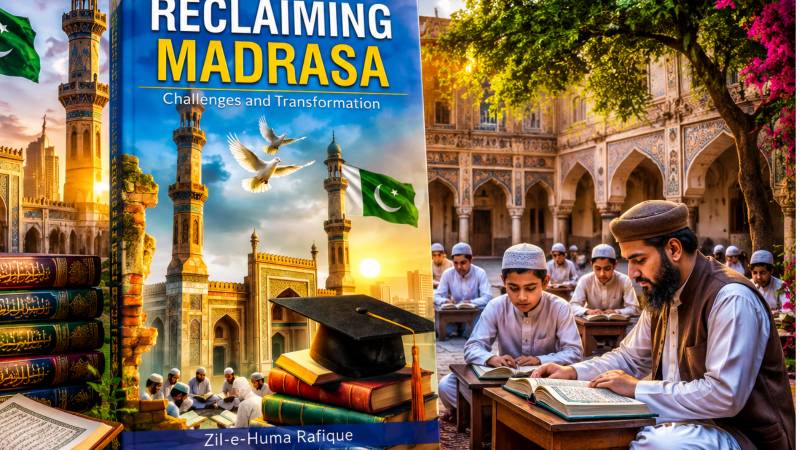
Book Review: Reclaiming Madrassa: Challenges and Transformation
Author: Dr. Zil-e-Huma Rafique
The contemporary discourse on religious madrasas in Pakistan remains largely confined to a single stereotype that portrays these institutions as breeding grounds for extremism and militancy. This reductionist perspective has profoundly shaped both academic scholarship and public policy, particularly in the post-9/11 era, when a security-centric framework became the dominant lens through which these centuries-old institutions have been examined. Dr. Zil-e-Huma Rafique's Reclaiming Madrasa: Challenges and Transformation (2026) offers a timely and much-needed corrective to this narrow outlook. Combining historical inquiry, sociological analysis, empirical fieldwork, and policy-oriented research, the book presents a comprehensive examination of Pakistan's madrasa system and argues persuasively that it should be understood within its broader historical, educational, social, and political contexts rather than viewed solely through the prism of national security. This review examines the principal arguments of the book, evaluates its methodological contributions, and assesses the feasibility of the reform framework proposed by the author.
Dr. Zil-e-Huma Rafique has served as Assistant Professor in the Department of Pakistan Studies at Government College University Faisalabad since 2005. Over the past two decades, she has established herself as a respected scholar of Pakistan Studies through numerous publications in national and international peer-reviewed journals. Her research focuses on the relationship between religion and the state in contemporary Pakistan, with particular emphasis on madrasa education, religious extremism, radicalization, democratic governance, national security, and foreign policy. Reclaiming Madrasa is the culmination of many years of sustained scholarly research and is a substantially revised and expanded version of her doctoral dissertation submitted to Bahauddin Zakariya University, Multan. What distinguishes her scholarship is the successful integration of historical analysis, field-based research, and policy-oriented inquiry, enabling her to propose reforms that are firmly grounded in both empirical evidence and practical realities.
The book is carefully organized into six interconnected chapters that collectively advance a coherent and persuasive argument. The opening chapter introduces the conceptual framework, research questions, and historical background necessary for understanding the evolution of Pakistan's madrasa system. Chapter Two examines the principal challenges confronting contemporary madaris, including institutional, educational, socioeconomic, and administrative issues, thereby laying the foundation for the subsequent discussion of reform. Chapter Three critically evaluates the reform initiatives undertaken by successive governments and analyses the resistance these measures have encountered from religious organisations and madrasa leadership. Chapter Four presents a comparative study of madaris across different regions of Pakistan, demonstrating significant regional variations in organisational structures, educational practices, sectarian orientations, and patterns of community engagement. Chapter Five, arguably the empirical core of the book, presents extensive survey findings on the perceptions, aspirations, and experiences of madrasa graduates, providing valuable insights that are largely absent from earlier scholarship. The final chapter synthesizes the preceding discussions and outlines a comprehensive vision for the future transformation of Pakistan's madrasa system through gradual, participatory, and institutionally sustainable reforms.
One of the book's greatest strengths lies in its historical approach. Rather than treating contemporary madaris as isolated institutions, Dr. Rafique situates them within the broader intellectual tradition of Islamic civilisation. She traces their historical evolution from prestigious centres of learning where theology coexisted with philosophy, medicine, mathematics, astronomy, and statecraft. This historical perspective effectively challenges the ahistorical assumption that militancy is an inherent characteristic of Islamic religious education. Instead, the author convincingly argues that the challenges confronting Pakistan's madrasa system are products of specific historical, political, and socioeconomic developments rather than inevitable consequences of the institutions themselves.
The book's examination of the colonial period is particularly insightful. Dr. Rafique demonstrates how British educational policies fundamentally transformed the character of Islamic education by institutionalising a dual educational system that separated religious instruction from modern secular learning. As a consequence, madaris became increasingly confined to the teaching of religious subjects, while state-sponsored institutions assumed responsibility for secular education. The study persuasively argues that this colonial legacy had profound and enduring consequences. It contributed to the emergence of sectarian divisions, weakened the traditional intellectual authority of the ulama, and created a lasting sociocultural divide between the religious and secular educational sectors—a divide that continues to shape Pakistan's educational, political, and intellectual landscape. The author further argues that the colonial strategy of divide and rule extended beyond politics into the realm of education, creating parallel educational institutions whose divergent trajectories persisted long after independence. By placing contemporary debates within this broader historical framework, the book provides a far more nuanced understanding of the origins and evolution of Pakistan's madrasa system than is commonly found in existing scholarship.
The book's treatment of the contemporary period is particularly commendable. While acknowledging the profound impact of General Zia-ul-Haq's regime (1977–1988) on the expansion and politicization of sections of the madrasa network, Dr. Rafique carefully distinguishes between the politicization of certain institutions and the historical significance of the madrasa system as a whole. Rather than portraying madaris as inherently predisposed to extremism, she argues that their association with militancy emerged largely from the geopolitical dynamics of the Afghan Jihad, the influx of foreign funding, and state-sponsored ideological mobilization during the Cold War. This distinction allows the study to move beyond deterministic explanations and situate the evolution of militant networks within their broader political and historical contexts.
This balanced interpretation is reinforced by extensive fieldwork involving interviews with madrasa administrators, teachers, and students across Pakistan. The empirical evidence suggests that the overwhelming majority of madaris continue to focus primarily on religious instruction, moral education, and community service. One of the study's most significant findings is that the actual relationship between madaris and violence is limited both globally and within Pakistan, involving only a very small proportion of institutions. Instead of depicting militancy as an institutional characteristic, Dr. Rafique identifies socioeconomic marginalization as a more significant source of vulnerability. She highlights an important paradox: while many madrasa graduates possess strong intellectual and analytical abilities, their limited employment opportunities often make them susceptible to recruitment by extremist organisations. By shifting the focus from institutional blame to structural socioeconomic constraints, the study provides a more balanced and evidence-based explanation of radicalization.
The book also offers a timely and incisive assessment of successive government initiatives aimed at reforming Pakistan's madrasa sector. Dr. Rafique argues that these reforms have generally been ad hoc, poorly coordinated, and driven primarily by security concerns rather than genuine educational objectives. Consequently, they have generated mistrust between the state and madrasa authorities, with many religious leaders perceiving government intervention as an attempt to control rather than improve religious education. According to the study, this security-oriented approach has failed not only to achieve its intended counterterrorism objectives but also to deepen the suspicion of organised religious groups toward state policies, thereby widening the divide between the two.
One of the book's major contributions is its comprehensive and forward-looking reform agenda, which emphasizes integration rather than confrontation. At the heart of this vision is the creation of a unified national education system that respects the religious identity and institutional autonomy of madaris while incorporating them into Pakistan's broader educational framework. The proposed reforms include curriculum diversification, teacher training, improved governance, financial transparency, and institutional accountability. Particularly noteworthy is the proposal to establish a National Religious Reforms Enforcement Authority (NRREA), envisioned as a coordinating body capable of facilitating dialogue among government institutions, religious organisations, and educational stakeholders while ensuring the effective implementation of reform initiatives.
Equally significant is the study's rejection of a top-down model of reform in favour of a participatory and consultative approach. Dr. Rafique argues that meaningful and sustainable reform can only be achieved through active engagement with madrasa leadership and representative bodies such as the Ittehad Tanzeemat-e-Madaris Pakistan (ITMP). Recognising the sensitivities surrounding religious education in Pakistan, she contends that reform efforts must be based on mutual trust, respect, and negotiated consensus rather than coercive state intervention. Her recommendations demonstrate a nuanced appreciation of Pakistan's educational realities and acknowledge that lasting institutional transformation is most likely to emerge through gradual, internally supported change.
The study persuasively argues that this colonial legacy had profound and enduring consequences: it contributed to the emergence of sectarian divisions, weakened the traditional intellectual authority of the ulema, and created a lasting sociocultural divide between the religious and secular educational sectors.
The book is firmly grounded in the existing scholarship on Pakistan's madrasa system and positions itself within a well-established academic discourse. Dr. Rafique engages critically with the pioneering works of Jamal Malik and Ahmed Rashid while extending and refining their analyses. Malik's scholarship on the historical evolution, educational functions, and sociopolitical significance of madaris in South Asia provides an important intellectual foundation for the study. In Teaching Terror?, he challenges simplistic assumptions regarding the relationship between madrasas and extremism, while Colonization of Islam examines how colonial policies transformed Islamic educational institutions and reshaped religious authority. These works provide valuable historical and conceptual frameworks that inform Dr. Rafique's analysis.
The study also builds upon Ahmed Rashid's influential work on the emergence of the Taliban and the role played by segments of Pakistan's madrasa network during the Afghan conflict. Rashid's examination of the connections among religious seminaries, militant organisations, Pakistan's security establishment, and regional geopolitics provides important insights into the political dimensions of religious education. By engaging critically with these seminal contributions, Dr. Rafique successfully situates Reclaiming Madrasa within the broader scholarly debate while offering a more comprehensive, empirically grounded, and policy-oriented interpretation of the historical evolution, contemporary challenges, and future reform of Pakistan's madrasa system.
Dr. Rafique distinguishes her work from earlier scholarship by offering a more comprehensive and multidimensional analysis of Pakistan's madrasa system. Whereas Jamal Malik primarily situates the emergence and evolution of madrasas within their historical and political contexts, and Ahmed Rashid focuses on the geopolitical dimensions of their expansion and alleged links with militancy, Dr. Rafique combines historical inquiry, sociological analysis, empirical fieldwork, and policy recommendations into a coherent and integrated study. In doing so, she moves beyond the reductive binaries of "teaching terror" and "teaching tradition" to portray madaris as complex institutions that perform a wide range of educational, religious, social, and cultural functions within Pakistani society.
Reclaiming Madrasa makes a significant contribution to the growing scholarship on Pakistan's religious seminaries. One of its greatest strengths lies in its methodological rigor. In addition to drawing extensively on archival records, government documents, and secondary literature, Dr. Rafique conducted extensive fieldwork involving interviews with madrasa administrators, teachers, students, and graduates from different regions of Pakistan. This combination of documentary research and empirical investigation enables her to develop a balanced and nuanced understanding of the madrasa system that would have been difficult to achieve through a single methodological approach. The integration of qualitative evidence with historical analysis considerably strengthens the credibility of the study. By foregrounding the voices and lived experiences of madrasa graduates, the study enriches existing scholarship and introduces an important empirical dimension that distinguishes it from much of the earlier literature.
The study is ambitious in both its scope and objectives. It examines a wide range of interconnected themes, including the historical evolution of madrasas, sectarian diversity, socioeconomic conditions, educational reforms, and the relationship between religious education and counterterrorism. This breadth is one of the book's strengths, allowing readers to appreciate the complexity of the madrasa system from multiple perspectives. At times, however, the wide-ranging coverage comes at the expense of analytical depth. Some important issues—particularly the role of foreign funding and its long-term influence on the evolution of the madrasa system—deserved more sustained examination. Similarly, a more detailed discussion of the political economy of religious education and the role of state institutions in shaping educational policy would have further strengthened the analysis.
The treatment of sectarian dynamics could also have been developed in greater detail. The interaction among the major religious traditions—including the Deobandi, Barelvi, Ahl-i-Hadith, Jamaat-e-Islami, and Shia schools of thought—has profoundly shaped Pakistan's religious, educational, and political landscape. A more comprehensive examination of how these sectarian identities influence attitudes toward curriculum reform, state regulation, institutional autonomy, and integration into the national education system would have provided deeper insight into one of the most complex challenges facing madrasa reform today.
Although the book presents a thoughtful and pragmatic reform agenda, it devotes comparatively less attention to the practical mechanisms necessary for translating its recommendations into policy. A more detailed discussion of strategies for addressing the longstanding trust deficit between the state and religious seminaries would have enhanced the policy framework. The analysis appears to underestimate the extent to which decades of political tension, institutional mistrust, and competing ideological interests may continue to generate resistance even to well-intentioned reform initiatives.
Despite these limitations, Reclaiming Madrasa remains an important and timely contribution to the study of Pakistan's educational system and its intersections with religion, politics, and national security. By moving beyond simplistic portrayals of madrasas as either inherently beneficial or inherently problematic, Dr. Rafique offers a balanced, evidence-based, and intellectually nuanced framework for understanding these institutions. Equally significant, the book challenges entrenched stereotypes surrounding madaris while bringing forward perspectives that have often been neglected in both academic scholarship and public policy debates. Through its interdisciplinary approach, robust empirical foundation, and constructive policy orientation, Reclaiming Madrasa will serve as an indispensable resource for scholars, policymakers, educationists, and all those seeking a deeper understanding of religious education and educational reform in Pakistan.