

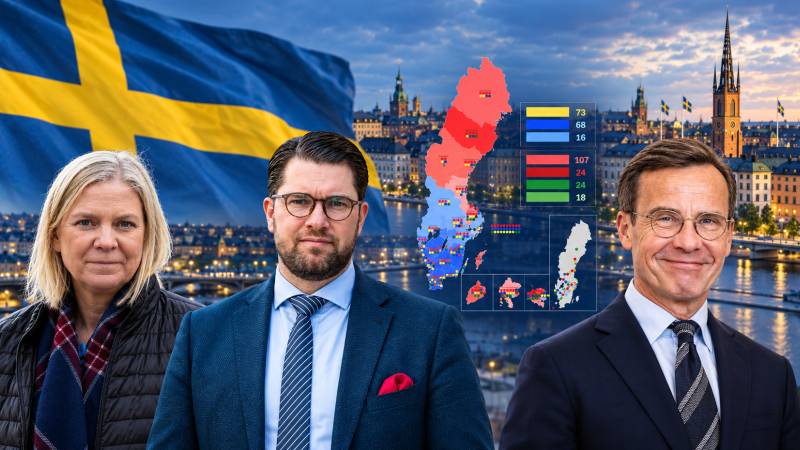
Europe’s political landscape is undergoing one of its most consequential transformations since the end of the Cold War. Established parties are losing their traditional hold over voters, parliaments are becoming increasingly fragmented, and movements once considered too extreme for government are moving closer to the centre of political power. Economic insecurity, migration, demographic change, the war in Ukraine, pressure on welfare systems and declining trust in institutions have unsettled old political loyalties. Against this turbulent background, Sweden’s fiercely contested national election has acquired significance far beyond the Nordic country’s borders. Preliminary results from the September 13 election show the centre-left opposition bloc, led by former prime minister Magdalena Andersson, holding an exceptionally narrow advantage over the governing right-wing alliance of Prime Minister Ulf Kristersson. With most districts reporting, Andersson’s bloc was projected to secure 176 seats in the 349-member Riksdag, compared with 173 for the governing alliance.
The difference remains sufficiently small to require caution. Late advance ballots, including votes cast abroad, must still be counted, while the official review will determine the final distribution of seats. Neither side can responsibly claim an unqualified victory until the process is complete. The numbers alone explain the uncertainty. In a race this close, a relatively small movement of votes could alter the allocation of parliamentary seats and determine which leader has the first realistic opportunity to form a government. Sweden’s election authorities emphasize that the election-night figures remain preliminary and that the final result follows a careful examination of all ballots. Yet the real importance of this election does not lie simply in whether Andersson or Kristersson becomes prime minister. At stake is the political direction of a country long associated with social democracy, humanitarian internationalism, an extensive welfare state and comparatively liberal attitudes toward immigration. During the past decade, Sweden has moved toward stricter migration controls, tougher criminal-justice policies and a political vocabulary increasingly centered on national identity, integration and public order. The election therefore represents a test of whether that movement will continue, accelerate or encounter meaningful resistance.
For much of the twentieth century, Sweden represented one of the most recognizable models of European social democracy. Its political identity was built around a strong welfare state, high but broadly accepted taxation, organized labour, universal public services and the belief that economic prosperity should be accompanied by social protection. The Social Democratic Party occupied the central position in this arrangement. It was not simply another political organisation but the principal architect of modern Sweden. Under its influence, the country developed the concept of the “people’s home”: a society in which citizens would enjoy security against illness, unemployment, poverty and old age. Internationally, Sweden cultivated an image of neutrality, diplomacy, development assistance and humanitarian responsibility. It welcomed refugees, supported international mediation and presented itself as a moral voice in global affairs. That Sweden has not disappeared. Its welfare institutions remain extensive, its democratic system remains strong and its commitment to international cooperation continues. But the conditions under which the traditional Swedish model developed have changed.
Globalisation has transformed labour markets, ageing populations have increased pressure on healthcare and pensions, housing shortages have worsened and widening inequality has weakened the sense that prosperity is being shared fairly. Immigration has become the most emotionally charged dimension of this transformation. Sweden received substantial numbers of asylum seekers, particularly during periods of conflict in the Middle East and elsewhere. Many newcomers established successful lives and contributed to Swedish society. Integration, however, was uneven. Some communities experienced unemployment, educational disadvantage, overcrowded housing and geographical isolation. These difficulties became politically explosive when combined with gang violence, shootings and organized crime. The resulting debate has frequently moved between two unhelpful extremes. One side has sometimes appeared reluctant to acknowledge genuine failures of integration and public security, fearing that doing so might encourage prejudice. The other has treated migration itself as a complete explanation for complicated problems involving housing, education, employment, narcotics, policing and social exclusion. Sweden’s election demonstrates how profoundly this unresolved debate has reshaped national politics.
The principal beneficiary has been the Sweden Democrats. The party emerged from extremist nationalist circles and carries a history that made it unacceptable to much of Sweden’s political establishment. For years, mainstream parties refused formal cooperation with it even as its electoral support increased. That strategy became progressively harder to maintain. The Sweden Democrats presented themselves as the only major party willing to speak directly about immigration, cultural identity and crime. Their opponents regarded much of this rhetoric as divisive and exclusionary, but the party persuaded many voters that established politicians had ignored legitimate concerns. Its rise was not based on ideology alone. It also reflected a crisis of political trust. Voters who believed that their neighborhoods had changed without their consent, that public services were deteriorating or that officials dismissed their anxieties found in the Sweden Democrats a vehicle for protest. By 2022, the party had become essential to the survival of Kristersson’s centre-right government. It supported the administration in parliament and acquired considerable influence over migration, criminal justice and integration policy without initially holding ministerial office.
This arrangement helped normalize the Sweden Democrats. Once a party regularly participates in budget negotiations and shapes legislation, voters may begin to view it less as an outsider and more as an ordinary part of the political system. Ideas once regarded as marginal can become government policy even if the party that introduced them remains outside the cabinet. In the 2026 campaign, Kristersson went further by opening the possibility of bringing the Sweden Democrats formally into government. The election consequently became a referendum not only on the administration’s record but also on whether a party with far-right origins should be entrusted with national ministries.
Preliminary results suggest that the Sweden Democrats have suffered their first significant decline after years of almost uninterrupted growth. They appear to have fallen from second to third place, behind both the Social Democrats and Kristersson’s Moderate Party. This setback is important, but its meaning should not be exaggerated. Some conservative voters may approve of tighter migration and law-and-order policies while remaining uncomfortable with Sweden Democrat ministers. Others may have voted tactically for the Moderates to strengthen Kristersson’s position within the right-wing bloc.
The ballots being counted therefore represent much more than the selection of a prime minister. They capture Europe’s struggle to decide what kind of political community it wishes to become: secure without becoming exclusionary, diverse without becoming fragmented, prosperous without abandoning solidarity, and democratic without allowing fear to determine the limits of belonging.
The distinction between rejecting a party and rejecting its policies is crucial. Swedish voters may have checked the institutional advance of the far right without repudiating the policies it helped popularize. The Sweden Democrats may lose seats while continuing to exercise substantial ideological influence. If Andersson’s bloc ultimately wins, supporters may be tempted to describe the result as Sweden returning to its traditional liberal and social-democratic identity. Such an interpretation would be reassuring but incomplete. Andersson remains a strong and experienced political figure. She offers voters the possibility of greater investment in public services, a stronger emphasis on social cohesion and a less confrontational approach to national identity. Her leadership has enabled the Social Democrats to remain Sweden’s largest party despite the fragmentation of the political system. Nevertheless, today’s Social Democrats do not occupy the same position they held a decade or two ago. They have themselves adopted tougher positions on immigration, integration and crime. The country’s political centre of gravity has already moved.
The Left Party favours higher public expenditure, stronger labour protections and greater redistribution. The Centre Party is economically liberal and reluctant to support an administration dependent on the Left. The Greens bring additional priorities concerning climate, energy and environmental transition. These divisions illustrate a broader European problem. Several parties may agree that they want to remove a government, but opposition to the same adversary does not automatically provide a common governing program. A parliamentary majority against Kristersson may not become a coherent majority for Andersson. Sweden could therefore experience extended negotiations, a minority administration, issue-by-issue agreements or some form of cross-bloc cooperation.
Migration is particularly powerful because it combines economics, identity, security and morality. Employers may consider newcomers necessary in societies facing labour shortages and ageing populations. Humanitarian organizations emphasize obligations toward refugees. Local communities may focus on pressures affecting housing, schools and healthcare. Nationalists frame the matter as a struggle over culture, sovereignty and national survival. These concerns do not fit neatly into the traditional division between left and right. Some working-class voters who once supported social-democratic parties now fear that migration places pressure on wages or welfare services. Some business-oriented conservatives favour legal immigration because their economies require workers. Other citizens support protection for genuine refugees while demanding efficient borders and the removal of people who have no legal right to remain.
European governments have increasingly moved toward deterrence, faster decisions and accelerated returns. In January 2026, the European Commission described migration as a continuing political priority and called for an approach that is both “fair and firm.” Fairness requires humane treatment and respect for legal obligations; firmness demands controlled borders, efficient administration and the enforcement of lawful decisions. Mainstream parties have responded to populist pressure by adopting parts of the nationalist right’s program. Their calculation is understandable: refusing to address public concerns may drive more voters toward radical alternatives. Yet this strategy carries a serious risk. When established parties repeat the language and priorities of the far right, they may legitimize their opponents instead of defeating them. Voters may ask why they should choose an imitation when they can support the original. The democratic centre must therefore move beyond both denial and imitation. It must show that it can administer borders competently, enforce laws fairly and address the social conditions in which insecurity flourishes.
Events elsewhere increase the continental importance of Sweden’s election. In Germany, the Alternative for Germany recently achieved a historic victory in the eastern state of Saxony-Anhalt, taking approximately 44 per cent of the vote. The result placed a far-right party within reach of leading a state government and intensified pressure on Chancellor Friedrich Merz. It also challenged Germany’s political “firewall,” under which mainstream parties have refused formal cooperation with the AfD. Germany’s experience shows how regional inequality and historical grievance can combine with contemporary fears. Parts of eastern Germany continue to experience demographic decline, economic disappointment and a belief that national elites do not understand local communities. The AfD has transformed these feelings into a revolt against immigration, liberal social policies and the political establishment.
France faces a different but related challenge. The National Rally has spent years softening its public image and presenting itself as a plausible party of government. Its success has pushed policing, immigration and national identity to the centre of French politics. Italy has demonstrated another form of right-wing normalization. A party rooted in the post-fascist tradition can lead a government while operating within the European Union and maintaining major international alliances. Rather than attempting to destroy the European system from outside, nationalist governments may seek to reshape it from within.
These examples show that Europe’s political shift does not follow a single route. In some countries the far right remains excluded; in others it supports governments, joins coalitions or leads them. Its influence cannot be measured only by counting cabinet positions. It must also be judged by examining which issues dominate political debate and how far mainstream parties have moved in response.
To interpret Europe’s rightward movement purely as a reaction to immigration would be a mistake. Economic insecurity supplies much of its emotional energy. Europeans have experienced the financial crisis, sovereign-debt instability, the pandemic, disrupted supply chains, inflation, rising energy costs and the economic consequences of war. Even where official indicators show recovery, many households continue to struggle with food, housing and energy expenses. Welfare systems are also under pressure. Populations are ageing, healthcare services face staff shortages, and younger citizens are expected to support growing pension obligations while struggling to obtain affordable housing themselves.
Under these conditions, politics becomes a struggle over scarcity. People become increasingly sensitive to who receives public assistance, who contributes and whether the system treats them fairly. Migrants can become convenient symbols of much broader failures involving weak planning, insufficient housing, poorly funded schools and uneven regional development. Populist parties simplify structural problems by presenting them as the result of betrayal by political elites. Their appeal rests not only on proposed solutions but also on the enemies they identify: migrants, bureaucrats, global institutions, cultural liberals or established media. Mainstream parties cannot answer this challenge through moral condemnation alone. They must restore confidence that democratic government can still improve daily life. Effective services, secure employment, affordable housing and equal enforcement of the law may provide stronger defenses against extremism than repeated appeals to moderation.
Sweden’s next government must demonstrate that national security and social security are not opposing objectives. A country cannot remain resilient abroad while allowing its domestic institutions to weaken. Public trust, social cohesion and effective services are themselves elements of national strength. If Andersson’s bloc ultimately prevails, the result will be welcomed by those concerned about the normalization of far-right parties. It would show that Europe’s rightward movement is neither uniform nor irreversible. Voters may favour controlled borders and effective policing while refusing to entrust executive authority to a movement with extremist origins.
Nevertheless, one narrow election cannot be regarded as a decisive reversal. Sweden remains deeply divided. The Social Democrats have not recovered their former dominance, while the Sweden Democrats remain a major parliamentary force. The problems that encouraged their rise i.e., segregation, insecurity, integration failures and distrust of political elites, have not disappeared. The deeper lesson is that European politics is no longer organized neatly around the traditional contest between centre-left and centre-right parties. New divisions cut across the older categories: openness against protection, cosmopolitanism against national identity, environmental transition against immediate economic security, and institutional moderation against disruptive political change.
Sweden’s election may slow one country’s movement toward formal far-right participation in government. It may also encourage Europe’s democratic centre by revealing limits to nationalist expansion. But it will not restore the political environment that existed before migration, economic anxiety and cultural identity became defining electoral questions. The ballots being counted therefore represent much more than the selection of a prime minister. They capture Europe’s struggle to decide what kind of political community it wishes to become: secure without becoming exclusionary, diverse without becoming fragmented, prosperous without abandoning solidarity, and democratic without allowing fear to determine the limits of belonging. Whatever the final result, Sweden has delivered an important message. Europe’s future is not moving in one predetermined direction. The rightward shift is powerful, but it remains contested. The centre-left can remain competitive only if it confronts difficult realities rather than seeking refuge in nostalgia. The democratic centre can survive only if it proves that moderation is capable not merely of restraining extremes but of solving problems. That is the real test now facing Sweden and, in different forms, democracies across Europe.